
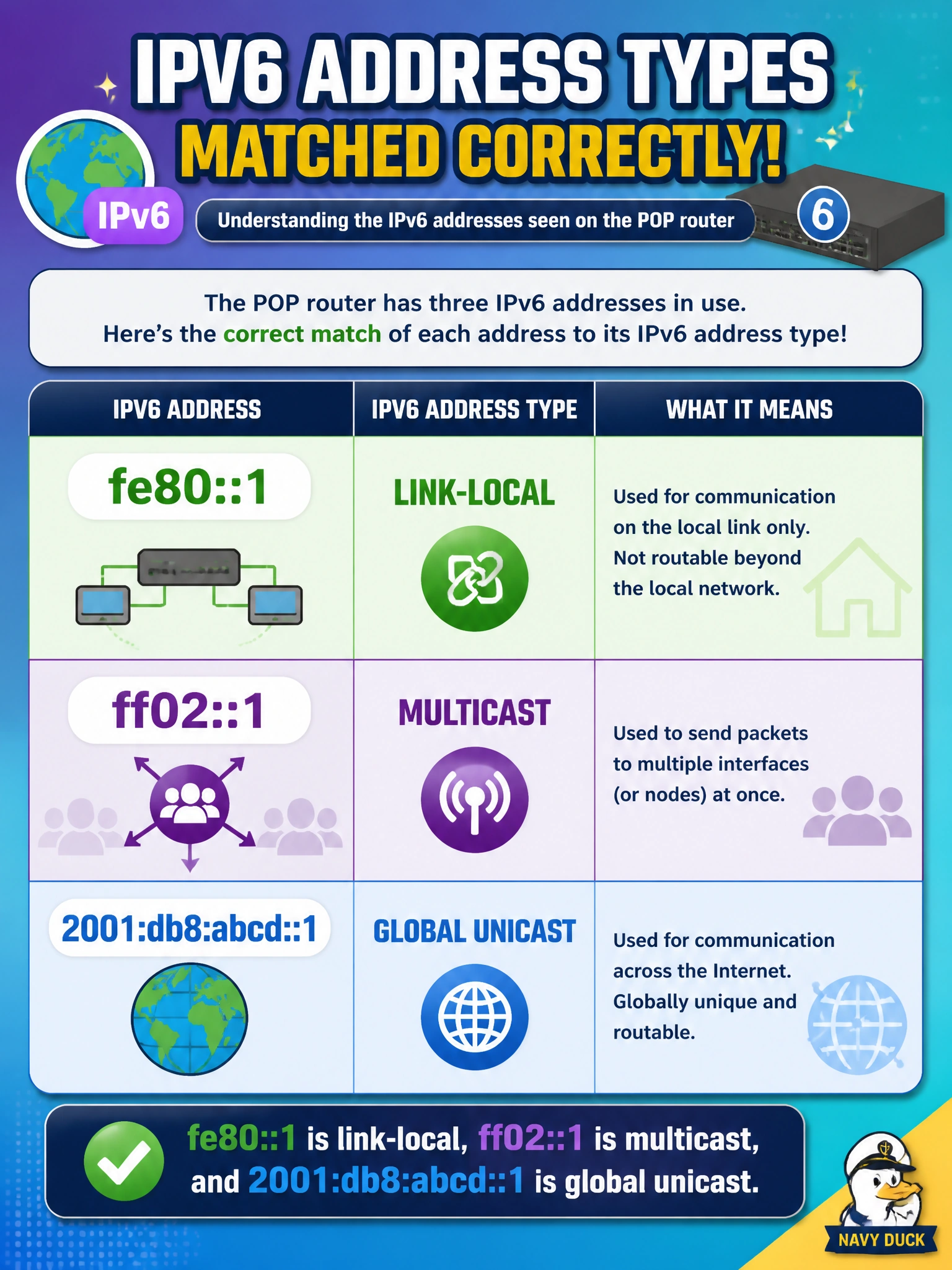
While documenting the co-op's new IPv6 rollout, an engineer captures three addresses in use on a POP router: fe80::1, ff02::1, and 2001:db8:abcd::1. Which statement correctly matches each address to its IPv6 address type?
Select an answer to reveal the explanation.
Short Explanation
IPv6 wears its role on its sleeve if you know the prefix: fe80 always means link-local, ff always signals multicast, and a 2001:db8-style prefix here stands in for a routable global address. Read the first few hex digits and the address type basically announces itself.
Full Explanation
IPv6 reserves specific prefix ranges for each address type, which makes classification a matter of pattern-matching rather than guesswork. Addresses beginning fe80 fall in fe80::/10, the link-local range used only for communication on a single local segment and never routed off it. Addresses beginning ff fall in ff00::/8, the multicast range used to reach a defined group of interfaces, such as all-nodes or all-routers groups, rather than one specific host. A prefix like 2001:db8:abcd::/48 (2001:db8:: is the documentation range, but the pattern applies identically to real allocated 2001:: space) represents a global unicast address, routable across the internet, which is what a co-op would assign to a POP router's outward-facing interface. The all-global-unicast option ignores that IPv6, unlike a flat address space, explicitly reserves prefixes for local and multicast use. The two mismatched options swap link-local with unique local or with global unicast, conflating fe80's local-segment-only scope with either fc00::/7's site-local routing scope or the internet-routable global range. A quick check when documenting addresses is to read only the first hex block: fe80 signals link-local, ff signals multicast, and fc or fd signals unique local, with everything else in the current allocated space typically global unicast.