
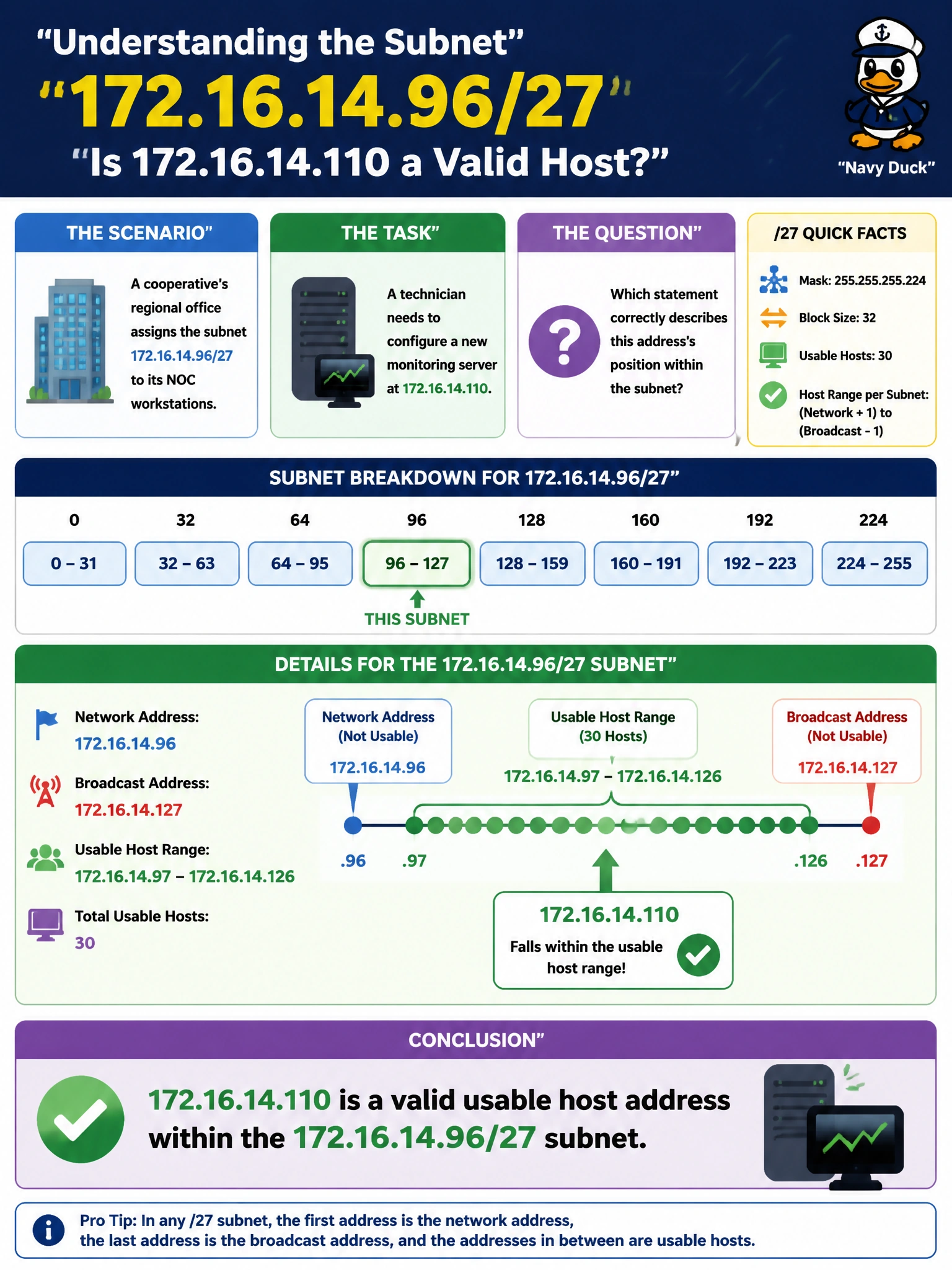
A cooperative's regional office assigns the subnet 172.16.14.96/27 to its NOC workstations. A technician needs to configure a new monitoring server at 172.16.14.110. Which statement correctly describes this address's position within the subnet?
Select an answer to reveal the explanation.
Short Explanation
A /27 carves out a block of 32 addresses, and the network and broadcast addresses at each end are off-limits — everything in between is fair game for a host. Since 172.16.14.110 sits comfortably inside that block, between the network address of .96 and the broadcast at .127, it's a perfectly valid pick for the server.
Full Explanation
A /27 mask leaves 5 host bits, producing blocks of 32 addresses each; the block starting at 172.16.14.96 runs through 172.16.14.127, with .96 reserved as the network address and .127 reserved as the broadcast address. That leaves .97 through .126 as usable host addresses, and 172.16.14.110 falls squarely within that range, making it a valid choice for the monitoring server. The broadcast-address claim is wrong by simple arithmetic: the broadcast address is the last address in the block, .127, not .110. The out-of-range claim misjudges the block boundaries, perhaps by assuming a /24-sized block instead of the actual /27. The network-address claim confuses .110 with .96, the true first address of the block; a network address always sits at the very start of its range, never in the middle. A reliable operational check is to convert the mask to a block size (2^host-bits), find the multiple of that size at or below the address's last octet to get the network address, then add block-size-minus-one to find the broadcast address.