
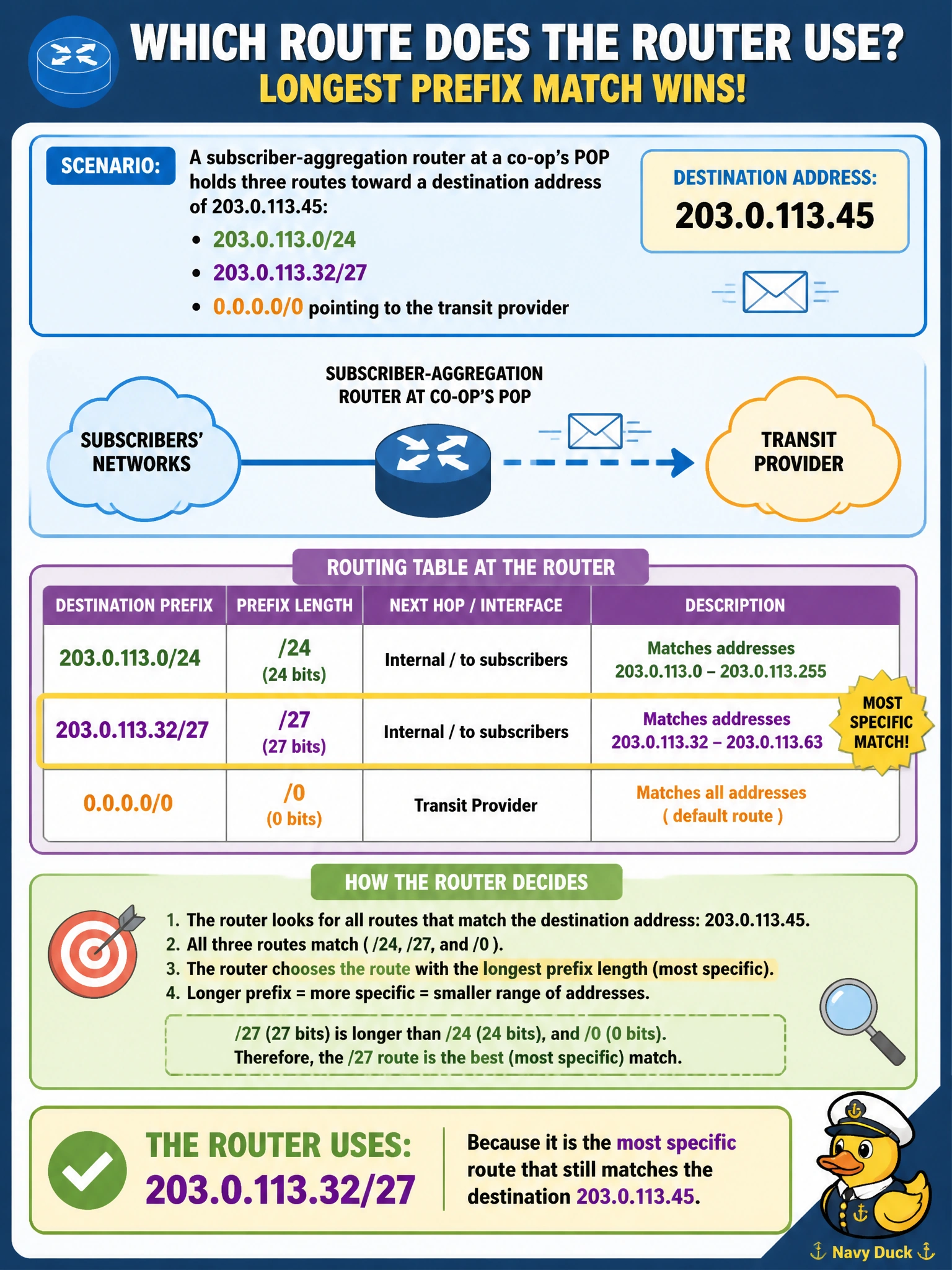
A subscriber-aggregation router at a co-op's POP holds three routes toward a destination address of 203.0.113.45: 203.0.113.0/24, 203.0.113.32/27, and a default route of 0.0.0.0/0 pointing to the transit provider. Which route does the router actually use to forward the packet?
Select an answer to reveal the explanation.
Short Explanation
Picture three nets of different mesh size all catching the same fish — the router always keeps the tightest net that still works. That's longest-match routing: among every route that covers the destination, the one with the longest prefix (most specific mask) wins, so the /27 beats both the /24 and the default here.
Full Explanation
Longest-match route selection compares every route whose prefix matches the destination address and forwards using the one with the longest, most specific prefix length. Here, 203.0.113.45 falls within all three ranges — the /24, the /27, and the default — but the /27 has the longest prefix of the three, so it is installed as the best match and used for forwarding regardless of arrival order in the table. The default-route option misunderstands its role: a default route is the catch-all used only when no more specific route matches, never a priority pick. The install-order option confuses routing with some other ordered process; Junos and virtually all routers evaluate prefix length, not table insertion time, when multiple routes match. The load-balancing option is wrong because longest match is a single deterministic winner, not a tie needing distribution — equal-cost load balancing only applies when two routes share the identical prefix length and metric. A quick operational check is to compare prefix lengths directly: the route with the highest number after the slash among all matches is always the one used.