
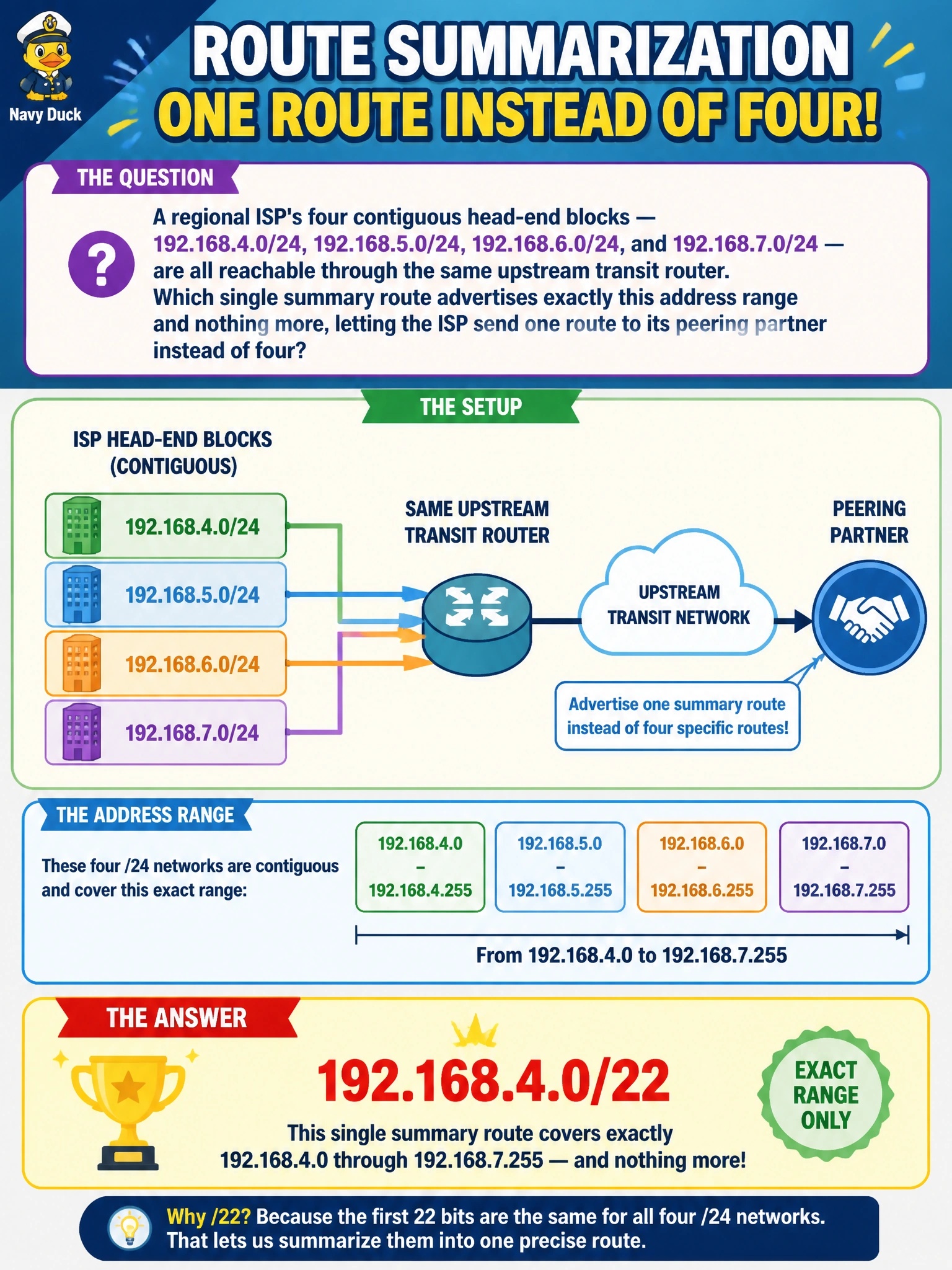
A regional ISP's four contiguous head-end blocks — 192.168.4.0/24, 192.168.5.0/24, 192.168.6.0/24, and 192.168.7.0/24 — are all reachable through the same upstream transit router. Which single summary route advertises exactly this address range and nothing more, letting the ISP send one route to its peering partner instead of four?
Select an answer to reveal the explanation.
Short Explanation
Summarization is like folding four adjacent index cards into one — as long as the edges line up, one card covers the same ground. Four consecutive /24s that start on a matching binary boundary collapse cleanly into a single /22, so the cooperative advertises one route instead of four.
Full Explanation
Supernetting works only when the block count is a power of two and the starting address falls on that exact boundary. Four /24 networks need 2 borrowed bits removed to merge (24 minus 2 = 22), and 192.168.4.0 is divisible by 4 in its third octet, so /22 is the correct, boundary-aligned summary that spans precisely 192.168.4.0 through 192.168.7.255. The /21 option looks like a natural next step up in size, but it would double the covered range and start pulling in 192.168.0.0 through 192.168.3.0 as well as 192.168.8.0 through 192.168.11.0 — addresses the cooperative does not actually own, which risks black-holing traffic that belongs to a neighbor. The 192.168.0.0/22 option shifts the base address to the wrong boundary entirely, covering .0 through .3 instead of .4 through .7. The /23 option only summarizes two of the four blocks, leaving the other pair to be advertised separately. Before publishing a summary route, an engineer should verify boundary alignment by confirming the block count is a power of two and the first octet value is evenly divisible by that count.