
A rural broadband cooperative has been allocated the 10.20.0.0/22 block for a new fiber build and wants to give each of its 16 villages its own separate subnet with room for up to 60 subscriber devices per village. Which subnet mask satisfies both requirements with no wasted subnets?
Select an answer to reveal the explanation.
Short Explanation
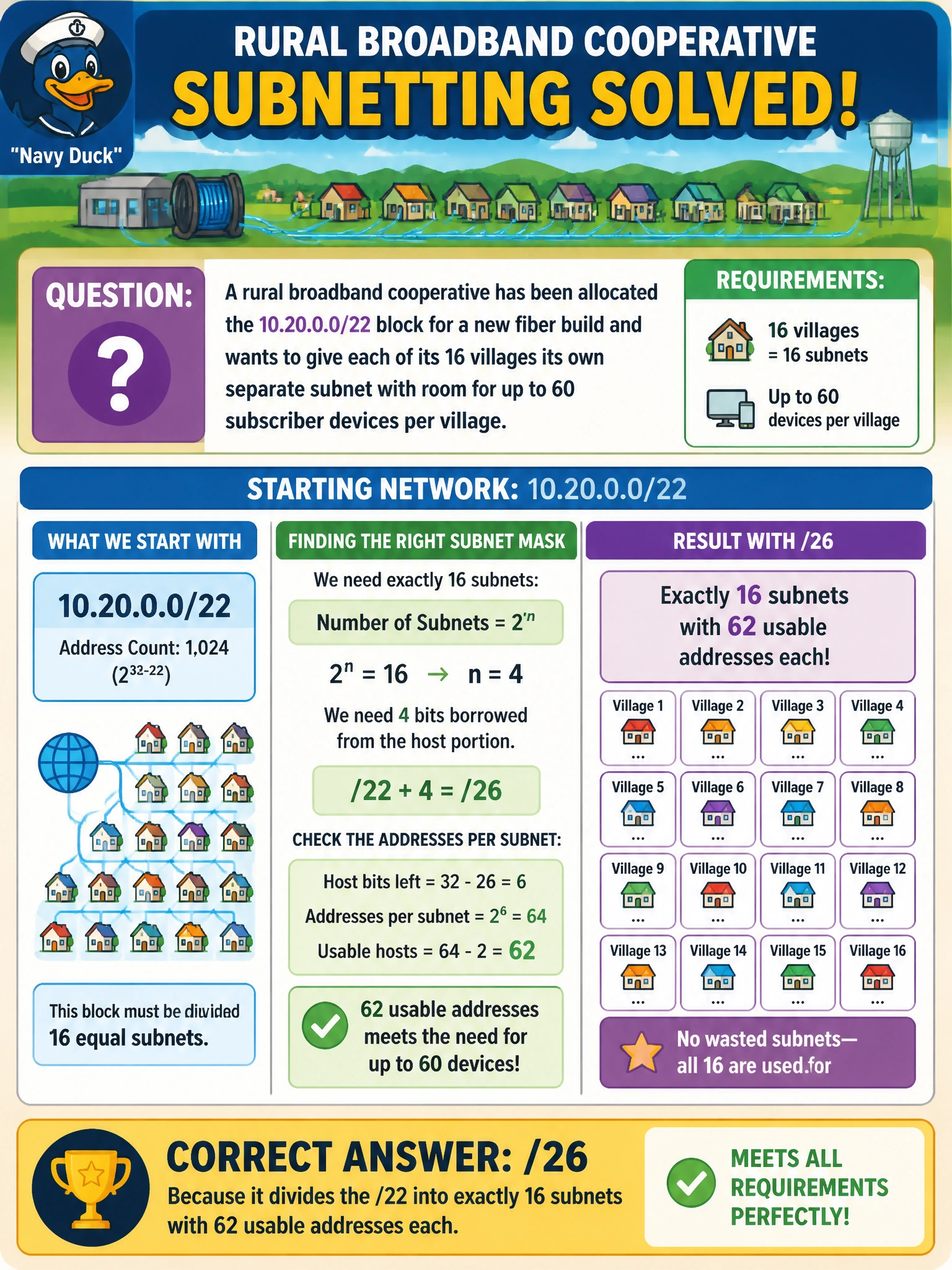
Think of the /22 as one big pie and each village as a slice — you just need to cut it into 16 equal pieces. A /26 does exactly that: it borrows enough host bits to create 16 subnets while still leaving room for 62 usable addresses in each, comfortably covering 60 devices.
Full Explanation
A /22 block spans 1024 total addresses (32 host bits minus 22 network bits = 10 host bits, 2^10). Splitting it into subnets that each support 16 groups means borrowing 4 more bits (2^4 = 16), which lands the new mask at /26 — 6 host bits remaining, giving 62 usable addresses per subnet after removing the network and broadcast addresses. That comfortably covers 60 subscriber devices with a small margin for growth, without wasting address space on oversized subnets. The /24 option ignores the requirement entirely and would only produce four subnets from a /22, far fewer than the 16 villages need. The /28 option looks tempting because it also divides evenly, but it only yields 14 usable hosts per subnet — too small for 60 devices. The /25 option is a leftover habit from thinking in whole-byte boundaries and produces just 8 subnets, half of what is needed. Before deploying, an engineer should confirm the plan by checking that 2^(borrowed bits) equals the number of subnets required and that 2^(remaining host bits) minus 2 meets or exceeds the largest expected subscriber count.