
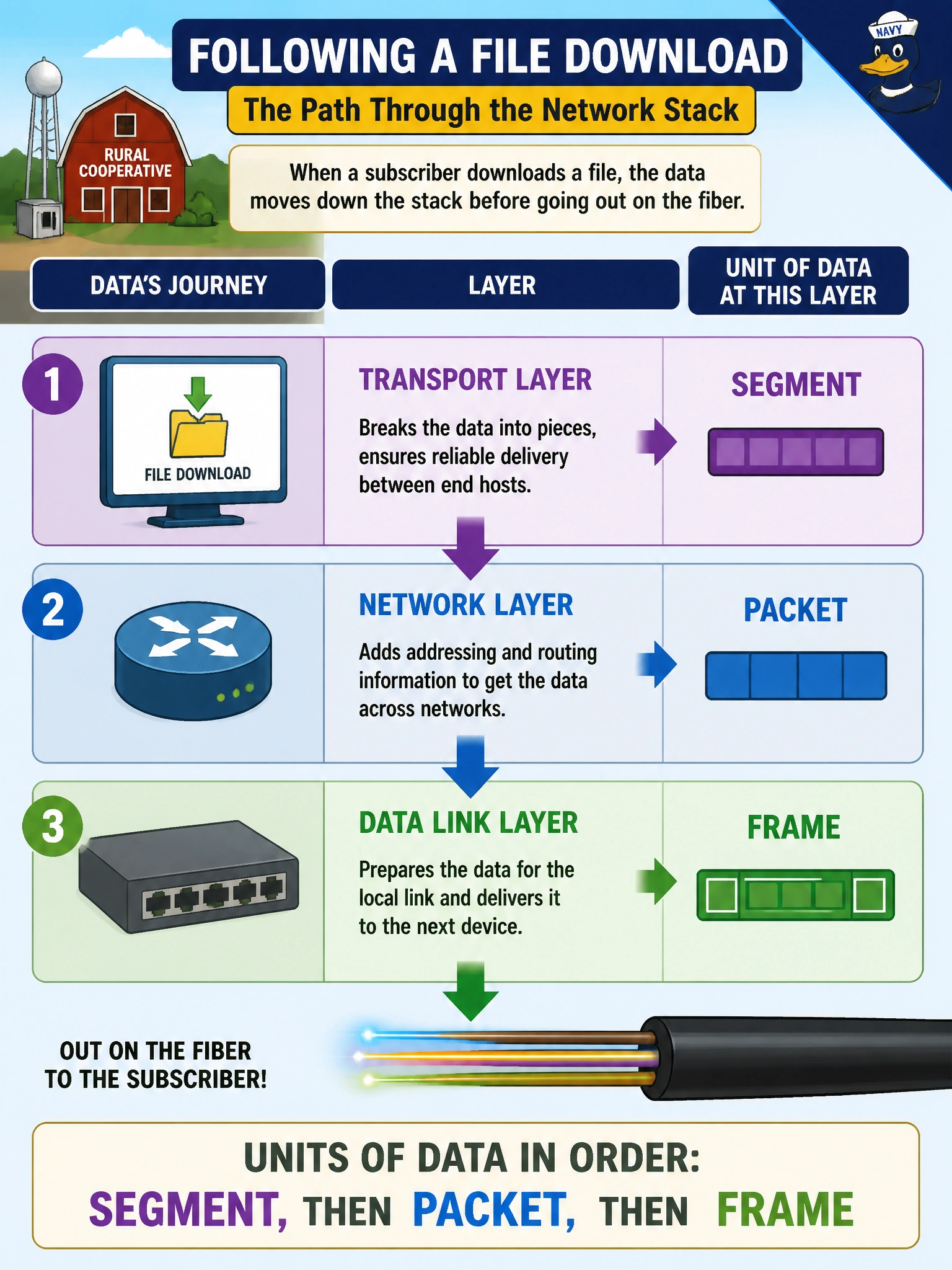
While training a new NOC hire, a senior technician at a rural cooperative draws the path a subscriber's file download takes: the data is handed to the transport layer, then the network layer, then the data link layer, before going out on the fiber. The new hire asks what the unit of data is called at each of those layers. In order, what should the technician say?
Select an answer to reveal the explanation.
Short Explanation
Each layer has its own name for the same traveling data, kind of like a package getting relabeled at every stop. Going down the stack it's a segment at transport, a packet once the network layer wraps it, and a frame by the time the data link layer sends it out.
Full Explanation
Standard networking terminology names the protocol data unit differently at each layer to reflect what that layer has added: at the transport layer, the unit is a segment; once the network layer adds its own addressing information, it becomes a packet; and once the data link layer adds its header and trailer for delivery on the local medium, it becomes a frame ready to go out on the fiber. Listing packet, then frame, then segment reverses the correct transport-to-data-link order and additionally skips the segment stage entirely, which would leave the network layer's contribution unaccounted for. Listing frame, then segment, then packet puts the data link layer's unit first, before the data has even reached the network or transport processing that produces a segment or packet, which doesn't match the order the new hire asked about (transport, then network, then data link). Listing frame, then packet, then segment gets the sequence backwards from transport-to-data-link and starts with the data link layer's terminology despite that layer being last in the stated path. Getting this terminology straight matters operationally because troubleshooting language depends on it — a technician who says the frame is getting corrupted versus the segment is being retransmitted is pointing at two different layers and two different classes of fix, so a NOC team that names layers consistently narrows down problems faster than one that uses the terms interchangeably.