
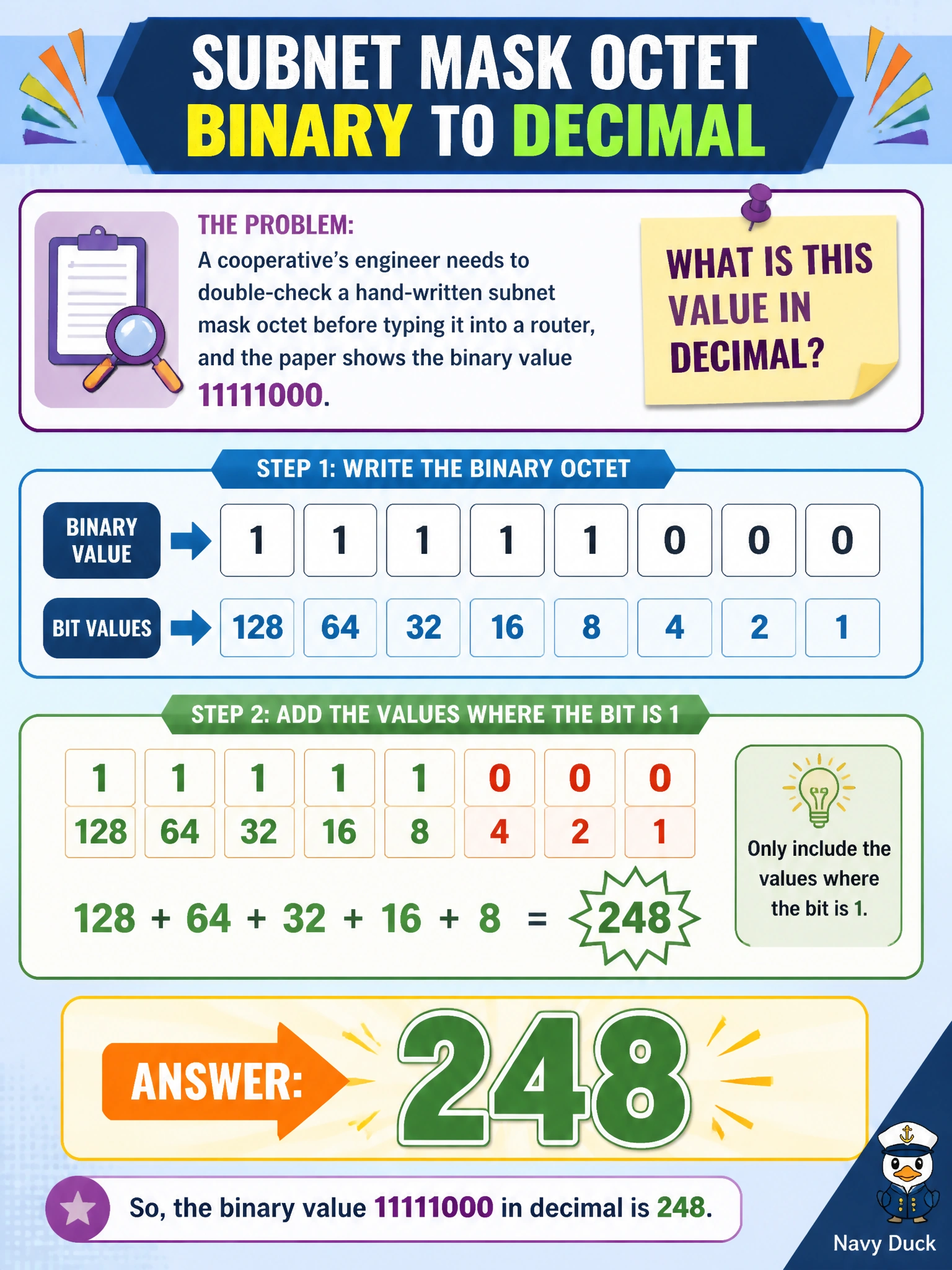
A cooperative's engineer needs to double-check a hand-written subnet mask octet before typing it into a router, and the paper shows the binary value 11111000. What is this value in decimal?
Select an answer to reveal the explanation.
Short Explanation
Binary-to-decimal conversion is just adding up the place values that have a 1 sitting in them: 128, 64, 32, 16, 8, 4, 2, 1, read left to right. Line 11111000 up against those columns and only the top five are lit, so you're adding 128+64+32+16+8. That total, 248, is the kind of number you'll be double-checking constantly once you're on the CLI.
Full Explanation
Converting an octet from binary to decimal relies on the fixed place-value weights 128, 64, 32, 16, 8, 4, 2, and 1, read left to right, where each position contributes its weight only when the bit there is a 1 and contributes nothing when it's a 0. The string 11111000 has 1s in the 128, 64, 32, 16, and 8 positions and 0s everywhere else, so the decimal value is the sum of exactly those five weights: 128+64+32+16+8 equals 248. Choosing 240 comes from stopping the addition one column early and treating the 8s place as a 0 instead of the 1 it actually holds, undercounting by 8. Choosing 252 comes from misreading the pattern as if the 4s place also held a 1, adding a weight the bit string doesn't contain. Choosing 254 goes further still, treating both the 4s and 2s places as 1s when the string only has five leading 1s followed by three 0s. A caveat worth remembering is that this weight-table method works one octet at a time — a 32-bit IPv4 value has to be converted four separate times, not as one continuous binary number. A reliable operational check is writing the eight place values above the bits before adding, so a misplaced digit is caught visually rather than compounding into an arithmetic mistake.