
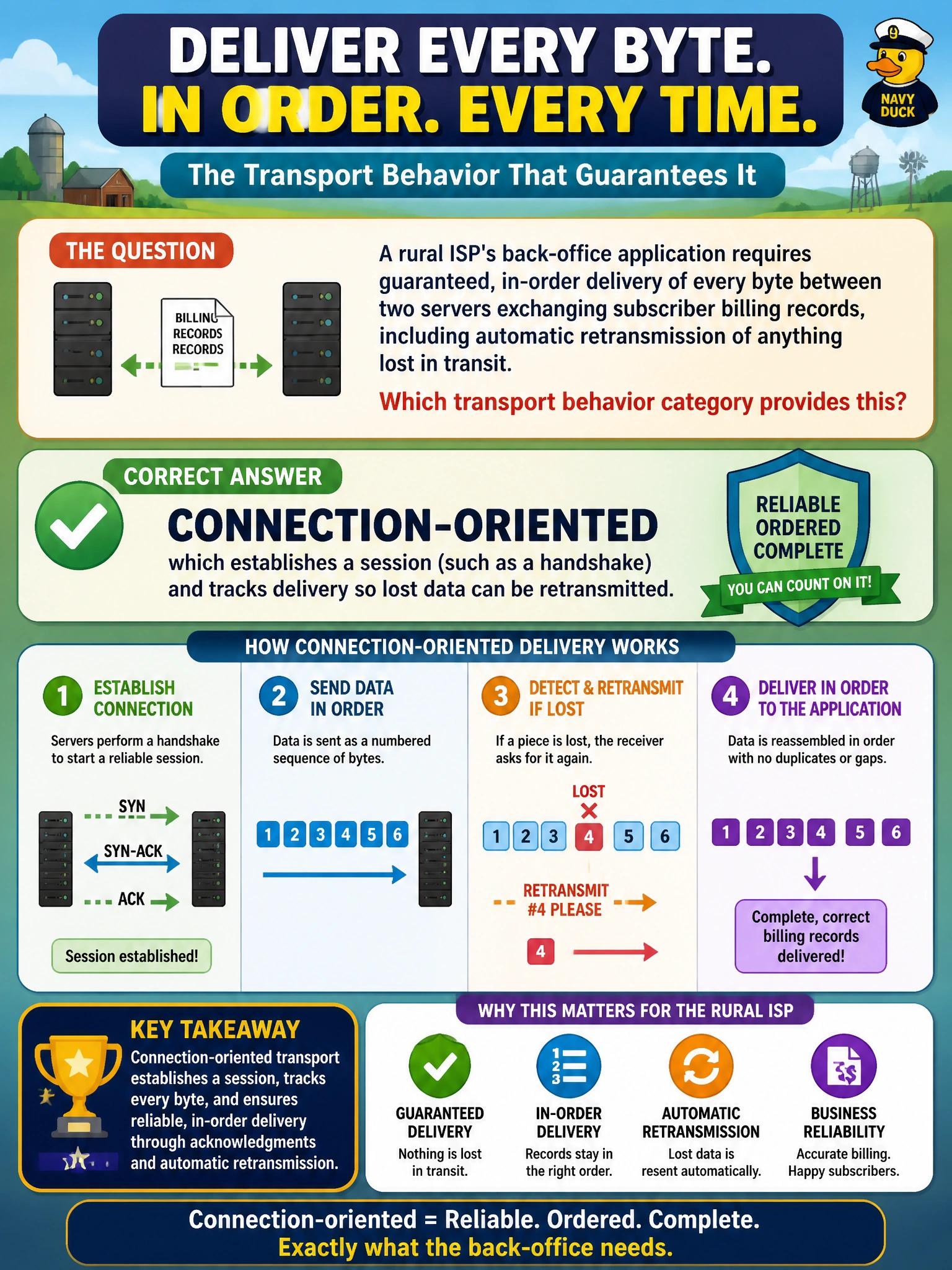
A rural ISP's back-office application requires guaranteed, in-order delivery of every byte between two servers exchanging subscriber billing records, including automatic retransmission of anything lost in transit. Which transport behavior category provides this?
Select an answer to reveal the explanation.
Short Explanation
Billing records aren't something you want showing up out of order or missing a byte, so this job calls for a transport that keeps score: it sets up a session first, tracks what's been delivered, and resends anything that goes missing. That's connection-oriented transport doing exactly what it's built for.
Full Explanation
Connection-oriented transport establishes a session between endpoints, often through a handshake, and then tracks delivery of every unit of data so that anything lost in transit can be identified and retransmitted, which is precisely what guaranteed, in-order billing data transfer requires. Connectionless transport being described as faster because it never acknowledges data is true as a general trade-off, but it's the wrong fit here, since faster-with-no-acknowledgment is the opposite of guaranteed-and-retransmitted — this scenario explicitly prioritizes reliability over speed. Claiming connection-oriented transport only guarantees the first packet in a session misrepresents how it works; the tracking and retransmission apply across the whole session for as long as it's established, not just to an initial packet, so this understates the reliability the mechanism actually provides. Describing connectionless transport as retransmitting lost data without session state is self-contradictory in practice — connectionless transport's defining trait is that it doesn't track what has or hasn't arrived, so there's no state from which to know something was lost or to trigger a retransmission. An operational check for a cooperative validating this design is monitoring for retransmission events on the billing link during a period of packet loss; seeing retransmissions occur and the record set ultimately arrive complete and in order confirms the connection-oriented transport is doing its job, whereas the same loss on a connectionless transport would simply show up as missing data with no automatic recovery.