
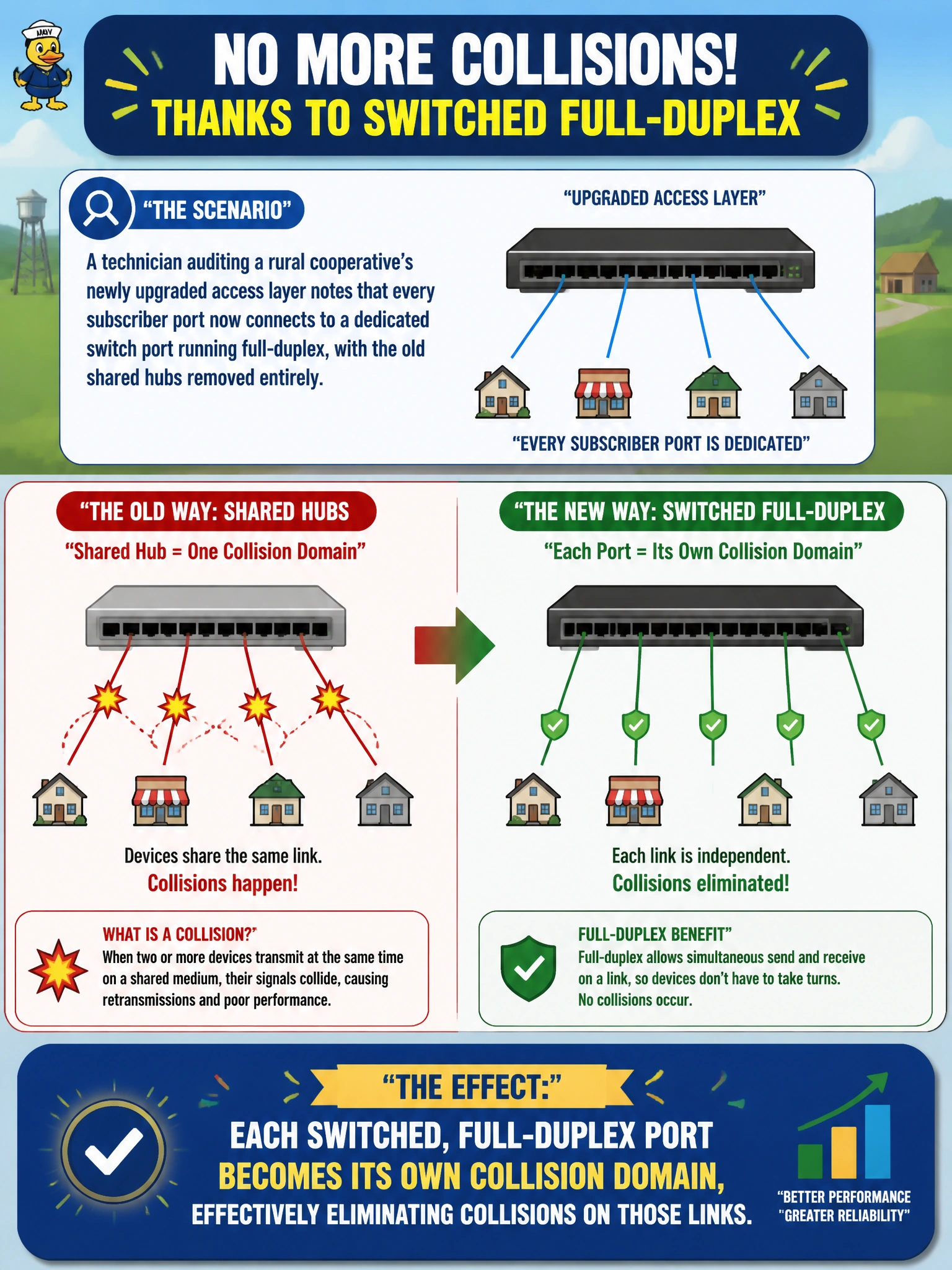
A technician auditing a rural cooperative's newly upgraded access layer notes that every subscriber port now connects to a dedicated switch port running full-duplex, with the old shared hubs removed entirely. What effect does this have on collisions for those links?
Select an answer to reveal the explanation.
Short Explanation
Swap a shared hub for dedicated switch ports running full-duplex, and each subscriber basically gets their own private lane instead of a shared party line. With nobody else on that lane to bump into, collisions on those links effectively disappear.
Full Explanation
Replacing a shared hub with a switch fundamentally changes the collision picture because each switch port, when running full-duplex to a single connected device, becomes its own isolated collision domain — since only that one device and the switch port share the segment, and full-duplex operation lets both directions transmit simultaneously without contention, collisions on that link become effectively impossible under normal operation. Claiming collisions increase with more directly connected devices confuses more connections with more shared media; it's the sharing, not the device count, that causes collisions, and this upgrade removed the sharing. Saying collision domains depend only on IP addressing ignores that collision domains are a Layer 1/2 concept governed by physical media access, not by Layer 3 addressing at all — IP addressing has no bearing on whether two signals collide on a wire. Describing the result as one large shared collision domain across the whole switch misunderstands how switches segment collision domains per port; that description would only be accurate if the switch itself were replaced by a hub, which is the opposite of what happened here. An operational check to confirm the upgrade's effect is reviewing interface counters for collisions and late collisions on the newly migrated ports — a properly configured full-duplex switched port should report zero, and any nonzero count is a strong signal of a duplex mismatch rather than genuine media contention.