
A cooperative's new hire is studying networking fundamentals and needs to understand how the four-layer TCP/IP model relates to the seven-layer OSI model. Which statement correctly describes that relationship?
Select an answer to reveal the explanation.
Short Explanation
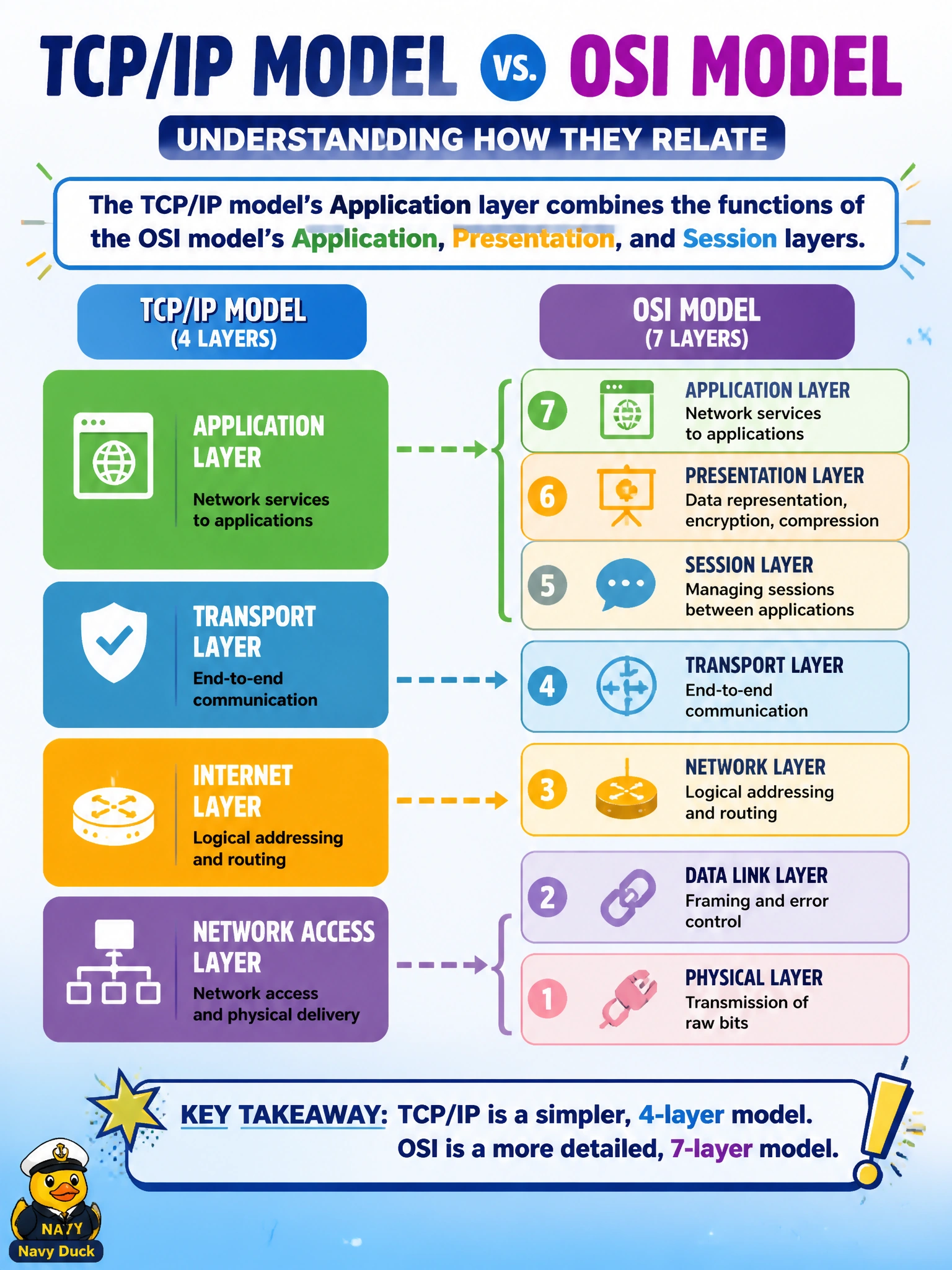
The two models aren't rivals describing different networks — they're two ways of slicing up the same job, and TCP/IP just uses fewer, broader layers. Its top layer alone does the work OSI splits into three: Application, Presentation, and Session.
Full Explanation
The TCP/IP model condenses OSI's seven layers into four broader ones, and the clearest example of that condensing is at the top: TCP/IP's single Application layer covers the responsibilities OSI splits across its Application, Presentation, and Session layers — formatting, session management, and application-level protocols are all folded together rather than kept as separate layers. The claim that TCP/IP has more layers than OSI is backwards on its face; TCP/IP has fewer layers overall, and the reason isn't a split of physical and data link functions — if anything, TCP/IP's Network Access layer combines OSI's separate Physical and Data Link layers rather than dividing them further. Saying OSI's Transport layer has no TCP/IP equivalent is incorrect; TCP/IP has its own Transport layer performing the same core job (such as segmentation and port-based multiplexing) and the two models line up cleanly at that layer. Describing the models as unrelated ignores that OSI is a conceptual reference model used to explain and troubleshoot networking, while TCP/IP is the practical model the real internet protocol suite is built on — they describe the same underlying functions at different levels of granularity, not different networks. For a new hire, a useful way to anchor this is mapping a familiar protocol, such as HTTP, to both models side by side: it sits at OSI's Application layer and equally at TCP/IP's Application layer, confirming the models describe the same reality rather than competing ones.