
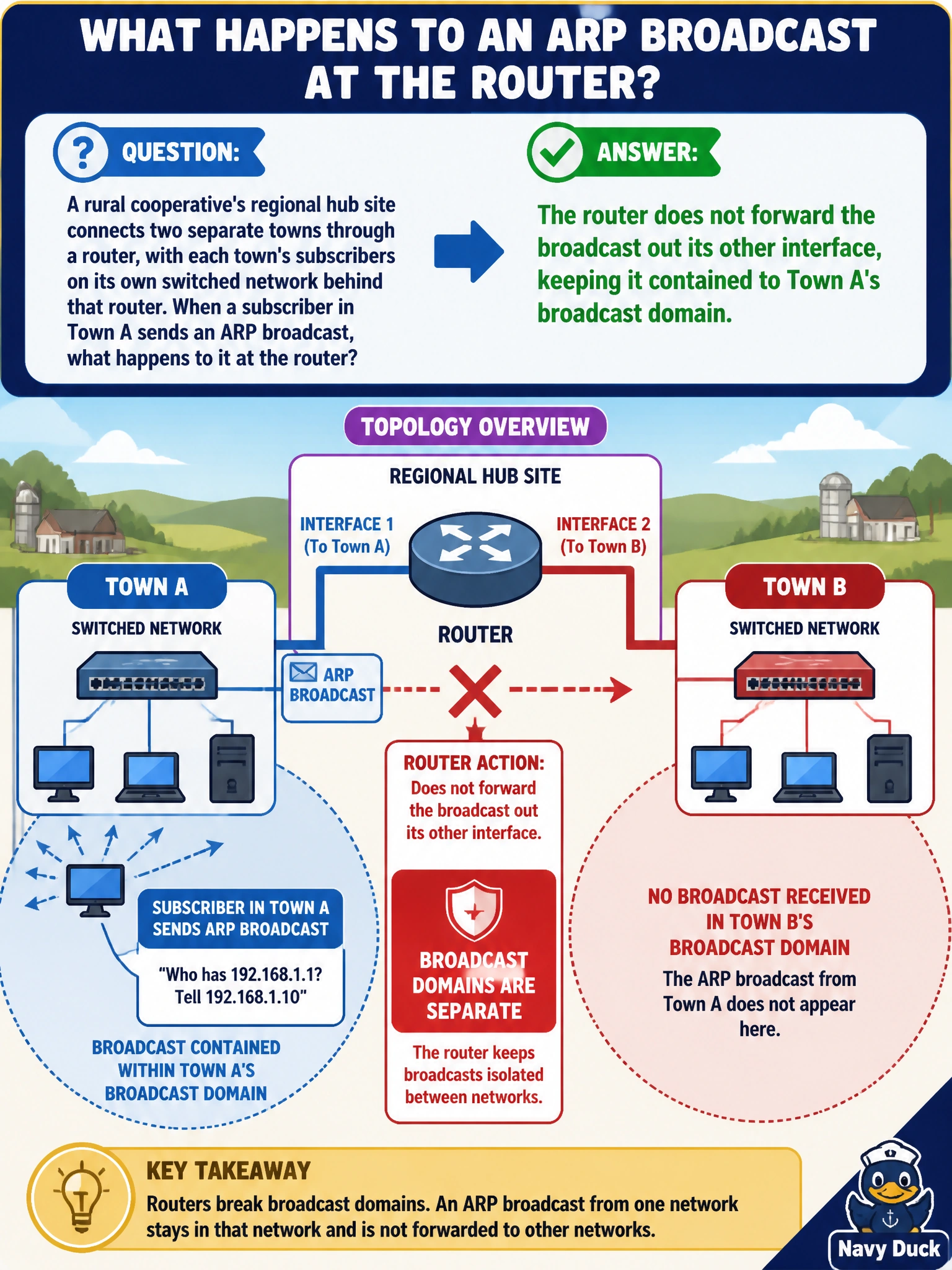
A rural cooperative's regional hub site connects two separate towns through a router, with each town's subscribers on its own switched network behind that router. When a subscriber in Town A sends an ARP broadcast, what happens to it at the router?
Select an answer to reveal the explanation.
Short Explanation
A router is the wall between broadcast domains, not a hallway through them. Town A's ARP broadcast hits the router and just stops there — it never wakes up Town B's network at all.
Full Explanation
Routers define the boundary of a broadcast domain: by default, a router does not forward broadcast traffic out its other interfaces, which is precisely why connecting two towns through a router (rather than a switch) keeps each town's subscriber network as its own separate broadcast domain. Saying routers extend broadcast domains across interfaces gets the router's core function backwards — extending broadcast domains across a link is what a switch or a bridge does, while containing them is the defining behavior that separates a router from those devices. Converting the broadcast into a multicast is not something a router does as part of normal ARP or broadcast handling; multicast and broadcast are distinct delivery types, and a router doesn't translate between them as a way of forwarding traffic it otherwise wouldn't forward. Describing the router as flooding the broadcast out every other interface conflates router behavior with switch flooding behavior; a switch floods frames within a broadcast domain when appropriate, but a router's job at its interfaces is to route between separate networks, and forwarding broadcasts by default would defeat that separation entirely. A technician can verify this containment directly by capturing traffic on a Town B access port while the ARP broadcast is generated in Town A and confirming it never appears — solid evidence the router is doing its job of keeping the two towns' broadcast domains apart.