
A subscriber's laptop at a rural cooperative receives an Ethernet frame carrying a web page from a regional data center. As that frame moves up through the receiving device's protocol stack toward the browser, what happens to it?
Select an answer to reveal the explanation.
Short Explanation
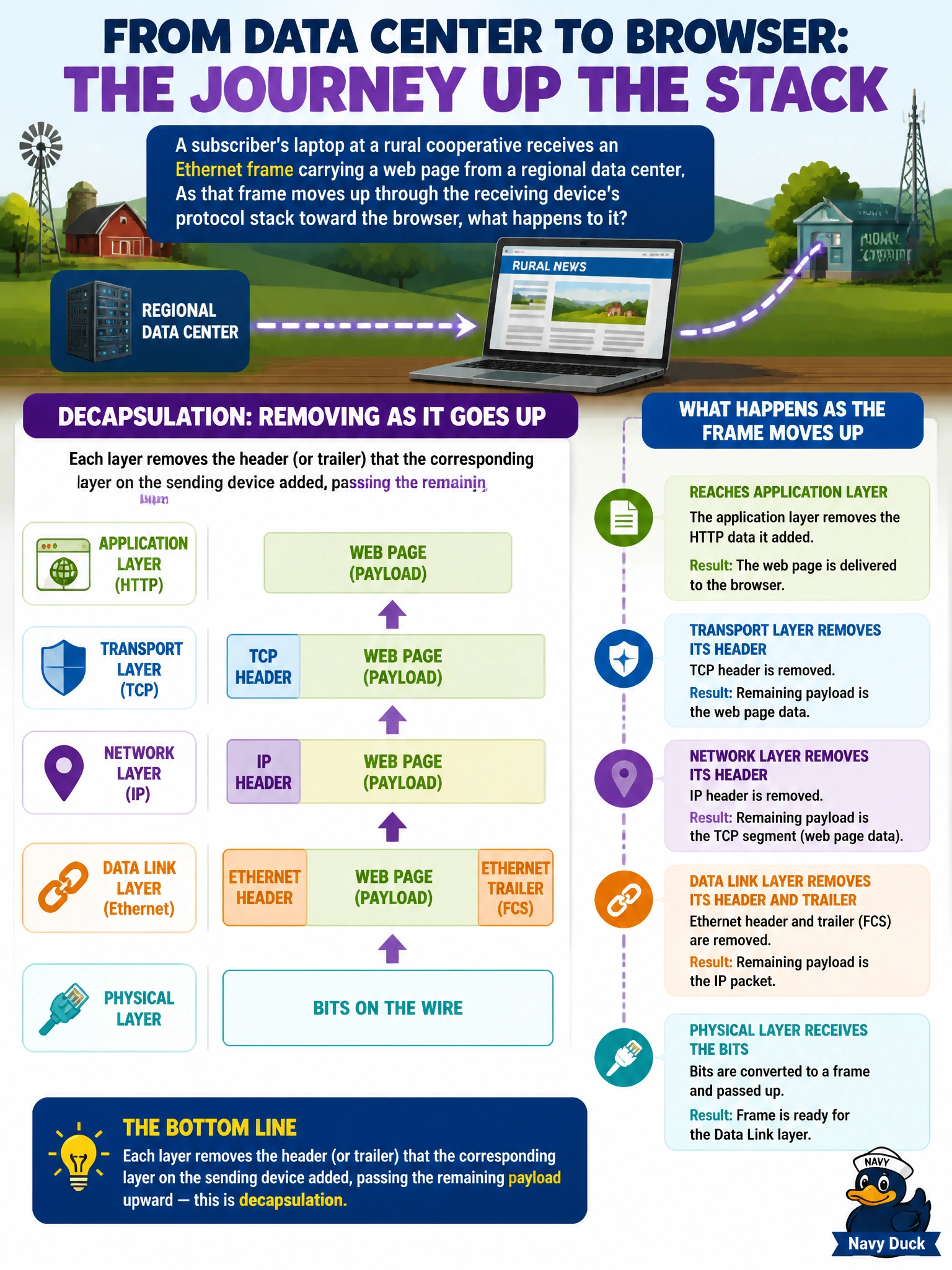
Going up the stack is just unwrapping the boxes that got packed on the way down: the data-link header comes off, then the network header, then the transport header, until what's left is the plain web page the browser can actually use. That unwrapping, one layer at a time, is decapsulation.
Full Explanation
Decapsulation is the reverse of encapsulation: as a frame moves up through the receiving device's stack, each layer strips off the header (and, at the data link layer, the trailer) that the matching layer on the sender added, then hands the remaining payload up to the next layer, until the original application data reaches the browser. Adding a header at each layer describes encapsulation, which is what happens on the sending side going down the stack, not on the receiving side going up — reversing that direction is the core error in that option. Discarding the frame after the physical layer confirms a valid signal would mean no data ever reaches the application at all, which contradicts the premise that the web page is delivered successfully. Broadcasting the frame to every layer simultaneously misrepresents the strictly sequential, layer-by-layer nature of the stack; each layer only sees what the layer below it hands up, one step at a time, never the whole stack at once. An operational way to confirm this behavior is to capture the frame as it arrives on the wire and compare it against what the application ultimately displays: the capture shows the full nested headers, while the browser only ever sees the final, fully decapsulated payload, demonstrating that each layer removed exactly its own wrapper along the way.