
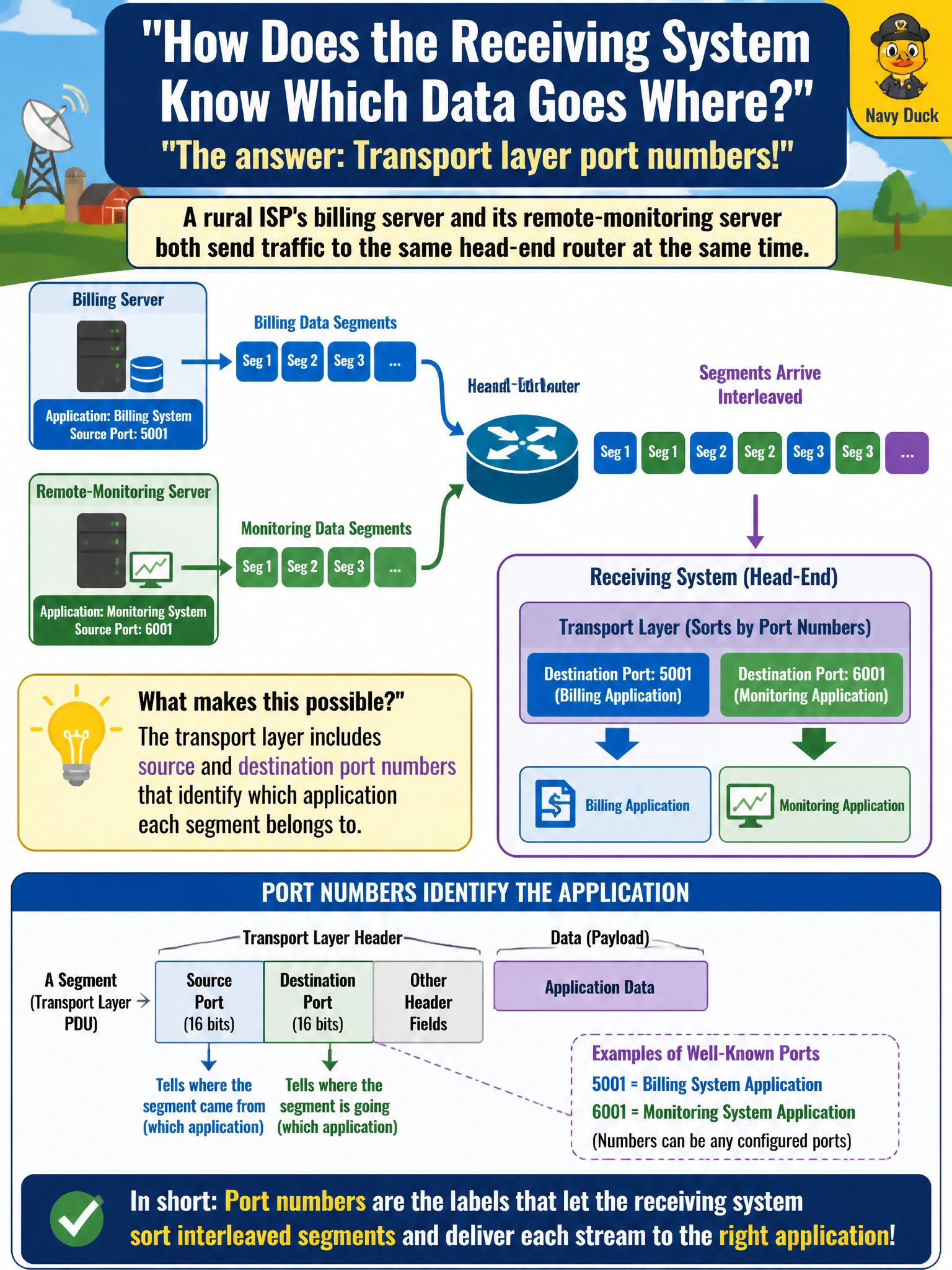
A rural ISP's billing server and its remote-monitoring server both send traffic to the same head-end router at the same time. What allows the receiving system to correctly sort the arriving segments and deliver each stream to the right application?
Select an answer to reveal the explanation.
Short Explanation
Two applications can share the same server and the same IP address just fine, because the transport layer tags every conversation with port numbers, like apartment numbers on top of a street address. That's how the receiving system knows which stream is for the billing app and which is for the monitoring app — it's multiplexing by port.
Full Explanation
The transport layer uses source and destination port numbers embedded in each segment to multiplex multiple simultaneous conversations over the same network-layer connection, which is exactly the mechanism that lets a receiving system sort billing traffic from monitoring traffic and hand each to the correct application. A MAC address table operates at Layer 2 and forwards frames based on physical addressing between adjacent devices on a segment — it has no concept of which application a stream belongs to and plays no role in this kind of application-level sorting. Assigning each application its own IP address is not how this problem is normally solved and isn't required; two applications on the same host routinely share one IP address, distinguished only by their port numbers, so this option describes an unnecessary and atypical workaround rather than the actual mechanism. A data link layer trailer, such as a frame check sequence, exists to detect transmission errors on that specific link, not to identify or route traffic to any application, and it does not survive beyond that single link's forwarding anyway. A technician verifying this behavior could capture traffic at the head-end router and observe the two servers' segments arriving with distinct destination port numbers even though they may share the same destination IP — confirming that ports, not addresses, are doing the sorting.