
A cooperative's engineer is choosing transport behavior for a live voice call between two rural offices, where a small amount of dropped audio is acceptable but delay caused by session setup or retransmissions is not. Which category of transport protocol behavior best fits this requirement?
Select an answer to reveal the explanation.
Short Explanation
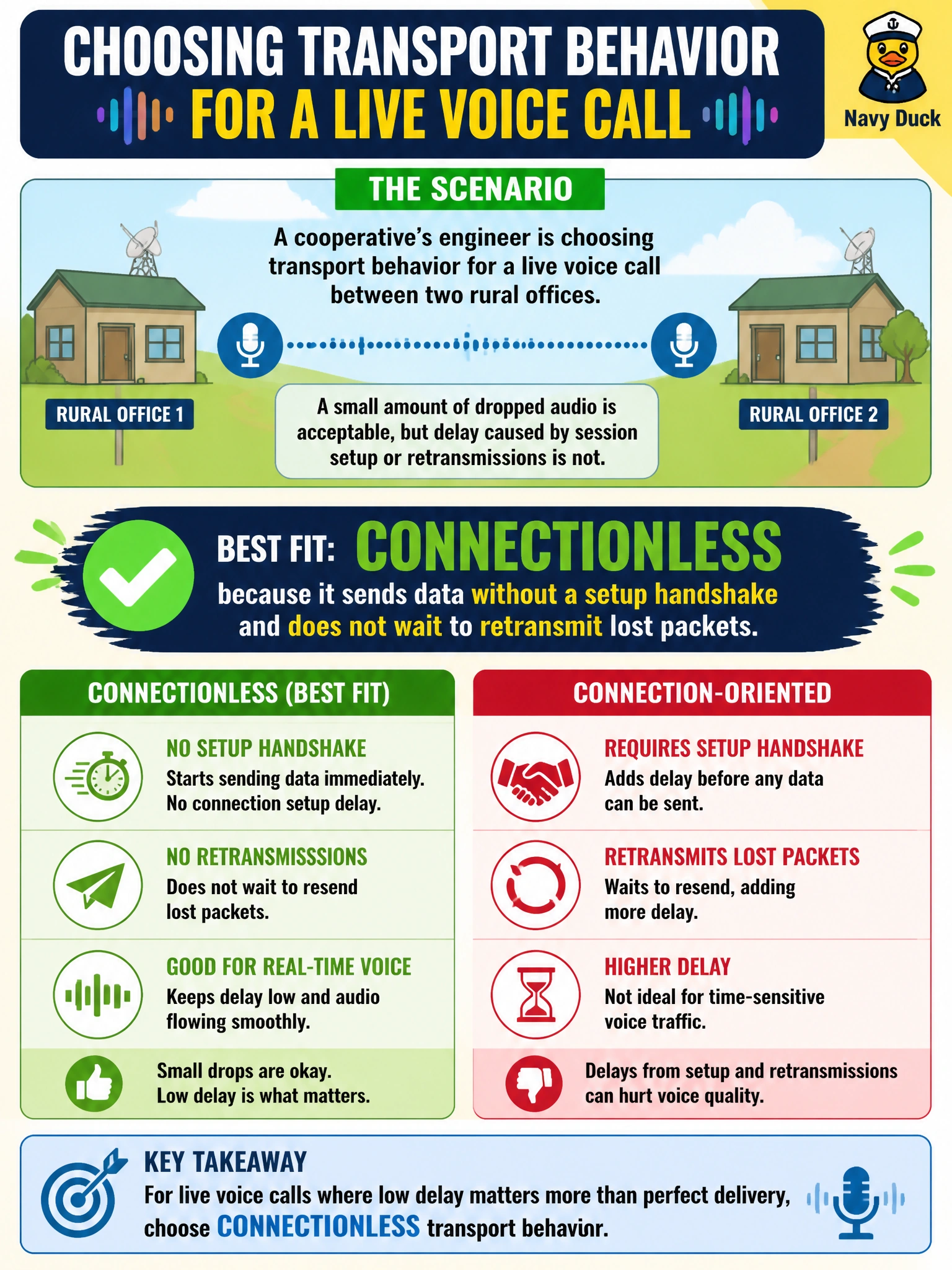
Voice calls hate waiting more than they hate a tiny glitch — a half-second of silence while something retransmits sounds worse than one dropped syllable. That's why real-time voice leans on connectionless transport: no handshake to set up, and no sitting around for missing pieces to be resent.
Full Explanation
Connectionless transport behavior sends data as independent units without first negotiating a session and without guaranteeing or retransmitting lost data, which minimizes delay — exactly the trade-off a live voice call needs, since a brief audio glitch is far less noticeable to a caller than the delay a retransmission or handshake would introduce. Connection-oriented transport is built for the opposite priority: it establishes a session (often via a handshake) and tracks delivery so lost data gets retransmitted, which guarantees completeness but introduces exactly the kind of delay this scenario is trying to avoid, so choosing it because it guarantees delivery misreads what the requirement actually calls for. Claiming a connection-oriented session automatically prioritizes voice traffic conflates session establishment with traffic prioritization, which is a separate mechanism (such as queuing or marking) and not an inherent property of being connection-oriented. Acknowledgments and sequence numbers for guaranteed, in-order delivery are hallmarks of connection-oriented transport, not connectionless transport; a protocol that tracked and re-ordered every segment that way would reintroduce the very retransmission delay this voice scenario is trying to avoid, so this option describes the opposite category's behavior while still labeling itself connectionless. A useful operational check when validating this choice is monitoring the call for jitter and packet loss rather than for retransmissions — since the connectionless transport carrying the voice stream won't retransmit lost audio, sustained loss should be addressed by improving the path itself, not by expecting the transport to recover it.