
A cooperative's NOC notices that a frame destined for a subscriber's set-top box is being sent out every port on an access switch except the one it arrived on, even though the box has been online and streaming for weeks without issue. What is the most likely explanation for this flooding behavior?
Select an answer to reveal the explanation.
Short Explanation
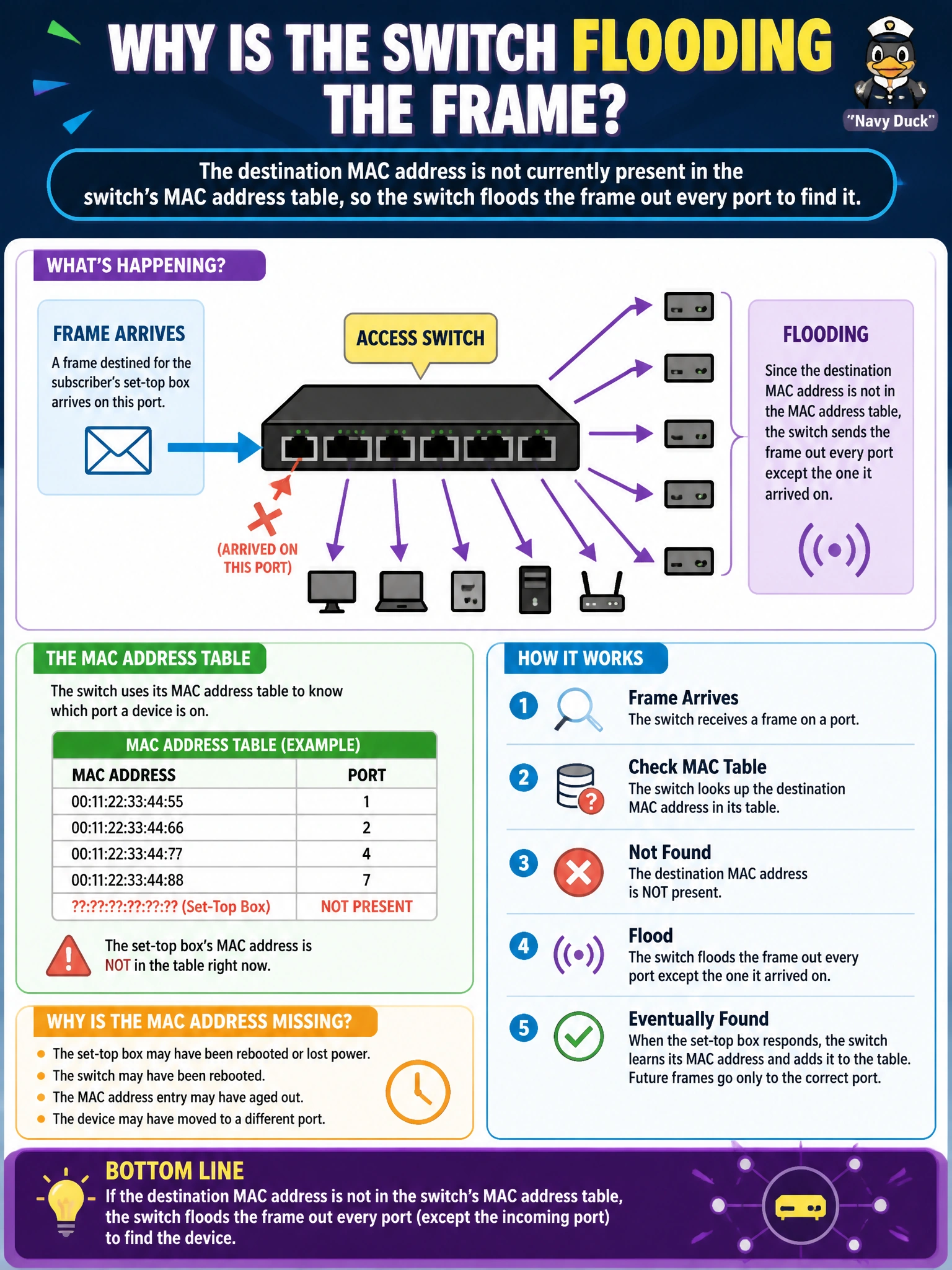
When a switch doesn't recognize where a MAC address lives anymore, it does the only safe thing it can: send the frame everywhere and let the right device pick it up. That's flooding, and it usually means the switch's table entry for that address quietly aged out or got knocked loose, not that anything is actually broken.
Full Explanation
A switch floods a unicast frame out every port (except the one it arrived on) specifically when the destination MAC address is not present in its MAC address table — the table entry may have aged out from inactivity, been cleared by a link event, or never been learned yet for that direction of traffic, so the switch falls back to flooding to guarantee delivery. This is the most likely explanation here because nothing about the scenario suggests multicast traffic; assuming all multicast is always flooded ignores that many switches support multicast-aware forwarding (such as snooping) that avoids blind flooding once configured. A full MAC address table is a real but much less common failure mode, and it behaves differently — a genuinely full table would typically cause broader learning failures and flooding for many addresses at once, not an isolated case for one long-stable device. An IP address change on the set-top box is a Layer 3 event and has no direct bearing on Layer 2 flooding decisions, which are driven purely by MAC table state. The operational check here is straightforward: inspect the switch's MAC address table for that specific destination MAC address, and watch whether a stable entry reappears on the correct port once the box sends its next frame — confirming the flooding was a normal, self-correcting aging event rather than a hardware or table-capacity problem.