
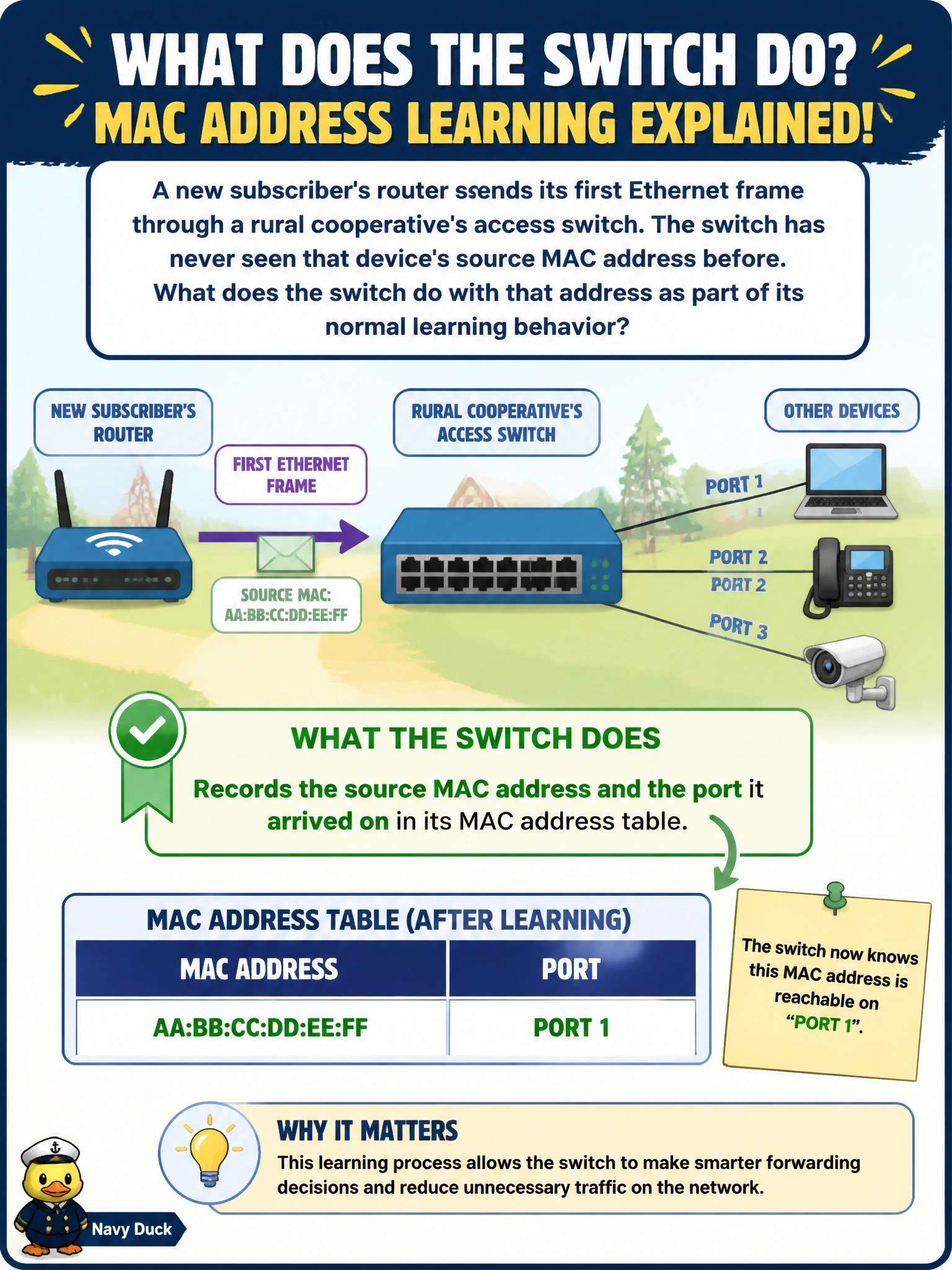
A new subscriber's router sends its first Ethernet frame through a rural cooperative's access switch. The switch has never seen that device's source MAC address before. What does the switch do with that address as part of its normal learning behavior?
Select an answer to reveal the explanation.
Short Explanation
Every switch is quietly taking attendance: the first time a frame shows up from a new device, the switch jots down its MAC address next to the port it walked in on. That's MAC learning, and it's how the switch builds the map it needs to forward traffic intelligently from then on.
Full Explanation
Switches build their forwarding intelligence dynamically through MAC address learning: whenever a frame arrives, the switch inspects the source MAC address and records it, together with the ingress port, in its MAC address table, even if it doesn't yet know how to reach the destination address in that same frame. This is exactly what happens with the new subscriber router's first frame — the switch has no entry for that device yet, so this frame is the learning opportunity. Dropping unknown-source frames would be wrong and would break basic connectivity; switches learn from any valid frame regardless of whether the source is already known, they don't require pre-population. Broadcasting the source address out every port describes neither learning nor normal forwarding behavior — announcing addresses isn't how switches operate, and doing so would flood the network needlessly. Requiring router confirmation before forwarding conflates Layer 2 switching with a Layer 3 function that switches don't perform; a switch makes forwarding decisions from its own table, not by consulting a router. A technician can confirm learning is working correctly by checking the switch's MAC address table shortly after a new device connects and verifying an entry appears mapping that device's MAC address to the correct access port.