
A rural ISP's access switch periodically removes MAC address table entries for ports that have not sent traffic for a while. What is this behavior called, and why does it matter operationally?
Select an answer to reveal the explanation.
Short Explanation
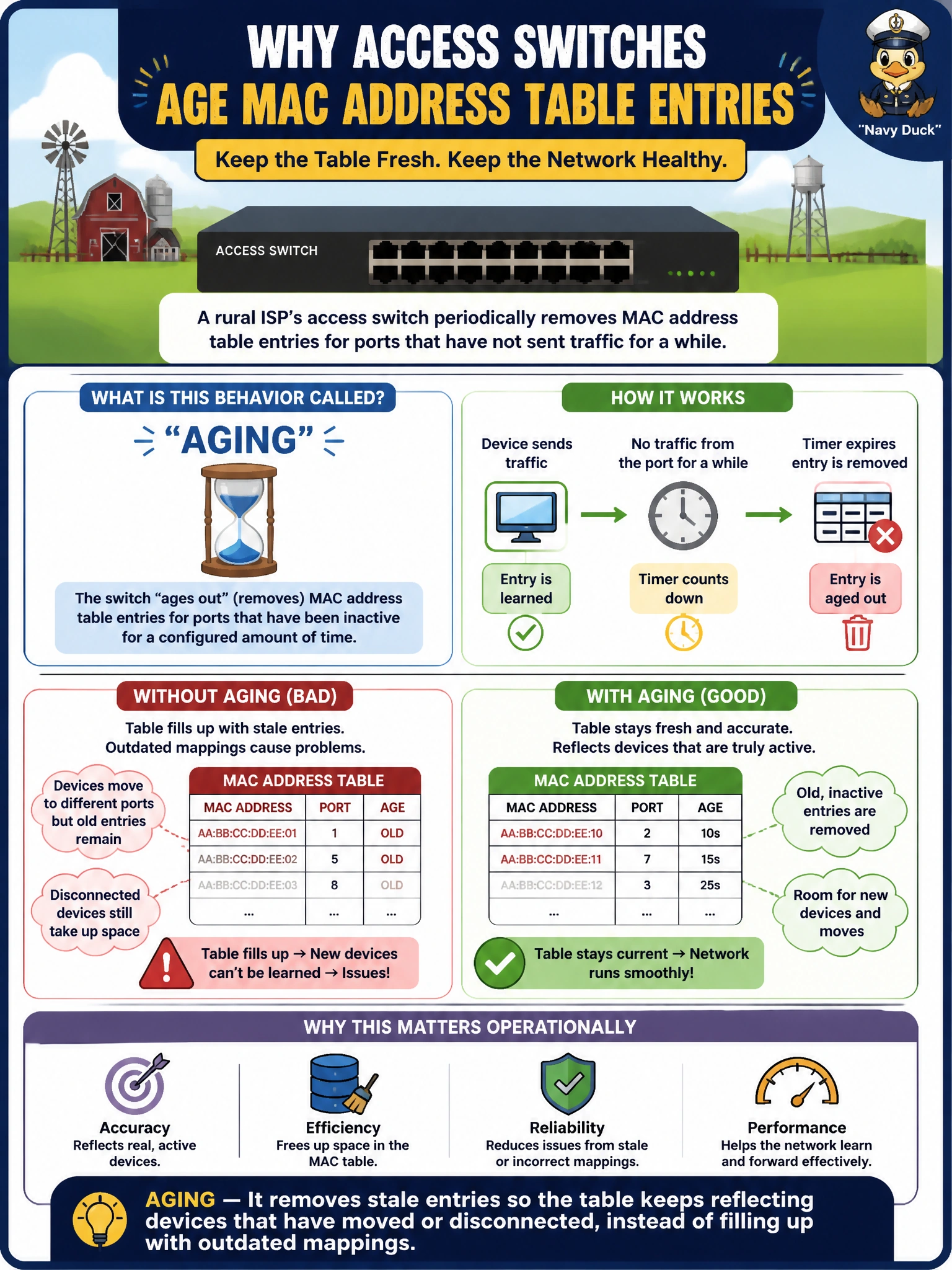
A switch's MAC table isn't meant to be a permanent guest list — old entries need to clear out so the table stays accurate as subscriber gear gets unplugged, swapped, or moved. That housekeeping is called aging, and without it the table would fill up with stale, useless entries.
Full Explanation
Aging is the mechanism by which a switch removes a MAC address table entry after that address has been inactive for longer than a configured timeout, keeping the table accurate as devices disconnect, get replaced, or move to a different port. This matters operationally at a rural ISP because subscriber equipment changes over time — a swapped router or a moved set-top box would otherwise leave a stale entry pointing traffic at the wrong, now-empty port indefinitely. Convergence is an unrelated concept describing how dynamic routing protocols recalculate paths after a topology change, which has nothing to do with a switch's own MAC table maintenance. Pruning is a real switching concept, but it applies to restricting VLAN traffic across trunk links based on active membership, not to timing out individual MAC entries. Flushing the entire table on every new connection would be wildly disruptive, forcing the switch to relearn every device's location constantly, and is not how switches behave in normal operation — aging removes individual stale entries, not the whole table at once. A technician can observe aging directly by unplugging a test device, waiting past the switch's aging interval, and confirming the corresponding MAC entry disappears from the table — proof the switch is cleaning up stale mappings rather than holding onto them forever.