
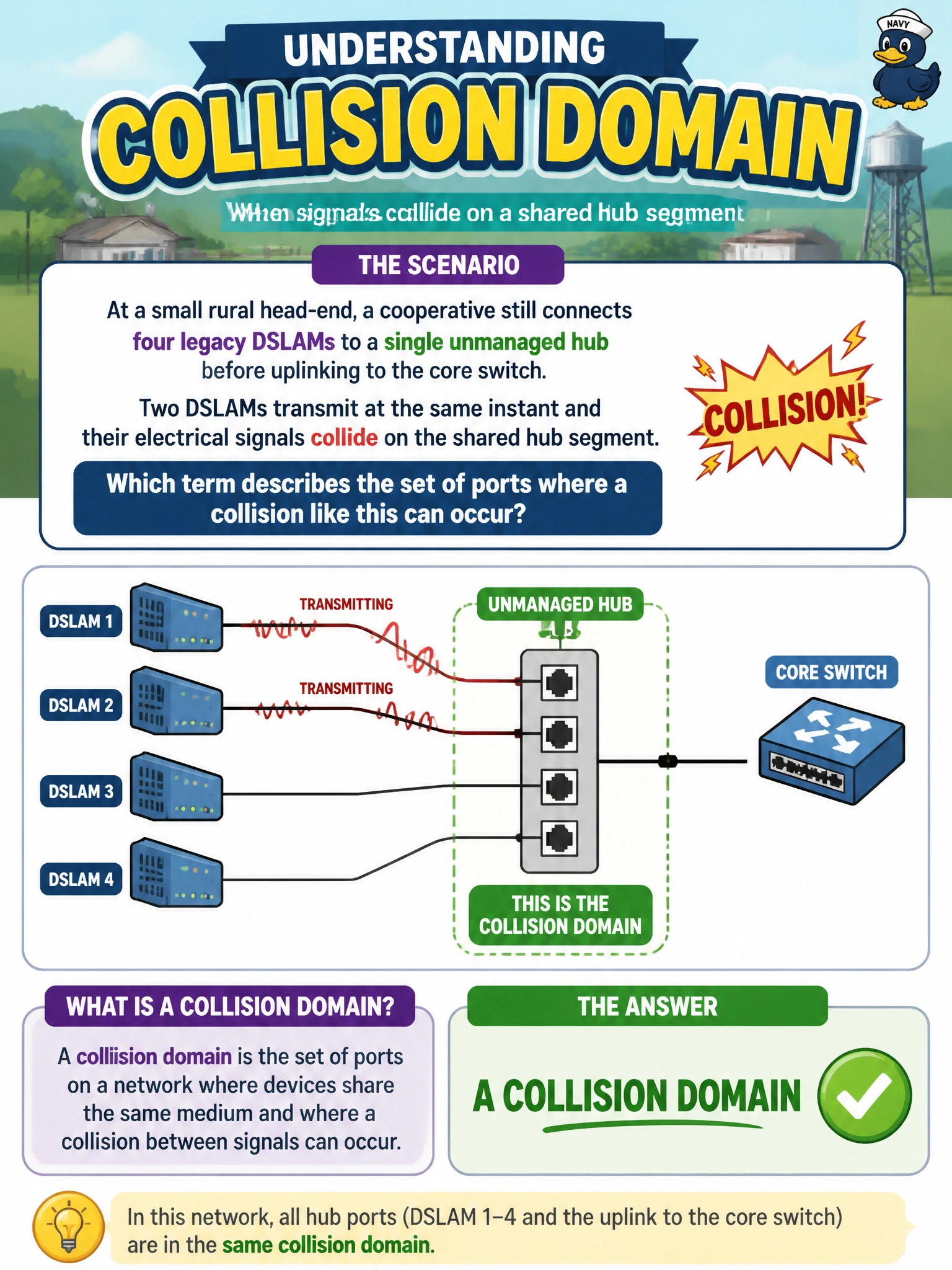
At a small rural head-end, a cooperative still connects four legacy DSLAMs to a single unmanaged hub before uplinking to the core switch. Two DSLAMs transmit at the same instant and their electrical signals collide on the shared hub segment. Which term describes the set of ports where a collision like this can occur?
Select an answer to reveal the explanation.
Short Explanation
Picture the hub as one shared party line: if two DSLAMs talk at the same moment, their signals smash into each other because everyone's plugged into the same wire. That shared wire, where a collision like that can actually happen, is a collision domain — and it's exactly why hubs got replaced by switches.
Full Explanation
A collision domain is the set of network segments or ports where two devices transmitting at the same time can cause their signals to collide, corrupting both frames. A shared hub is the classic example: because every port repeats every signal to every other port, all four DSLAMs connected to that hub sit in a single collision domain, and simultaneous transmissions from any two of them collide. A broadcast domain is a different, larger scope — it's the set of devices that receive each other's broadcast frames, and it is not reduced or eliminated by replacing a hub with a switch the way collisions are. A VLAN is a logically segmented broadcast domain configured on switching equipment, not a description of where electrical collisions occur, and a subnet is a Layer 3 addressing construct with no bearing on Layer 1/2 collision behavior at all. The practical fix a cooperative technician would apply here is to replace the unmanaged hub with a switch: because a switch gives each connected device its own dedicated, typically full-duplex port, each of those ports becomes its own collision domain, and collisions on that segment effectively disappear. A quick operational check is watching interface error counters for collision or late-collision counts — a healthy switched, full-duplex link should show none.