
A field technician wiring a new subscriber aggregation switch at a rural cooperative's point of presence needs to know which layer of the OSI model is responsible for physical addressing and for delivering frames between devices on the same local segment. Which layer is that?
Select an answer to reveal the explanation.
Short Explanation
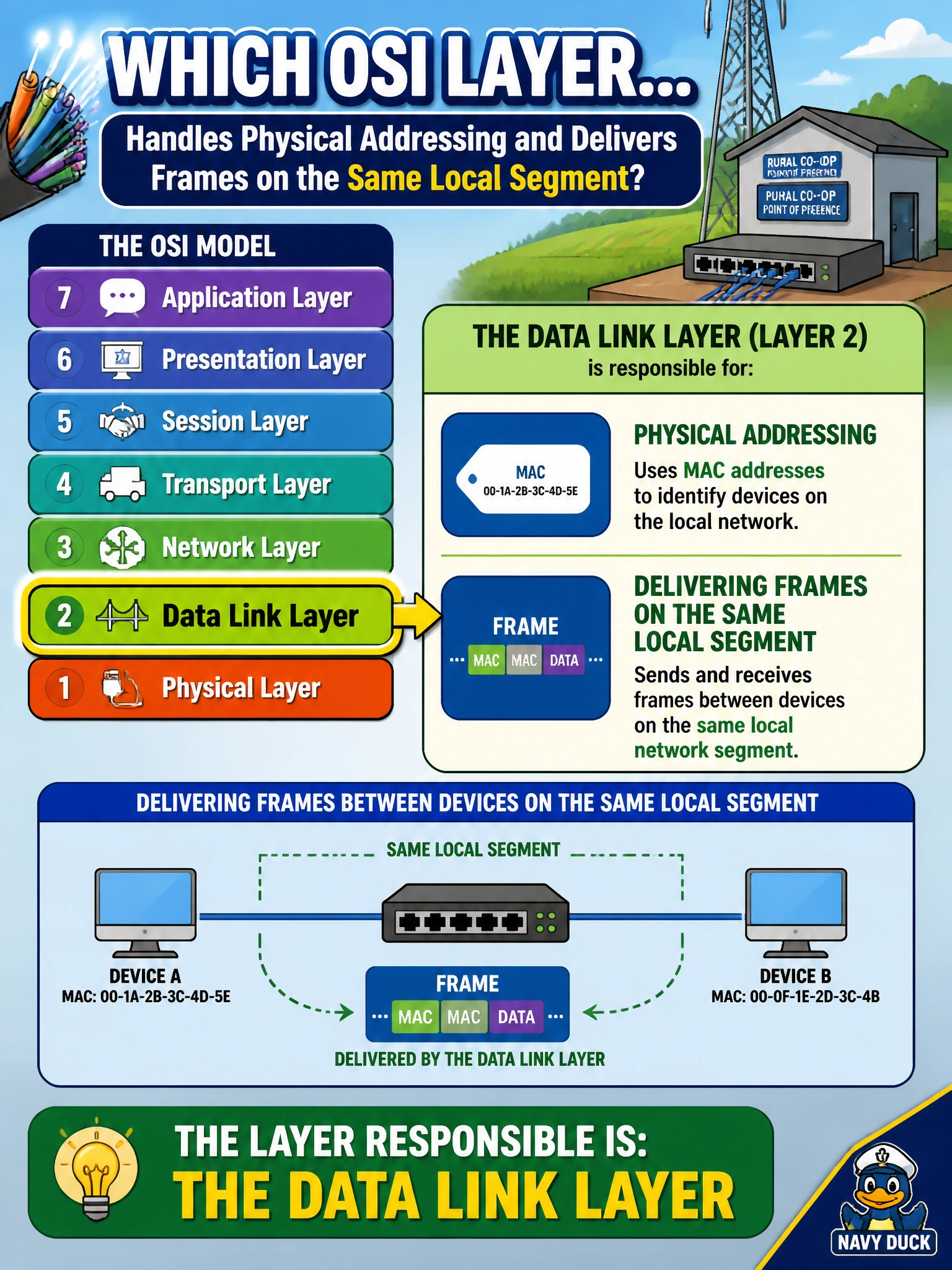
MAC addresses and frames live one layer above the raw electrical signal, at the layer that gets a frame from one box to the box right next to it on the same wire. That's the Data Link layer, and it's what an aggregation switch cares about when it forwards traffic locally.
Full Explanation
The Data Link layer is responsible for framing data for transmission on a shared local medium and for physical (MAC) addressing, which lets one device deliver a frame to a specific neighbor on the same segment without needing any routing decision. This is exactly the job an aggregation switch performs at a rural POP: it reads destination MAC addresses and forwards frames out the correct port toward the intended device. The Network layer is a different job entirely — it handles logical (IP) addressing and forwarding between different networks, which is a router's concern, not a switch's. The Physical layer is lower still; it deals with bits, voltages, and signaling on the cable or fiber itself, with no concept of an address at all. The Transport layer sits well above both, managing end-to-end communication between applications using port numbers, and has no role in delivering a frame across a local segment. A useful operational check for a technician wiring a new switch is to confirm the device's MAC address table is populating with entries as subscriber equipment powers on — that table is a Data Link layer structure, and seeing it fill in correctly confirms Layer 2 forwarding is working before troubleshooting anything higher in the stack.