
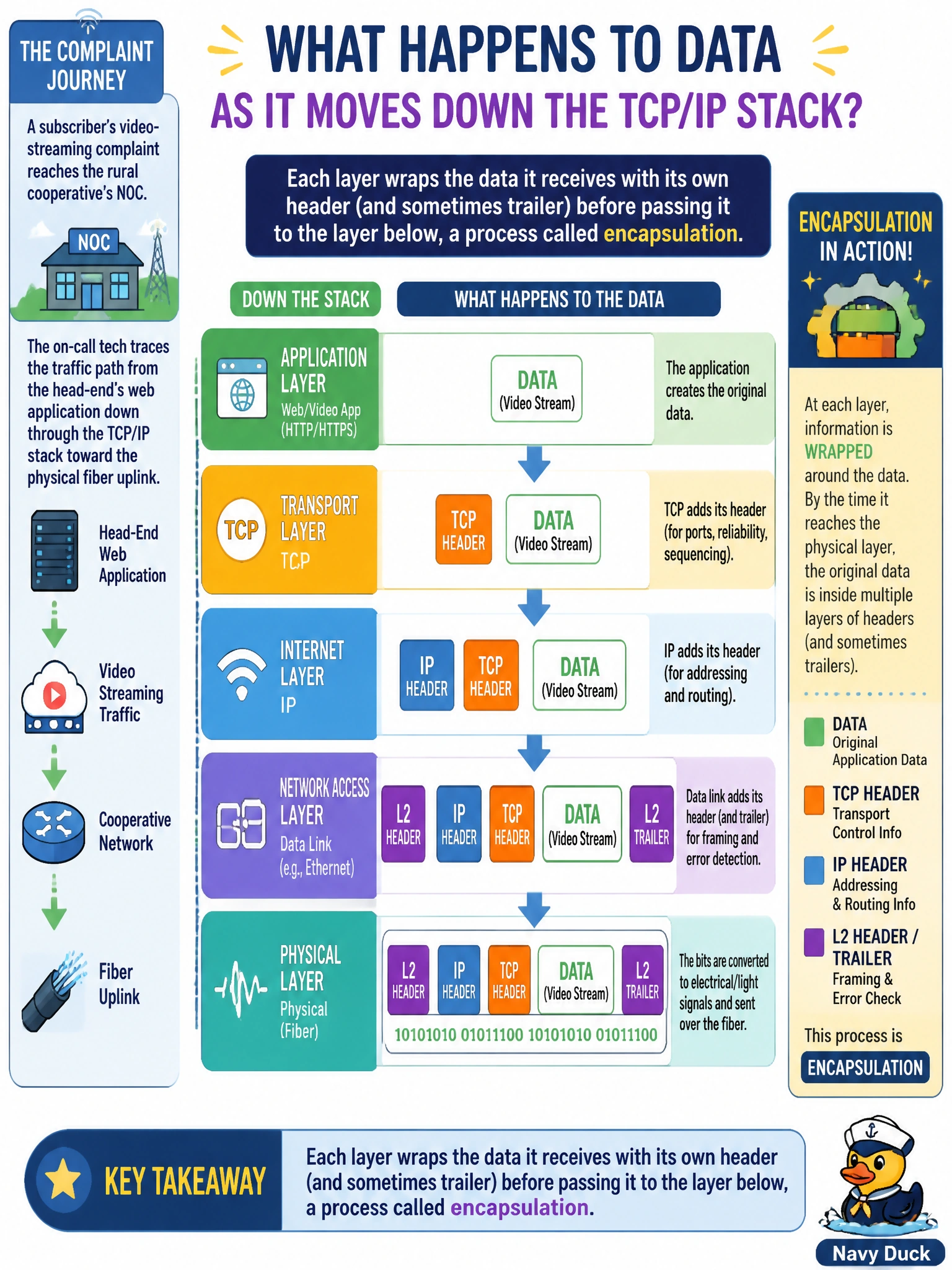
A subscriber's video-streaming complaint reaches a rural cooperative's NOC, and the on-call tech traces the traffic path from the head-end's web application down through the TCP/IP stack toward the physical fiber uplink. As the data moves down through each layer of the stack, what happens to it?
Select an answer to reveal the explanation.
Short Explanation
Think of it like packing a letter into smaller and smaller boxes: each layer tucks the data from above into its own wrapper before handing it further down the stack. By the time it reaches the fiber, that original web page is riding inside several nested headers, each one doing a different job. That stacking, one wrapper at a time, is encapsulation.
Full Explanation
Encapsulation is the process by which each layer of the TCP/IP (or OSI) stack adds its own header — and, at the data link layer, a trailer — to the data handed down from the layer above, without altering that payload's contents. On a cooperative's outbound path, application data becomes a transport-layer segment, then a network-layer packet, then a data-link frame, before the physical layer converts it to signals on the fiber. Compression is not a required or universal step at any single layer, so treating it as the defining event of the downward trip misses what encapsulation actually is. Chunking only once at the physical layer ignores that segmentation into transport-layer units and packaging into network-layer units both happen well before the signal is ever generated. Stripping headers as data moves down is backwards — that removal happens on the receiving side, moving up the stack, and is called decapsulation, not encapsulation. Operationally, a technician troubleshooting a slow stream can verify this layering directly with a packet capture at the NOC: seeing a frame header wrapped around an IP header wrapped around a TCP header wrapped around the HTTP payload confirms encapsulation happened correctly end to end, and a missing or malformed header at any layer narrows down exactly where the fault sits.