
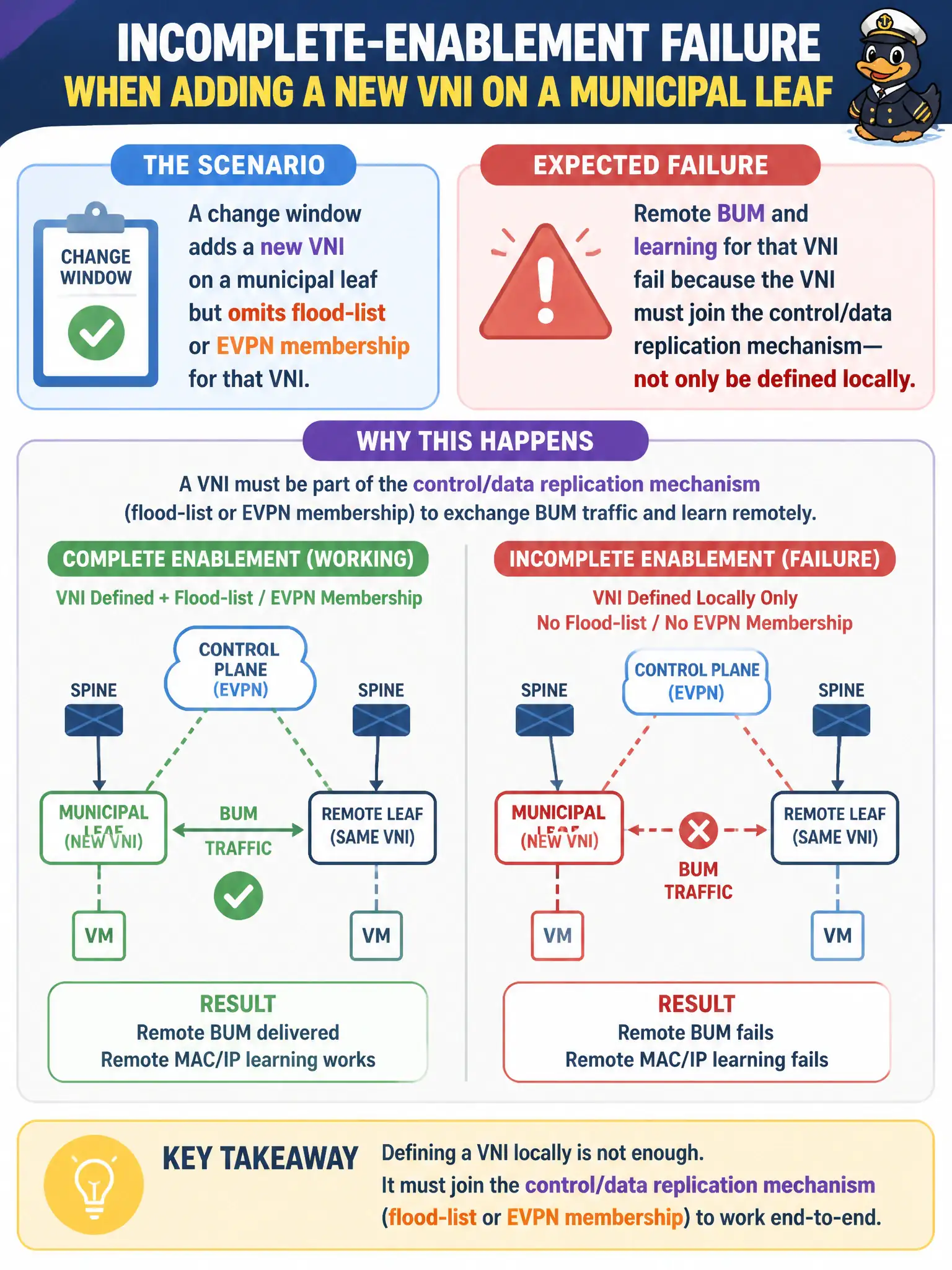
A change window adds a new VNI on a municipal leaf but omits flood-list or EVPN membership for that VNI. What incomplete-enablement failure should be expected?
Select an answer to reveal the explanation.
Short Explanation
Painting a new hallway number on one door doesn’t invite the other buildings to the party. The VNI needs membership in EVPN or the flood/replication list, not just a local definition. Incomplete enablement is how ARP goes quiet after a ‘successful’ change.
Full Explanation
When a change window adds a new VNI on a municipal leaf but omits flood-list or EVPN membership for that VNI, remote BUM and learning for that VNI fail because the VNI must join the control/data replication mechanism—not only be defined locally. Local definition without fabric membership leaves remote VTEPs without multi-destination traffic or appropriate learning for that segment.
The VNI will not automatically inherit membership from any VLAN with a similar ID. The failure is not limited to sFlow while unicast and broadcast overlay traffic remain fully functional. Spines do not synthesize EVPN membership from SNMP if the VNI integer exists anywhere.
Exam caveat: validate both local mapping and fabric membership after VNI changes on civic leaves.
Operational check: after adding a VNI, confirm EVPN advertisement/import or flood/ingress-replication list membership on peers, send BUM and unicast tests, and only then close the change ticket. Extend the change checklist with an explicit “membership verified” checkbox for every new VNI. Use a canary remote leaf to prove learning before rolling the VNI to all agency pods. Record the validated outcome in the municipal fabric runbook for the next change window.