
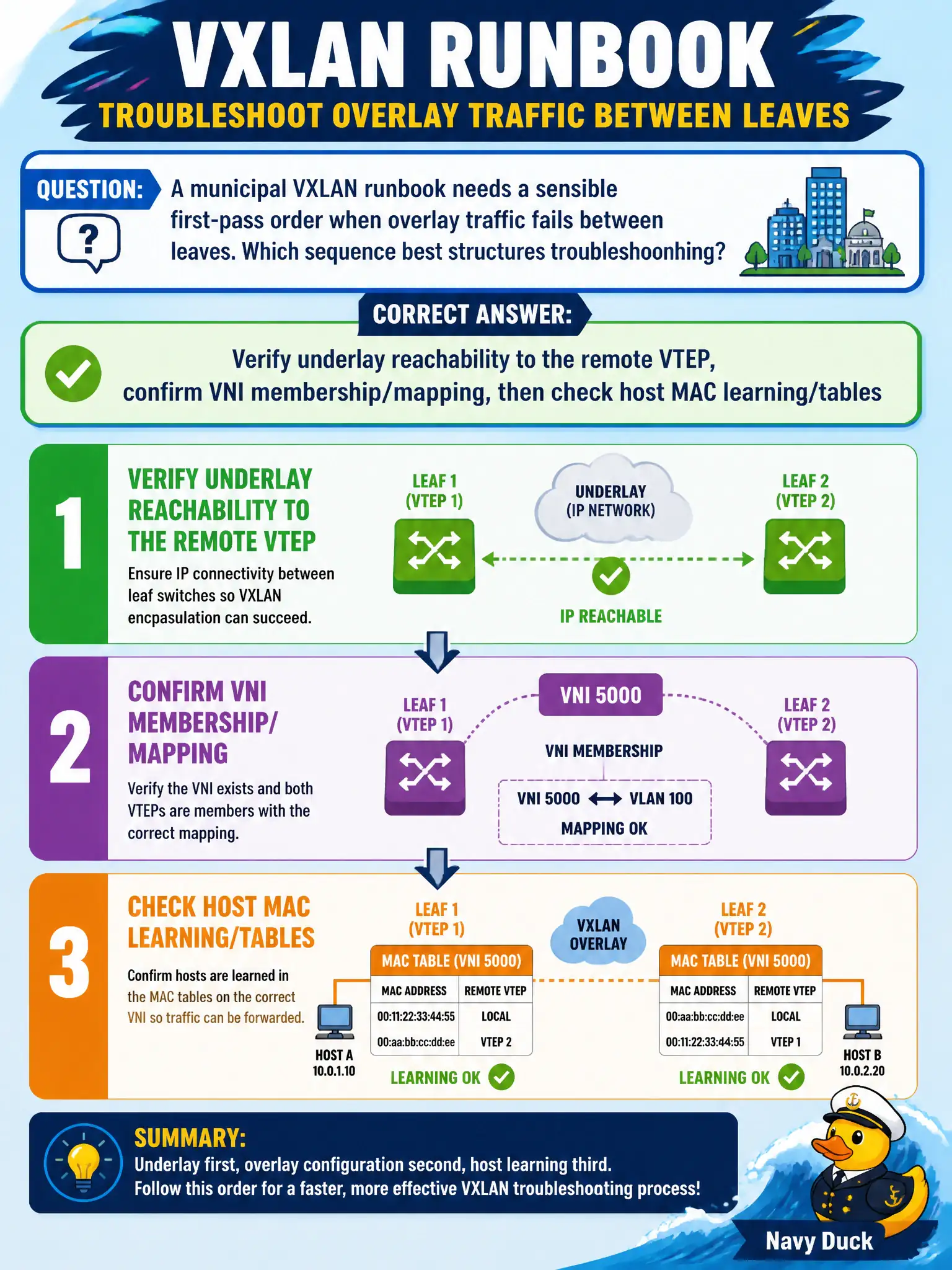
A municipal VXLAN runbook needs a sensible first-pass order when overlay traffic fails between leaves. Which sequence best structures troubleshooting?
Select an answer to reveal the explanation.
Short Explanation
Fix the road, then the hallway membership, then whether the host badge was learned—underlay → VTEP/VNI → MAC table. That order stops you from chasing ghosts in Wireshark on the wrong continent. City runbooks love a boring, repeatable sequence.
Full Explanation
A municipal VXLAN runbook needs a sensible first-pass order when overlay traffic fails between leaves: verify underlay reachability to the remote VTEP, confirm VNI membership/mapping, then check host MAC learning/tables. Encapsulation cannot succeed without underlay IP reachability; membership must align next; host learning is last among these fabric dependencies.
Wiping EVPN first, then redesigning ASN plan, then checking optics last inverts the dependency stack. Replacing host NICs, then disabling all spines, then renumbering every VNI is chaotic and unfocused. Only capturing packets on the Internet edge firewall before touching fabric state skips the structured overlay dependencies.
Exam caveat: underlay → VNI membership/mapping → MAC/host state is the professional first-pass triage order for civic VXLAN failures.
Operational check: execute the three steps in order on a failing pair of leaves, record which step first fails, remediate there, and confirm tenant traffic recovers before expanding scope to ASN redesigns or Internet-edge captures. Post the triage order on the NOC wall and in the municipal IR playbook. Run a game-day drill that injects underlay, membership, and MAC faults separately so staff recognize each class.