
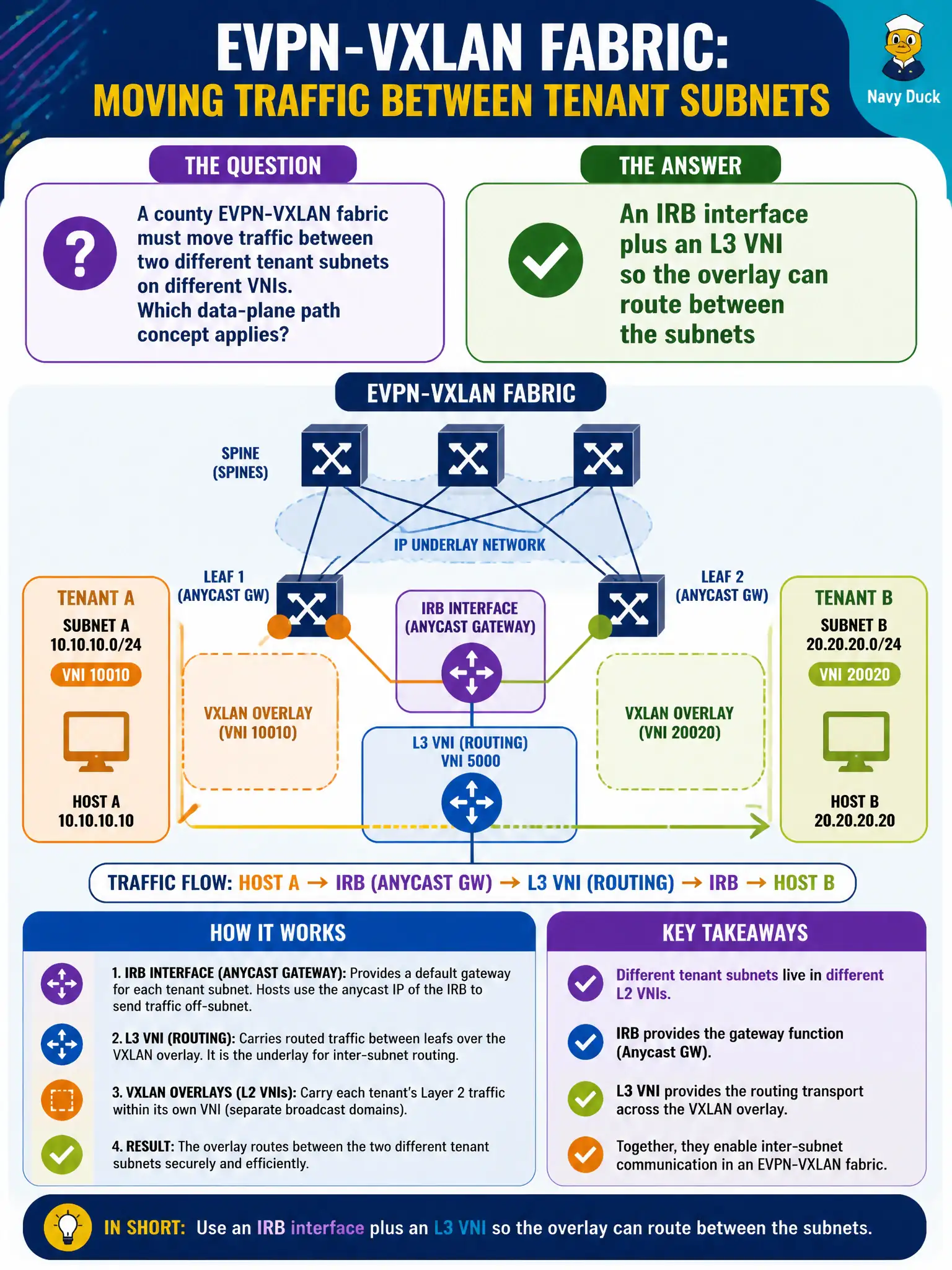
A county EVPN-VXLAN fabric must move traffic between two different tenant subnets on different VNIs. Which data-plane path concept applies?
Select an answer to reveal the explanation.
Short Explanation
Different subnets are different neighborhoods—bridging alone won’t get you there. The leaf’s IRB is the on-ramp to an L3 VNI that routes between those overlay networks. Think city street to highway to another street, not one endless hallway.
Full Explanation
A county EVPN-VXLAN fabric moving traffic between two different tenant subnets on different VNIs needs an IRB interface plus an L3 VNI so the overlay can route between those subnets. Hosts remain on their L2 VNIs for intra-subnet bridging; IRB provides the gateway, and the L3 VNI carries routed overlay traffic between VTEPs according to the fabric’s CRB/ERB placement model.
Only L2 VNIs with spanning-tree extension across the spines do not provide a correct routed overlay path between different subnets. GRE tunnels between the servers themselves, bypassing VTEPs, abandon the fabric overlay design. Static ARP entries on every spine with no leaf IRB configuration do not create inter-subnet EVPN-VXLAN routing.
Exam caveat: inter-subnet EVPN-VXLAN requires IRB plus L3 VNI; L2-only VNIs without IRB leave no proper routed overlay path.
Operational check: configure IRB gateways for two county subnets, associate an L3 VNI, verify relevant EVPN IP-prefix or IRB state, and confirm routed connectivity between hosts on different VNIs while same-subnet bridging still works on each L2 VNI. Fail IRB on one leaf in lab and observe inter-subnet breakage without disturbing same-VNI L2 bridging elsewhere.