
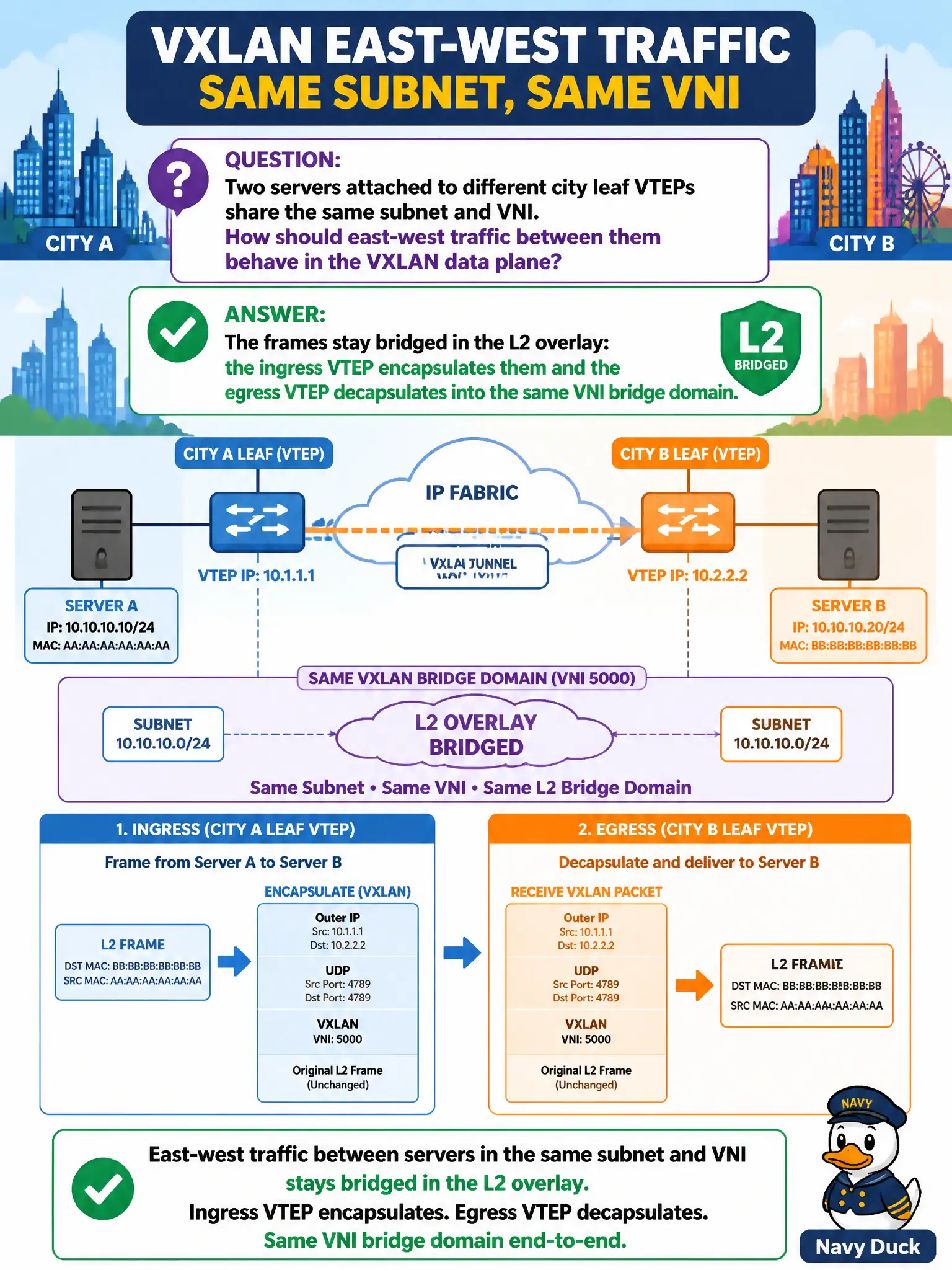
Two servers attached to different city leaf VTEPs share the same subnet and VNI. How should east-west traffic between them behave in the VXLAN data plane?
Select an answer to reveal the explanation.
Short Explanation
Same subnet, same VNI—picture two desks on the same open floor even though they sit in different buildings. VXLAN just stretches that floor across the city’s leaf-spine trucks. The packet gets wrapped, driven across the underlay, unwrapped, and bridged—no IRB detour required for that east-west hop.
Full Explanation
When two servers attached to different city leaf VTEPs share the same subnet and VNI, east-west traffic stays bridged in the L2 overlay: the ingress VTEP encapsulates the Ethernet frames and the egress VTEP decapsulates them into the same VNI bridge domain. IRB and an L3 VNI are not required for ordinary same-subnet communication across VTEPs—those constructs matter when hosts are in different subnets and need overlay routing.
Each packet need not hairpin through a perimeter firewall that strips the VXLAN header before L2 forwarding as a VXLAN data-plane rule. Spines must not terminate the overlay and NAT both hosts into a shared underlay subnet for same-VNI bridging. Inter-leaf same-subnet frames are not dropped merely because an L3 VNI and IRB are absent on every leaf.
Exam caveat: same-subnet/same-VNI equals L2 overlay bridging; IRB/L3 VNI is the inter-subnet story, not the same-subnet default.
Operational check: place two hosts in one subnet/VNI on different leaves, confirm EVPN Type-2 MAC learning, capture VXLAN encap between VTEPs, and verify no IRB hop is required for basic L2 east-west pings on the municipal fabric. Then move one host to a different subnet/VNI and confirm routed overlay now requires IRB/L3 VNI behavior.