
A transit-agency leaf receives a VXLAN packet destined to a server on a local access port. What should the VTEP do in the data plane?
Select an answer to reveal the explanation.
Short Explanation
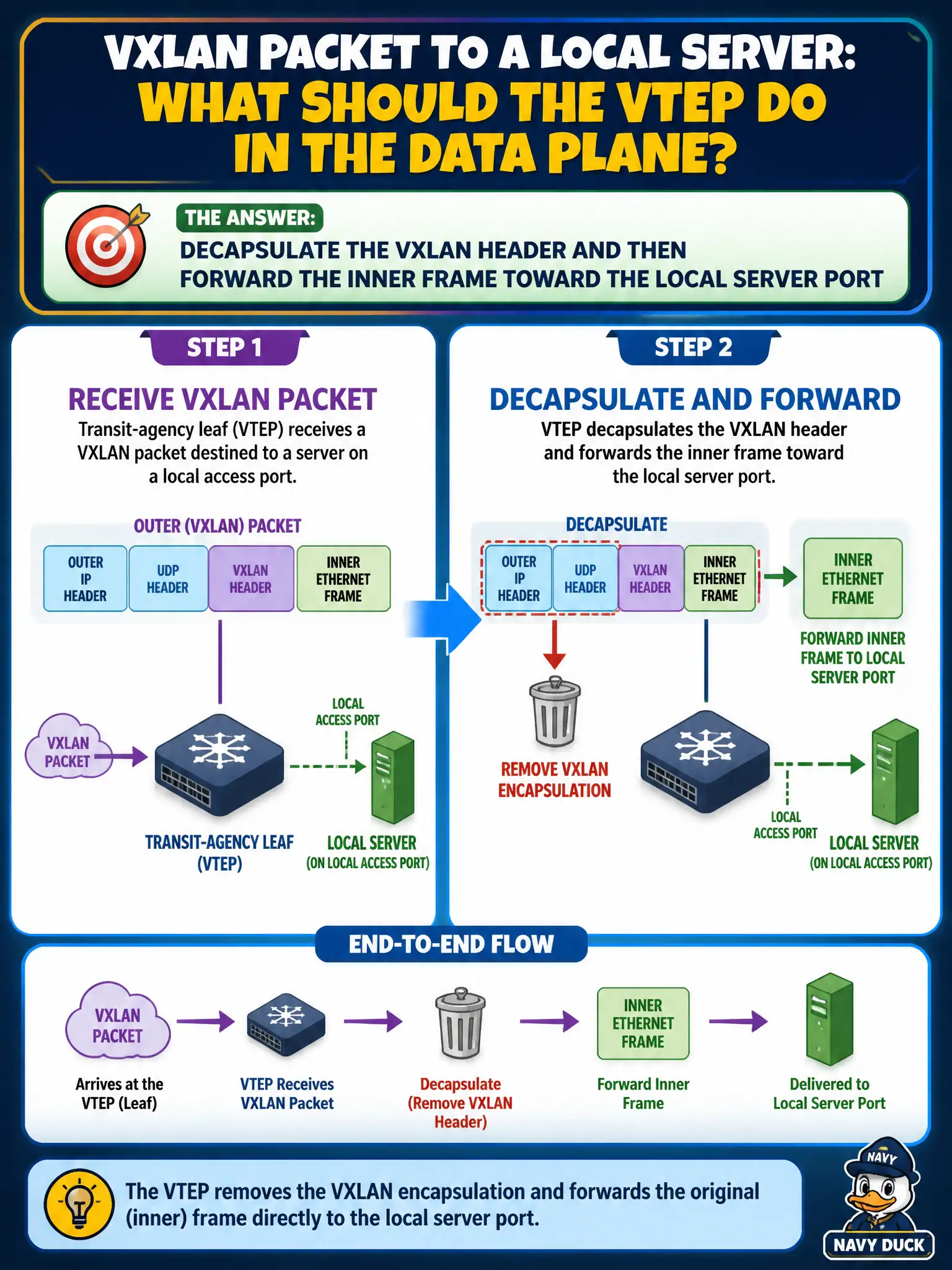
The leaf is the last truck stop: peel the VXLAN wrapper off, then hand the inner frame to the bay where the server lives. Local switching after decap is the whole point of being a VTEP. Leaving the outer header on would be like wheeling the shipping container into the office.
Full Explanation
When a transit-agency leaf receives a VXLAN packet destined to a server on a local access port, the VTEP decapsulates the VXLAN header and then forwards the inner frame toward the local server port. That egress processing recovers the original Ethernet frame and applies ordinary L2 or L3 forwarding in the VNI-mapped bridge domain or IRB context.
The leaf should not reflect the outer UDP packet unchanged toward every spine for further encapsulation when the destination is already local. Converting the packet into an MPLS label stack before any local switching is not VXLAN data-plane behavior. Dropping the packet unless the server MAC was learned only via underlay OSPF confuses underlay VTEP reachability with local MAC/IP forwarding after decap.
Exam caveat: remote VTEP encapsulation ends at the local VTEP with decapsulation plus local forward—not re-encapsulation toward spines for a local host.
Operational check: send traffic to a locally attached host from a remote VTEP, confirm decap counters increment on the transit-agency leaf, and verify the inner frame exits the correct access port without additional VXLAN encapsulation. If decap occurs but the access port is wrong, audit VNI-to-bridge-domain mapping before replacing optics.