
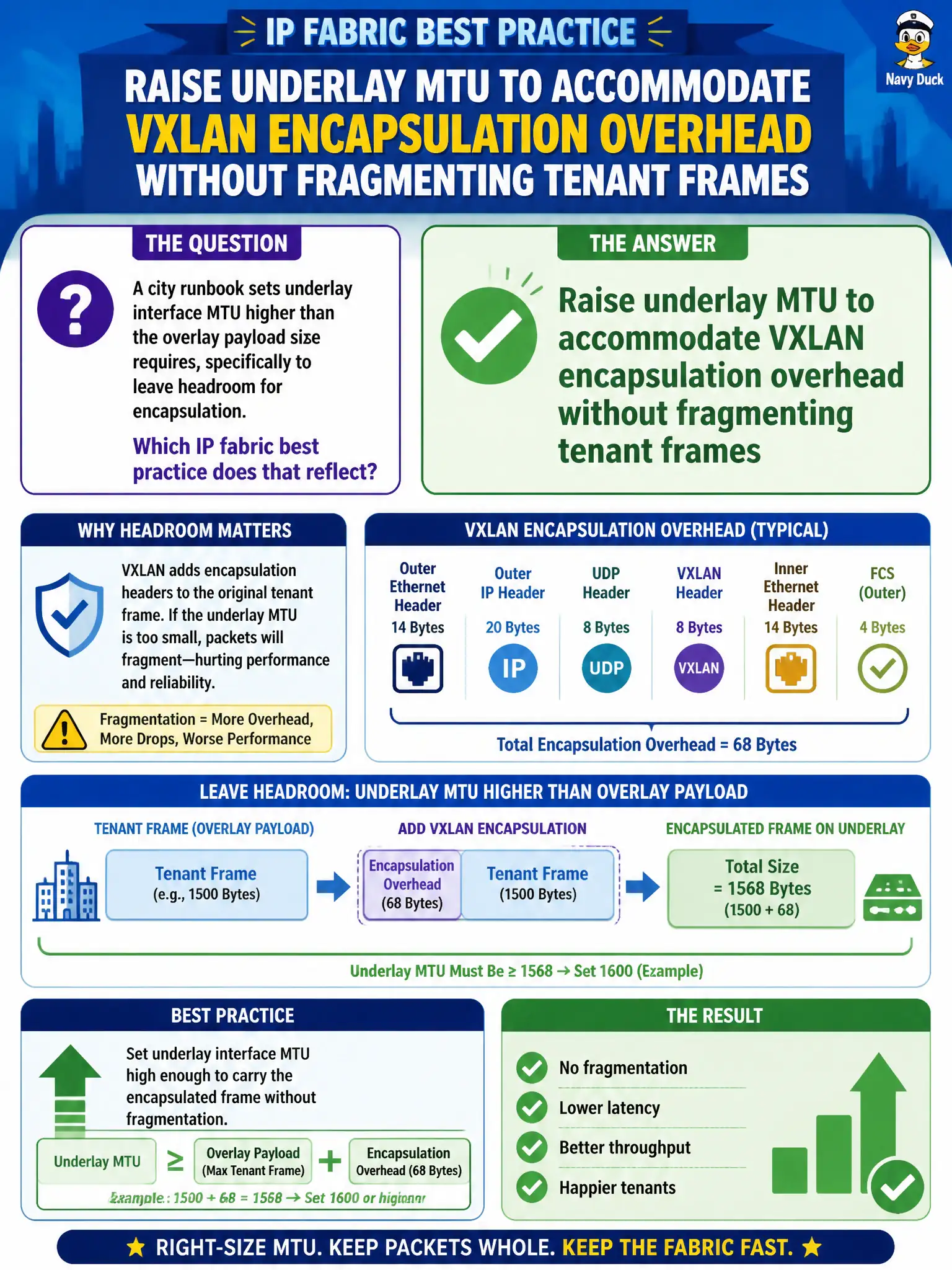
A city runbook sets underlay interface MTU higher than the overlay payload size requires, specifically to leave headroom for encapsulation. Which IP fabric best practice does that reflect?
Select an answer to reveal the explanation.
Short Explanation
VXLAN wraps the original frame like a shipping sleeve—if the truck bed (underlay MTU) is not a bit longer than the box, something gets crushed. Bump underlay MTU so the sleeve fits.
Full Explanation
A city runbook that deliberately sets underlay interface MTU higher than the overlay payload size—to leave headroom for encapsulation—captures a core IP fabric best practice. VXLAN adds outer Ethernet/IP/UDP/VXLAN overhead; without underlay headroom, tenant frames that fit the access MTU become oversized outer packets that blackhole or fragment across the civic Clos. Raising underlay MTU (often to a fabric jumbo standard) prevents that class of silent failure.
Lowering underlay MTU below overlay MTU so VXLAN always fragments in the fabric core is the opposite of hygiene and invites fragile fragmentation behavior. Matching underlay and overlay MTU exactly at 1500 so encapsulation overhead is ignored is a classic MTU-blackhole setup. Disabling jumbo frames anywhere VXLAN is present merely to force TCP MSS clamping is a blunt workaround compared with engineering proper underlay headroom for the designed tenant frame size.
Exam caveat: underlay MTU must exceed tenant MTU by encapsulation overhead; equal 1500 end-to-end is a frequent wrong answer.
Operational check: standardize underlay jumbo MTU on leaves and spines, send maximum planned tenant frames between VTEPs, confirm no underlay fragmentation or drops, and document the overhead budget in the municipal fabric standard.