
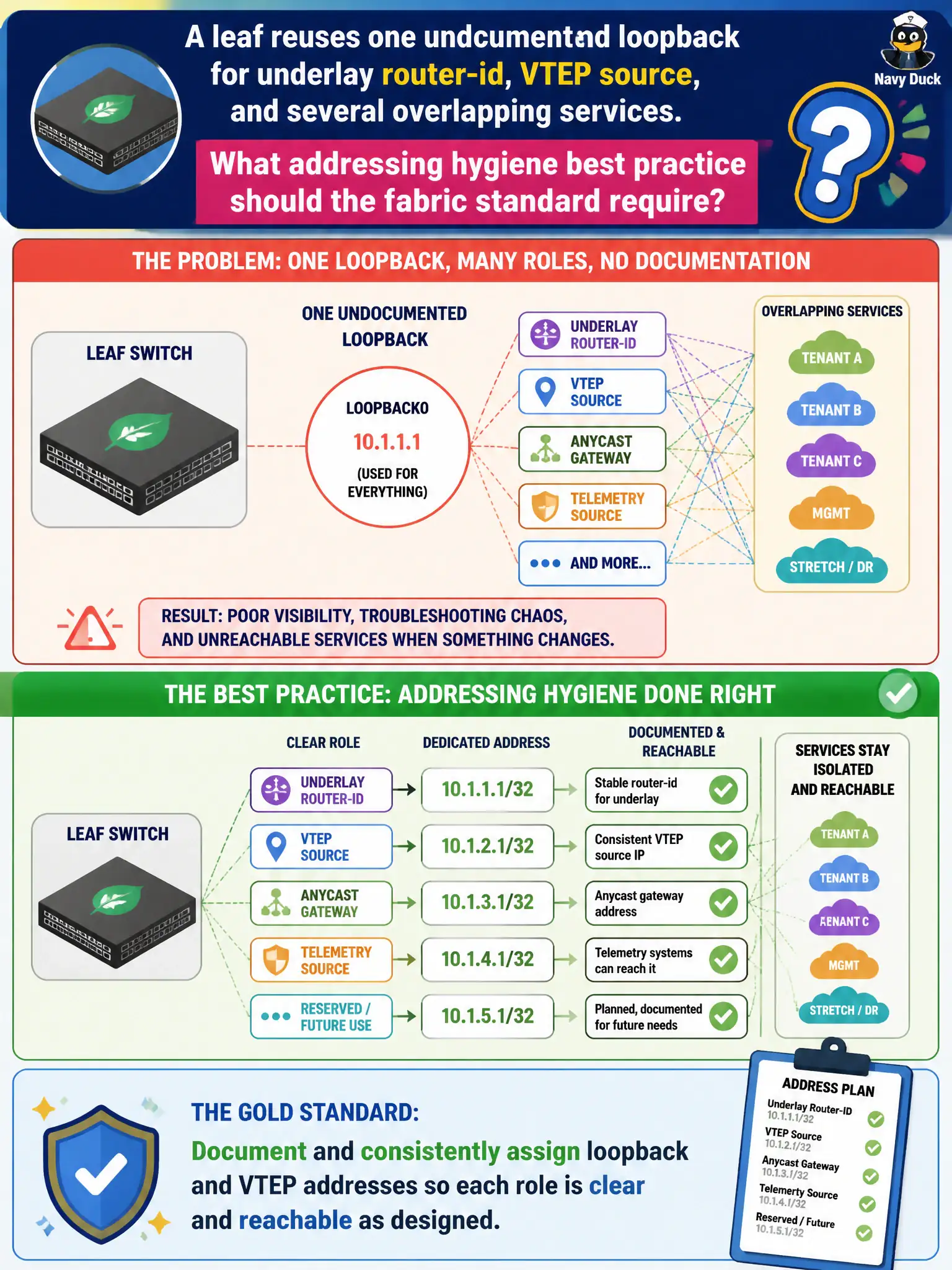
A leaf reuses one undocumented loopback for underlay router-id, VTEP source, and several overlapping services. What addressing hygiene best practice should the fabric standard require?
Select an answer to reveal the explanation.
Short Explanation
One mystery loopback doing five jobs is like one unlabeled master key on the janitor’s ring—fine until something breaks at 2 a.m. Give VTEP and underlay roles clear, documented addresses.
Full Explanation
When a leaf reuses one undocumented loopback for underlay router-id, VTEP source, and overlapping services, the fabric standard should require documented, consistent assignment of loopback and VTEP addresses so each role is clear and reachable as designed. Predictable VTEP sources that are advertised distinctly from other roles keep overlays and underlay troubleshooting separable during civic incidents.
Deriving VTEP addresses randomly per reboot so overlays cannot be fingerprinted destroys stable underlay reachability and is not a security best practice for production fabrics. Using only link-local addresses for VTEPs and never advertising them in the underlay leaves remote VTEPs unable to route to the tunnel endpoint. Placing all VTEP addresses in the same /32 as the default gateway anycast IP on every VLAN collides overlay endpoint identity with gateway anycast and creates forwarding chaos.
Exam caveat: stable, role-documented VTEP/loopback addressing is an operations best-practice theme; convenience reuse is the anti-pattern.
Operational check: audit leaves for unique documented loopback roles; traceroute VTEP addresses across the fabric from remote VTEPs; ensure anycast gateway IPs are not reused as VTEP sources.