
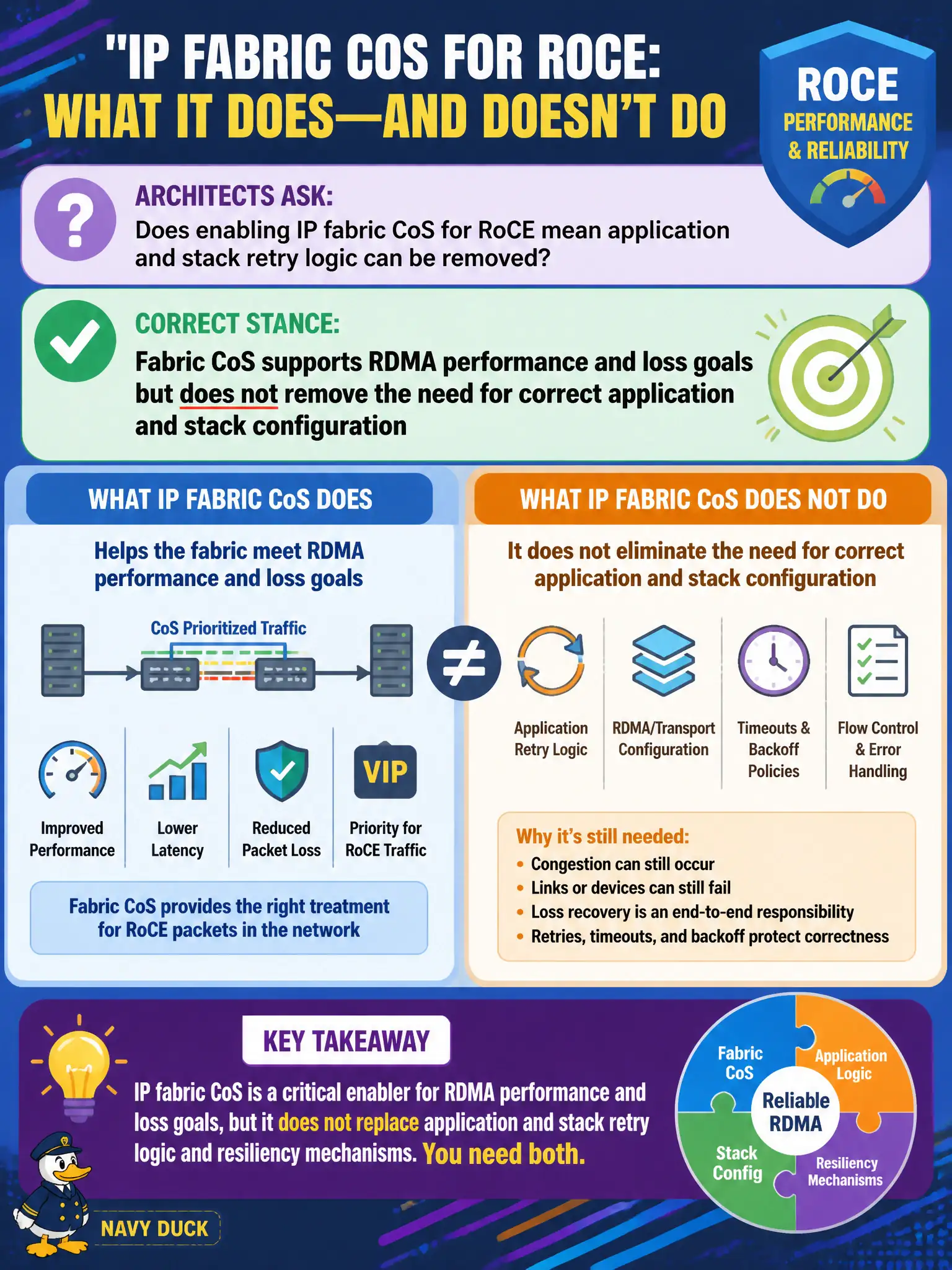
Architects ask whether enabling IP fabric CoS for RoCE means application and stack retry logic can be removed. What is the correct stance?
Select an answer to reveal the explanation.
Short Explanation
Nice roads help the delivery truck, but the driver still has to know the route. Fabric CoS backs RoCE performance—it does not let you delete stack settings and hope pause frames do all the thinking.
Full Explanation
Fabric CoS for RoCE on a municipal IP fabric supports RDMA performance and loss goals but does not remove the need for correct application and stack configuration. NICs still need proper MTU, markings, congestion control, and RDMA parameters; applications still need sane timeouts and recovery. Pause frames and ECN are network assistance layers, not a permanent zero-loss warranty that lets the city delete endpoint engineering.
Fabric CoS does not fully replace RDMA stack configuration because pause frames somehow guarantee zero loss forever. Once PFC is enabled, operators should not permanently disable all congestion control in NIC firmware as a policy. RoCE does not require turning CoS off so the application’s retry timers remain the only recovery mechanism—that undercuts the very fabric design the architects are asking about.
Exam caveat: network CoS and endpoint/stack tuning are complementary; trap answers claim one layer fully substitutes for the other.
Operational check: validate NIC PFC/ECN and MTU settings in the same change window as fabric CoS; induce congestion in a lab pod and confirm both network marks/pauses and stack rate control behave per the civic runbook before promoting the design to production GPUs.