
After enabling lossless queues for RoCE, a microburst still drops UDP telemetry on county leaves. What CoS tradeoff should the team recognize?
Select an answer to reveal the explanation.
Short Explanation
Giving the glass elevator reserved brakes means somebody else’s cart may hit the floor first. When you shield RoCE, scavenger or telemetry queues can still drop in a microburst—that is the tradeoff, not a bug in VXLAN.
Full Explanation
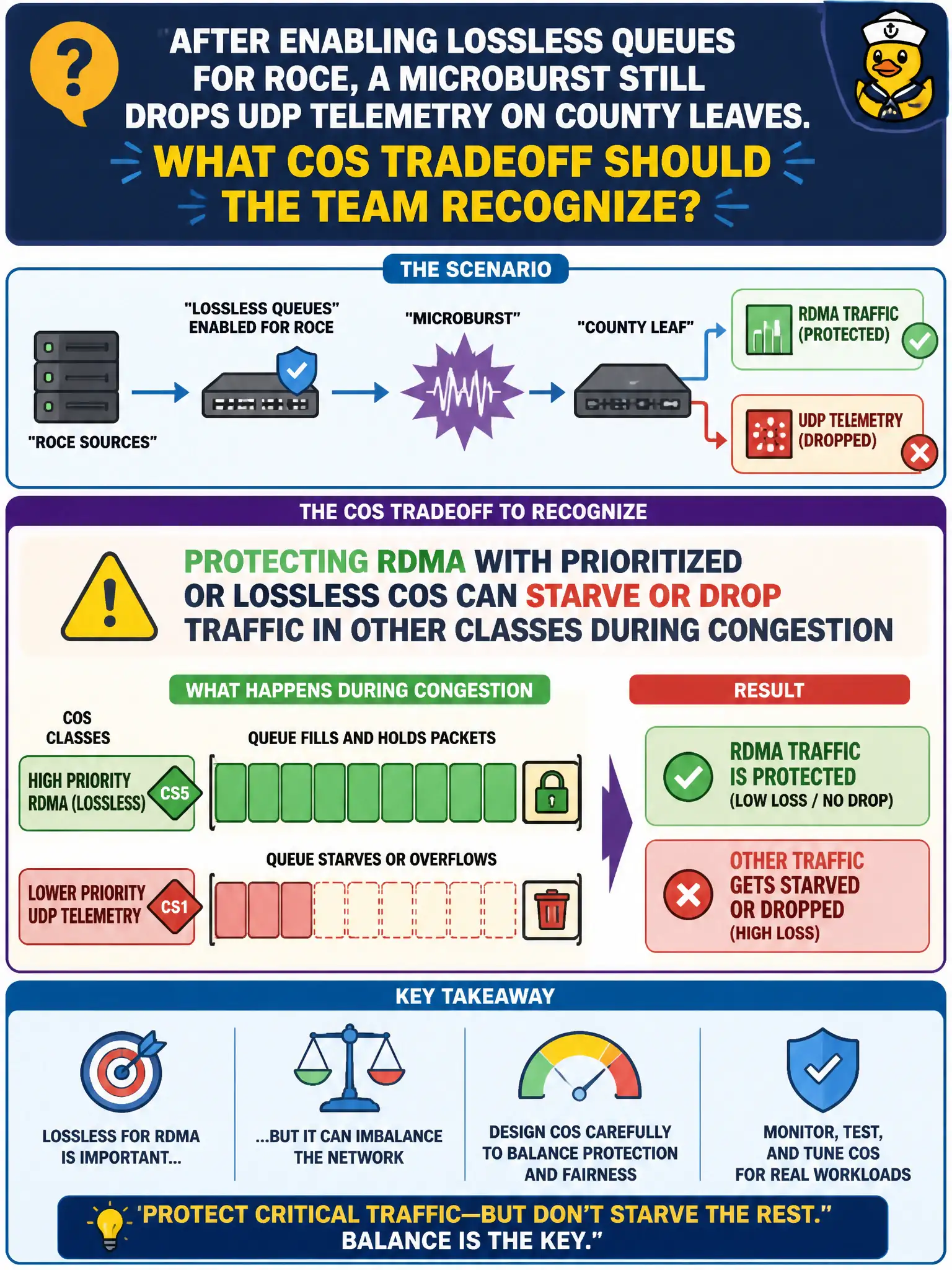
After enabling lossless queues for RoCE, a microburst that still drops UDP telemetry on county leaves illustrates Class of Service as a zero-sum system under congestion. Protecting RDMA with prioritized or lossless CoS consumes buffer and scheduler resources that other classes no longer have, so telemetry or best-effort flows can drop even while RoCE stays healthier. Recognizing that tradeoff prevents false expectations that “lossless somewhere” means “lossless everywhere.”
Lossless configuration does not guarantee every other class receives unlimited buffer under microbursts. UDP telemetry does not always preempt RoCE once PFC is enabled anywhere in the pod. Microbursts can affect non-RDMA classes whether or not VXLAN is enabled on the VTEPs—overlay enablement does not create free silicon buffers for every queue.
Exam caveat: professional answers acknowledge opportunity cost: privileging RoCE can increase loss for monitoring and scavenger classes during bursts.
Operational check: run a controlled microburst while RoCE lossless is enabled; compare drop and PFC counters on RoCE versus telemetry classes; if county monitoring SLOs break, retune scheduler weights, isolate telemetry paths, or add capacity rather than assuming PFC made all traffic safe.