
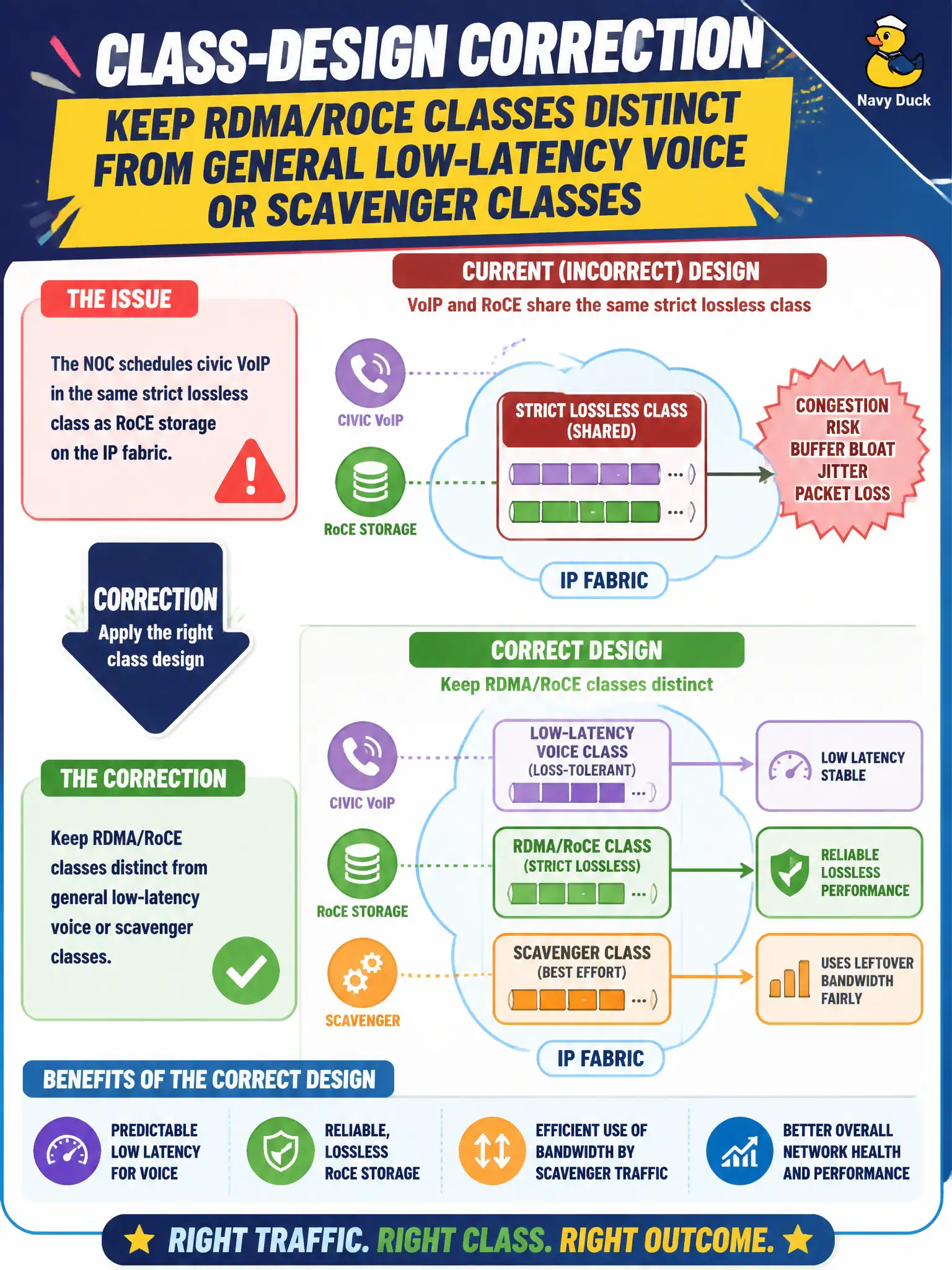
The NOC schedules civic VoIP in the same strict lossless class as RoCE storage on the IP fabric. What class-design correction is appropriate?
Select an answer to reveal the explanation.
Short Explanation
VoIP and RoCE both hate delay, but they are not the same animal—one wants low latency, the other wants a carefully built lossless track. Give them separate classes instead of cramming city phones onto the GPU freight elevator.
Full Explanation
Scheduling civic VoIP in the same strict lossless class as RoCE storage conflates incompatible application needs. Keep RDMA/RoCE classes distinct from general low-latency voice or scavenger classes: RoCE often depends on PFC/ECN-aware lossless treatment, while municipal VoIP needs low-latency priority without sharing pause domains that can stall or be stalled by storage microbursts.
Merging VoIP, RoCE, and bulk backup into one shared PFC-enabled queue for “simplicity” creates cross-coupled pause storms and unfair scheduler contention across unrelated apps. Placing VoIP in the scavenger class so RoCE monopolizes all scheduler weight harms voice quality and is not an appropriate civic CoS tradeoff. Disabling marking for both VoIP and RoCE and relying on ECMP fairness alone abandons intentional differentiation the fabric CoS system exists to provide.
Exam caveat: separate classes by application physics; “one big lossless queue for everything important” is a recurring wrong answer.
Operational check: verify distinct queue/class mappings for VoIP versus RoCE on leaf and spine; induce congestion and confirm voice remains low-latency without PFC sharing the RoCE lossless domain, while RoCE retains its engineered treatment.