
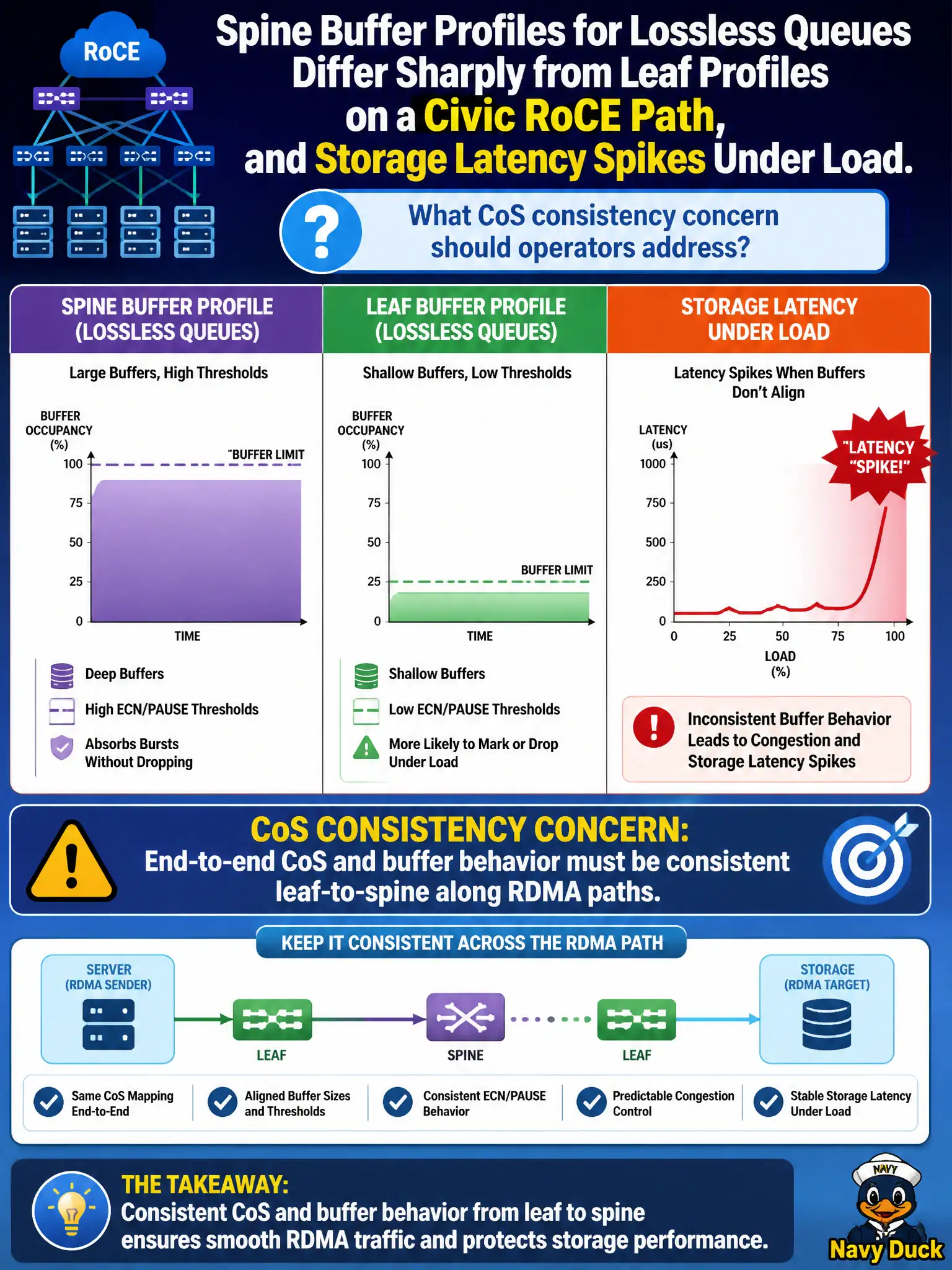
Spine buffer profiles for lossless queues differ sharply from leaf profiles on a civic RoCE path, and storage latency spikes under load. What CoS consistency concern should operators address?
Select an answer to reveal the explanation.
Short Explanation
A lossless lane that turns into a bumpy dirt road at the spine still wrecks the glass elevator. RDMA needs matching CoS/buffer intent from leaf through spine, not a leaf-only science project.
Full Explanation
Spine buffer profiles for lossless queues that differ sharply from leaf profiles on a civic RoCE path create congestion hotspots even when access-port classification looks correct. End-to-end CoS and buffer behavior must be consistent leaf-to-spine along RDMA paths—shared understanding of classification, scheduling, PFC/ECN treatment, and buffer contracts—or storage latency spikes under load as the Clos forwards encapsulated RoCE across mismatched hops.
RoCE does not require identical BGP ASN values on leaves and spines more than matching queue behavior; ASN sameness does not heal buffer mismatch. Claiming only the leaf CoS matters because spines never queue RDMA traffic in a Clos is false—spines forward and queue VXLAN-encapsulated RDMA packets on fabric links. Configuring lossless classes solely on access ports facing servers and never on fabric uplinks leaves the leaf-spine hop unprotected, which is exactly where many municipal RoCE designs fail.
Exam caveat: when the stem contrasts leaf versus spine lossless profiles, the correct theme is path-consistent CoS, not ASN matching or access-only PFC.
Operational check: export CoS and buffer profiles for the RoCE class on leaf access, leaf fabric uplink, and spine ports; align them to the city standard; remeasure GPU/storage latency plus PFC/ECN counters under the same synthetic load before and after alignment.