
A township engineer asks why modern RoCE-capable IP fabrics bother with Explicit Congestion Notification. What role does ECN play?
Select an answer to reveal the explanation.
Short Explanation
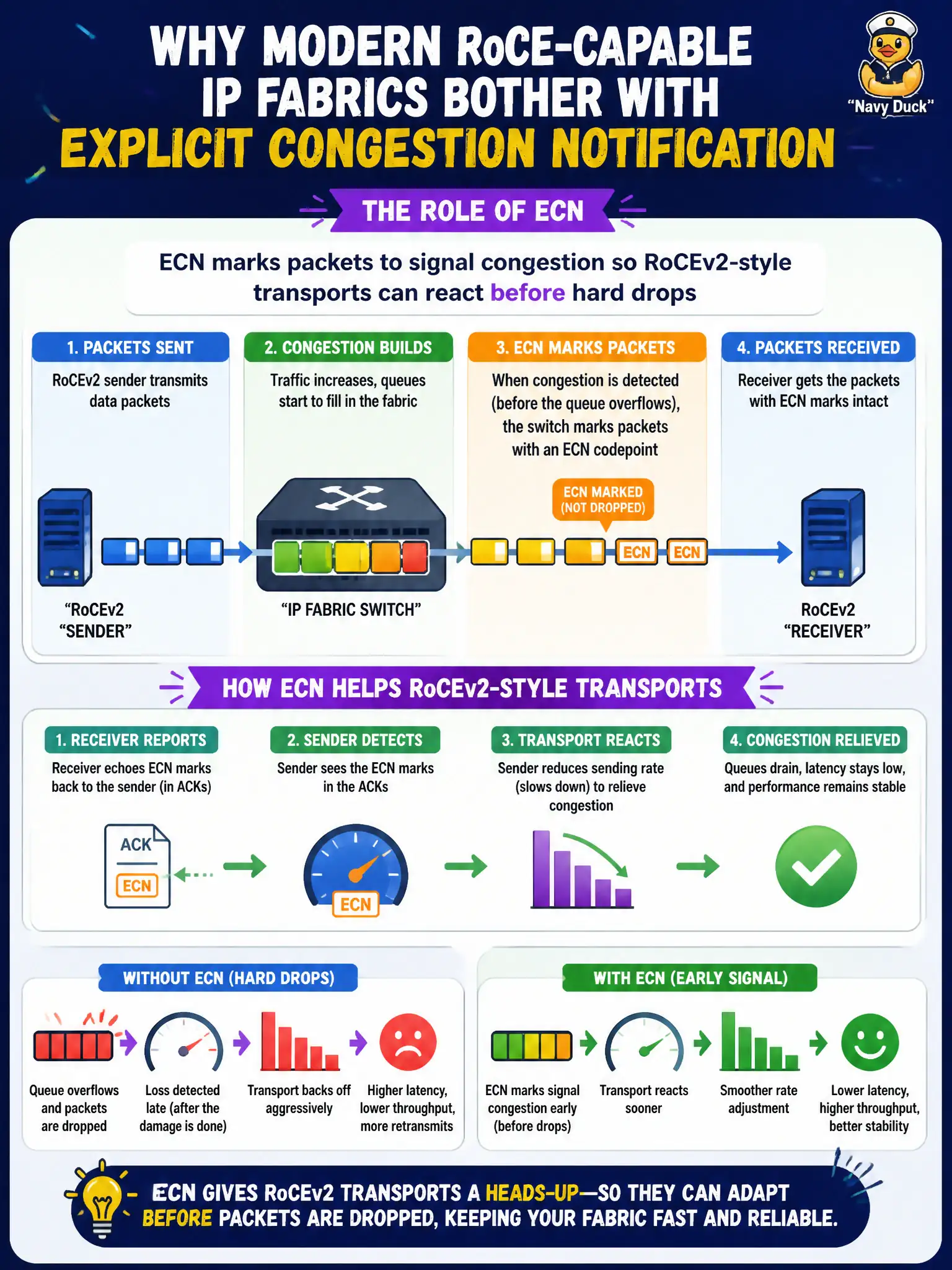
ECN is the yellow traffic light for RDMA stacks—it waves “slow down” before you smash into a red drop. That early signal is why it shows up in modern RoCE fabric CoS designs.
Full Explanation
Modern RoCE-capable municipal IP fabrics use Explicit Congestion Notification so leaf and spine queues can mark packets as they build, informing RoCEv2-style transports to reduce rate before hard tail drops destroy GPU storage performance. For a township engineer asking why fabrics bother with ECN, the answer is early congestion feedback that complements careful classification and, where used, PFC—giving endpoints a chance to react without relying solely on pause storms or irreversible loss.
ECN does not replace VXLAN by encoding tenant IDs in the IP TOS field; overlay identity remains the VNI plus the EVPN control plane, not a congestion mark. ECN does not disable all buffering so spines never store RoCE packets; buffers still exist, and ECN’s value is marking as those queues fill. ECN is not used to authenticate BGP sessions between leaf and spine—session security is a separate control-plane concern unrelated to data-plane congestion signaling.
Exam caveat: JN0-683-style RoCE items often test that ECN is proactive congestion feedback; do not confuse it with encryption, overlay segmentation, or BGP authentication distractors.
Operational check: enable ECN marking on the RDMA class leaf-to-spine across the township pod, generate controlled congestion, verify congestion-experienced marks increment in telemetry, and confirm the RoCE stack reduces rate rather than only showing drop counters after the fact.