
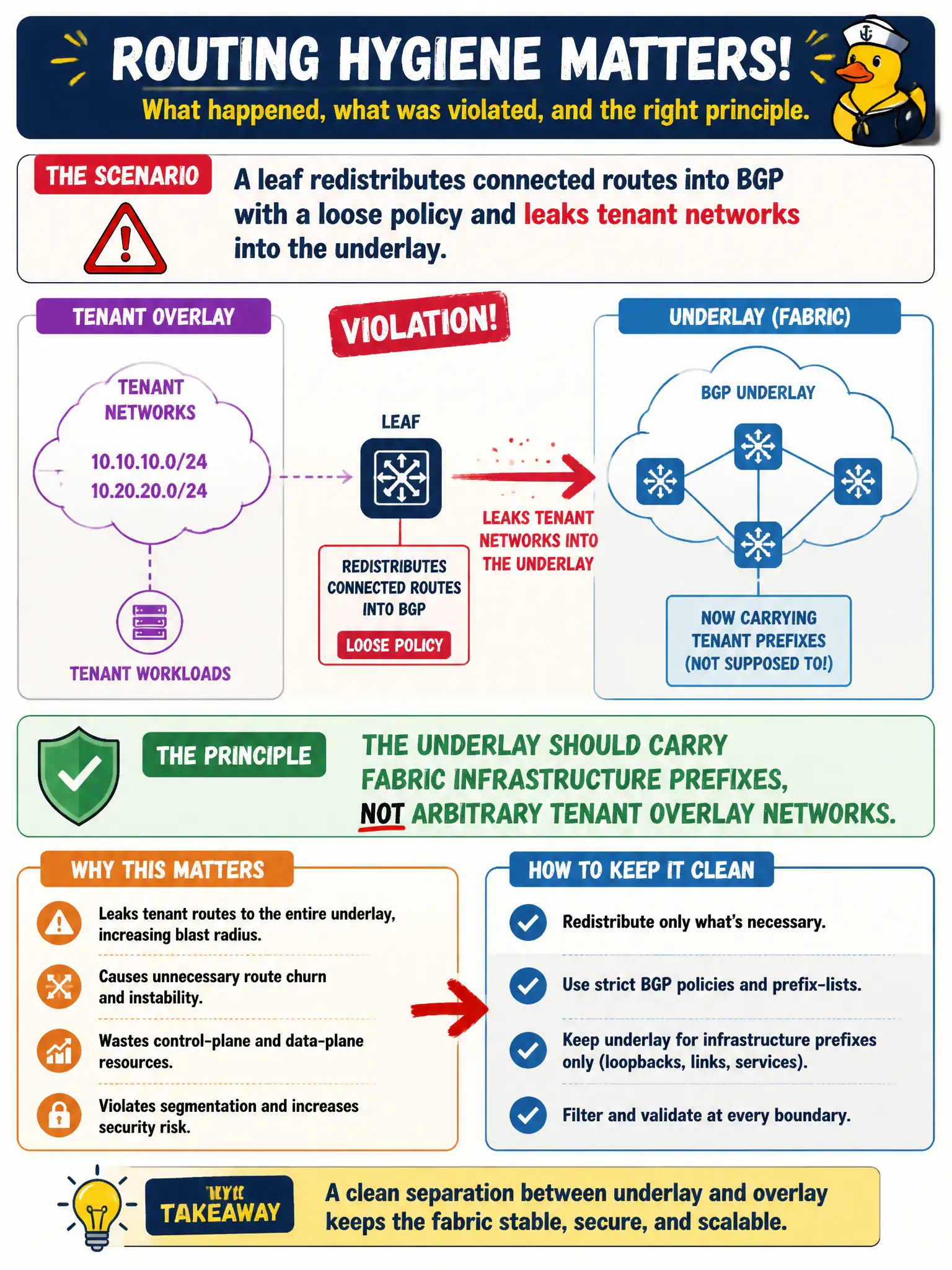
A leaf redistributes connected routes into BGP with a loose policy and leaks tenant networks into the underlay. What routing-hygiene principle did the fabric violate?
Select an answer to reveal the explanation.
Short Explanation
The underlay phone book should list fabric infrastructure—not every tenant hallway. Loose redistribution spills department nets into the Clos and makes troubleshooting miserable. Keep tenant reachability in the overlay/tenant control plane where it belongs.
Full Explanation
The underlay should carry fabric infrastructure prefixes, not arbitrary tenant overlay networks—violated when loose redistribution leaks tenant nets into underlay BGP. Tenant prefixes need not flood the underlay so spines can bridge without overlays. Loose redistribution is not preferred to guarantee ECMP for every VLAN. Not every connected printer/IoT VLAN is required underlay content. Exam caveat: Export policy discipline keeps overlay boundaries clear and troubleshooting sane. Operational check: Audit underlay BGP tables for tenant prefixes, tighten export policy, and confirm only infrastructure prefixes remain. In civic data-center operations, record the expected CLI or collector evidence for this concept so the next on-call engineer can validate fabric behavior without re-deriving the design under incident pressure. In civic data-center operations, record the expected CLI or collector evidence for this concept so the next on-call engineer can validate fabric behavior without re-deriving the design under incident pressure. In civic data-center operations, record the expected CLI or collector evidence for this concept so the next on-call engineer can validate fabric behavior without re-deriving the design under incident pressure.