
The city IBGP fabric has grown past a comfortable full mesh among leaves. Which scaling approach fits IP fabric underlay practice?
Select an answer to reveal the explanation.
Short Explanation
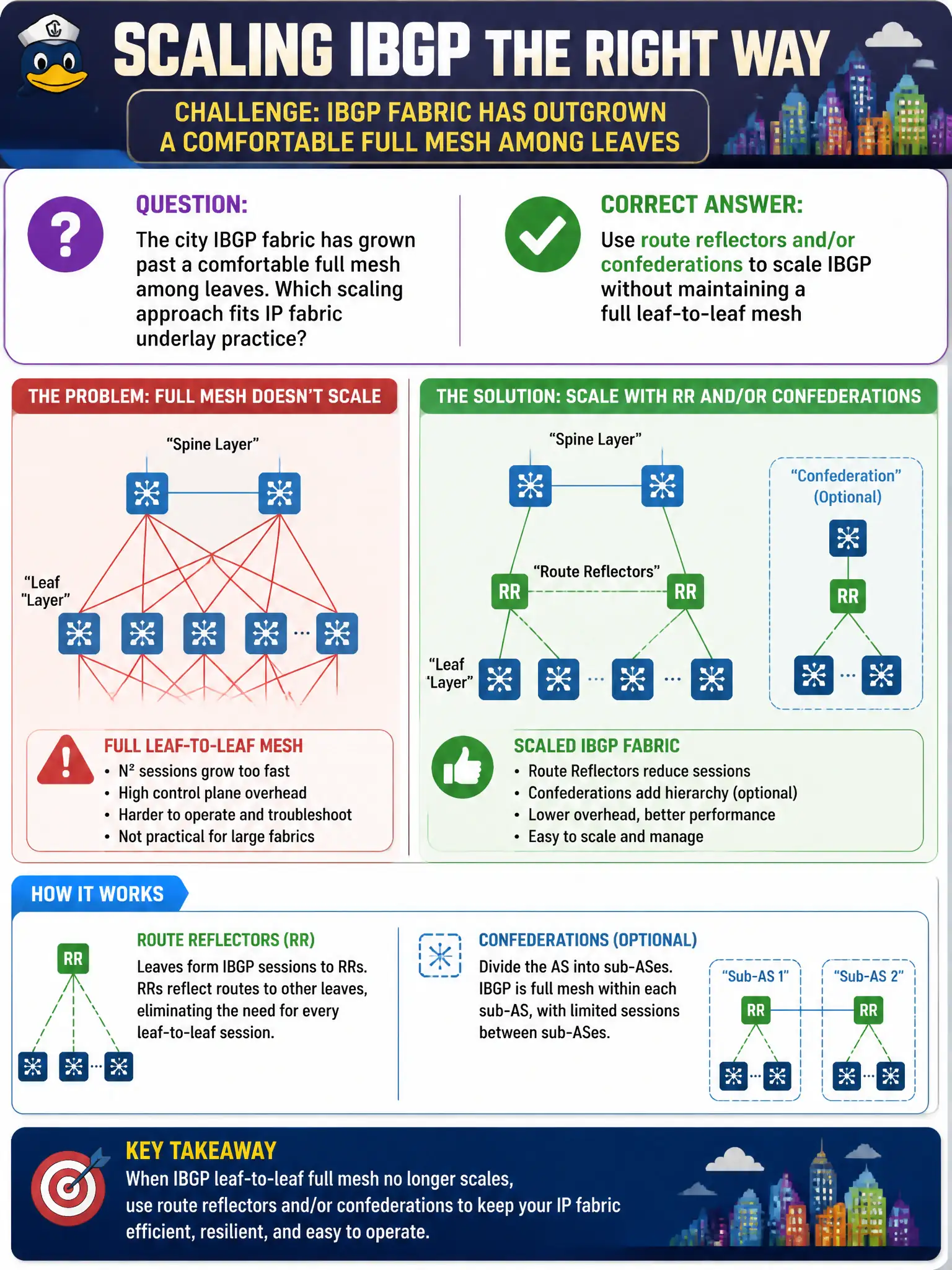
Full-mesh IBGP is a dinner party that does not scale—eventually you need hosts who repeat the gossip. Route reflectors (and sometimes confederations) keep the city fabric growing without every leaf peering every other leaf. Do not “solve” mesh pain with STP.
Full Explanation
Use route reflectors and/or confederations to scale IBGP without maintaining a full leaf-to-leaf mesh when the city fabric outgrows comfortable full mesh. Collapsing to a single spine ASN and disabling multipath is not the scaling approach. Replacing IBGP with STP does not solve mesh scale in an IP fabric. Advertising every tenant /32 into the underlay increases scale pressure rather than relieving session mesh. Exam caveat: Align reflector placement—often on spines—with client and policy design. Operational check: Migrate a lab full mesh to spine route reflectors and confirm prefix propagation with far fewer leaf-leaf sessions. In civic data-center operations, record the expected CLI or collector evidence for this concept so the next on-call engineer can validate fabric behavior without re-deriving the design under incident pressure. In civic data-center operations, record the expected CLI or collector evidence for this concept so the next on-call engineer can validate fabric behavior without re-deriving the design under incident pressure. In civic data-center operations, record the expected CLI or collector evidence for this concept so the next on-call engineer can validate fabric behavior without re-deriving the design under incident pressure.