
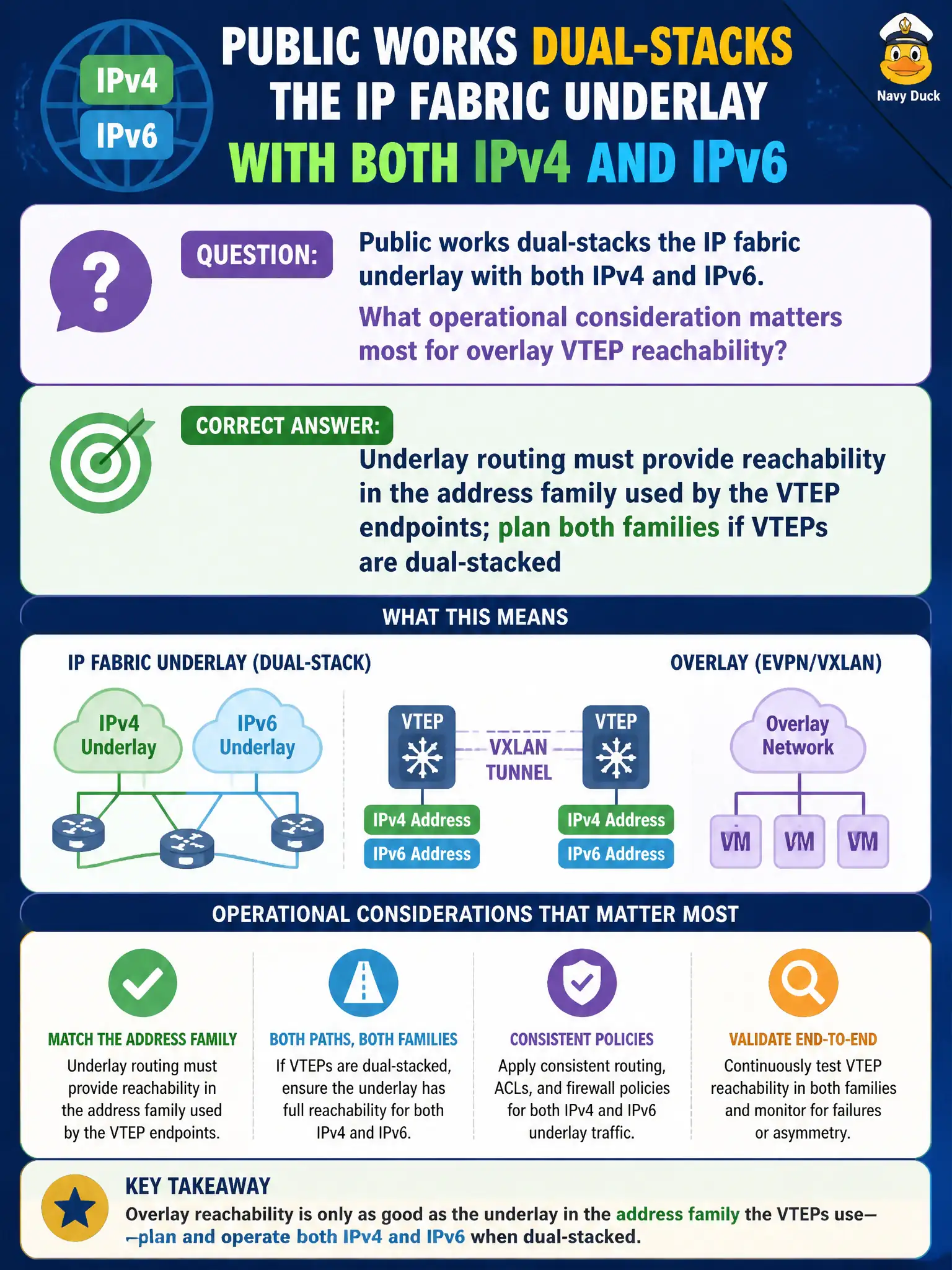
Public works dual-stacks the IP fabric underlay with both IPv4 and IPv6. What operational consideration matters most for overlay VTEP reachability?
Select an answer to reveal the explanation.
Short Explanation
If the VTEP speaks IPv6, the underlay needs an IPv6 road to it—same idea for IPv4. Dual-stack means two maps, not magic translation. Pick the families your tunnels actually use and route them.
Full Explanation
Underlay routing must provide reachability in the address family used by VTEP endpoints; if public works dual-stacks, plan both families when VTEPs are dual-stacked. Dual-stack does not forbid VXLAN or require deleting one family before overlays work. IPv6 underlay does not automatically advertise IPv4 VTEPs without configuration. IPv6 is not limited to management VRFs while only IPv4 may carry fabric ECMP on Junos fabrics. Exam caveat: Treat each family as a first-class underlay plane for the tunnels you actually use. Operational check: For each VTEP address family in use, verify remote underlay routes and successful overlay establishment. In civic data-center operations, record the expected CLI or collector evidence for this concept so the next on-call engineer can validate fabric behavior without re-deriving the design under incident pressure. In civic data-center operations, record the expected CLI or collector evidence for this concept so the next on-call engineer can validate fabric behavior without re-deriving the design under incident pressure. In civic data-center operations, record the expected CLI or collector evidence for this concept so the next on-call engineer can validate fabric behavior without re-deriving the design under incident pressure.