
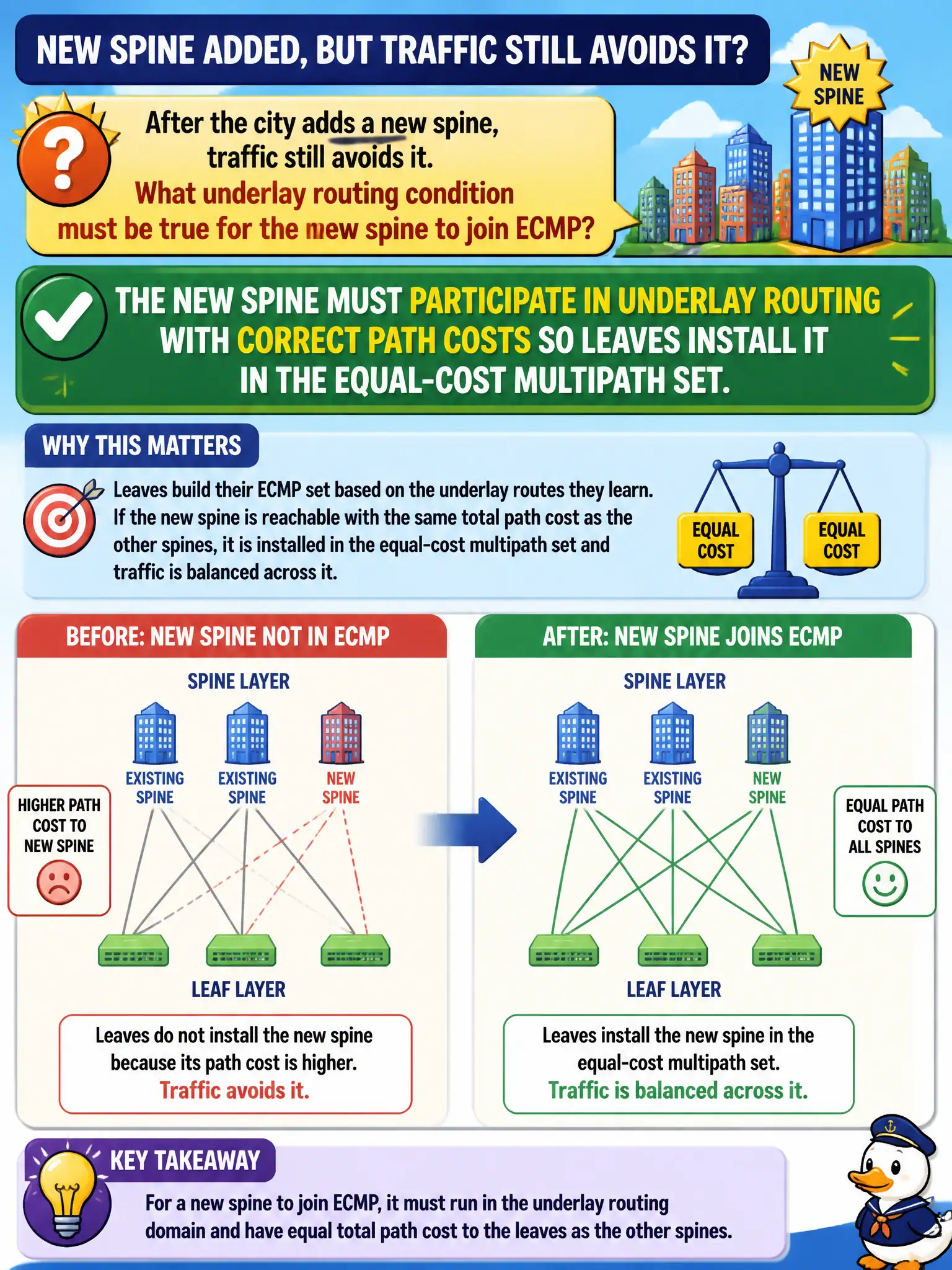
After the city adds a new spine, traffic still avoids it. What underlay routing condition must be true for the new spine to join ECMP?
Select an answer to reveal the explanation.
Short Explanation
A dark spine with no routing story is just an expensive shelf. It has to peer, advertise, and cost the same—or better, equally—before ECMP invites it to the party. Cable glow is not enough.
Full Explanation
After adding a spine, it joins ECMP only when it participates in underlay routing with correct path costs so leaves install it in the equal-cost multipath set. Power and L1 light alone are insufficient; routing adjacency is required. Leaves must not disable BGP multipath until the new spine is STP root. Shutting all existing spines to force traffic is not proper commissioning. Exam caveat: Commissioning includes sessions, prefix exchange, metrics, and multipath verification. Operational check: After adding the spine, confirm BGP/IGP up, equal costs, and traffic counters increment on the new uplinks. In civic data-center operations, record the expected CLI or collector evidence for this concept so the next on-call engineer can validate fabric behavior without re-deriving the design under incident pressure. In civic data-center operations, record the expected CLI or collector evidence for this concept so the next on-call engineer can validate fabric behavior without re-deriving the design under incident pressure. In civic data-center operations, record the expected CLI or collector evidence for this concept so the next on-call engineer can validate fabric behavior without re-deriving the design under incident pressure.