
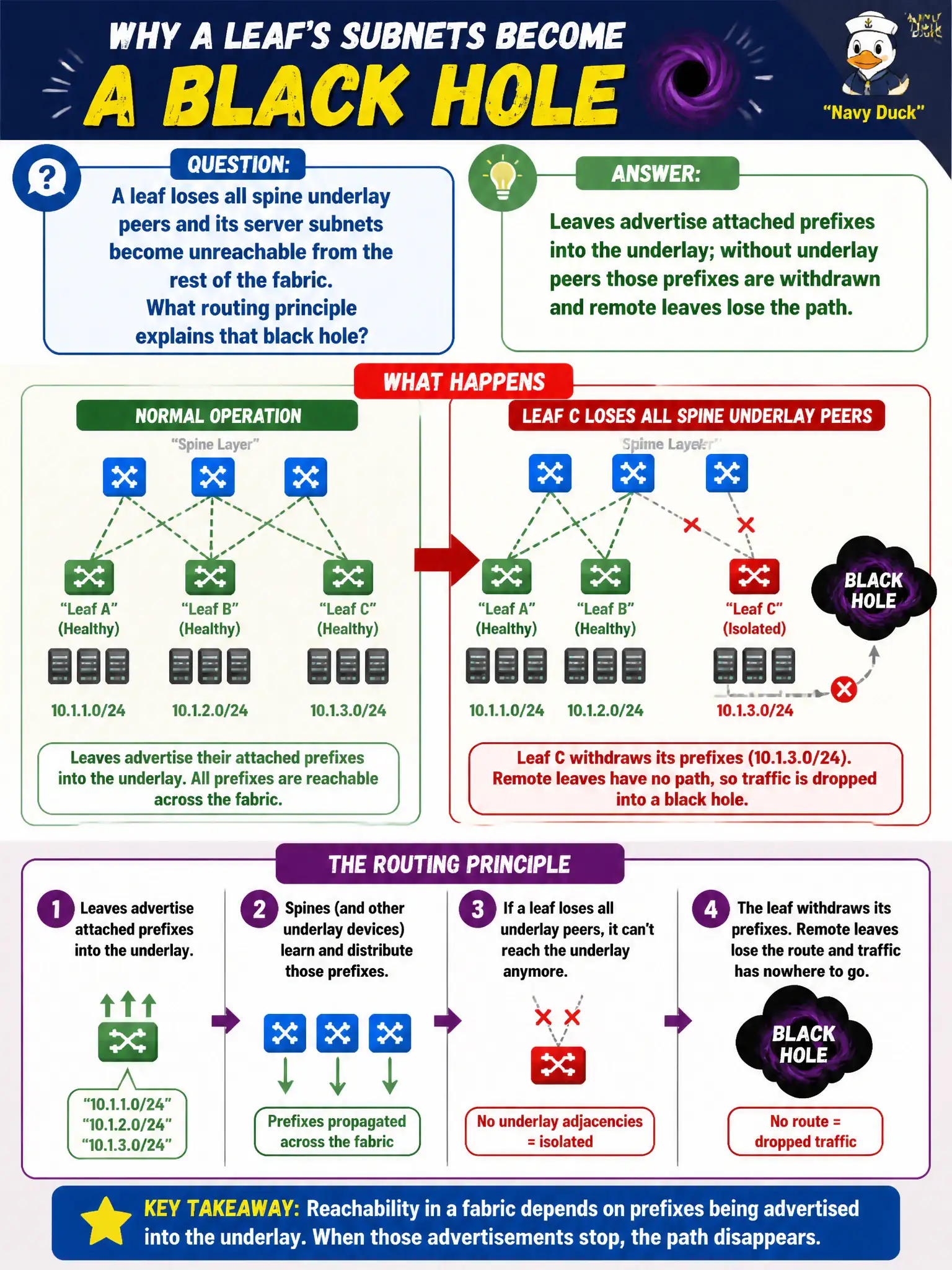
A leaf loses all spine underlay peers and its server subnets become unreachable from the rest of the civic fabric. What routing principle explains that black hole?
Select an answer to reveal the explanation.
Short Explanation
If the leaf cannot talk to any spine, it cannot tell the fabric “these server nets live here”—and remote leaves stop knowing the path. Peer loss withdraws the underlay advertisement. Overlay magic does not float without underlay reachability.
Full Explanation
Leaves advertise attached prefixes into the underlay; without underlay peers those prefixes are withdrawn and remote leaves lose the path—explaining black holes when a leaf loses all spine peers. Server subnets are not independently flooded L2 across a routed Clos underlay. Spines do not permanently retain leaf prefixes for 24 hours making ACLs the only explanation. VXLAN does not bridge server subnets without underlay reachability to the leaf/VTEP. Exam caveat: Overlay encapsulation still needs underlay IP reachability to endpoints. Operational check: Shut all spine peers on a lab leaf and confirm remote withdrawal of its prefixes and loss of reachability. In civic data-center operations, record the expected CLI or collector evidence for this concept so the next on-call engineer can validate fabric behavior without re-deriving the design under incident pressure. In civic data-center operations, record the expected CLI or collector evidence for this concept so the next on-call engineer can validate fabric behavior without re-deriving the design under incident pressure. In civic data-center operations, record the expected CLI or collector evidence for this concept so the next on-call engineer can validate fabric behavior without re-deriving the design under incident pressure.