
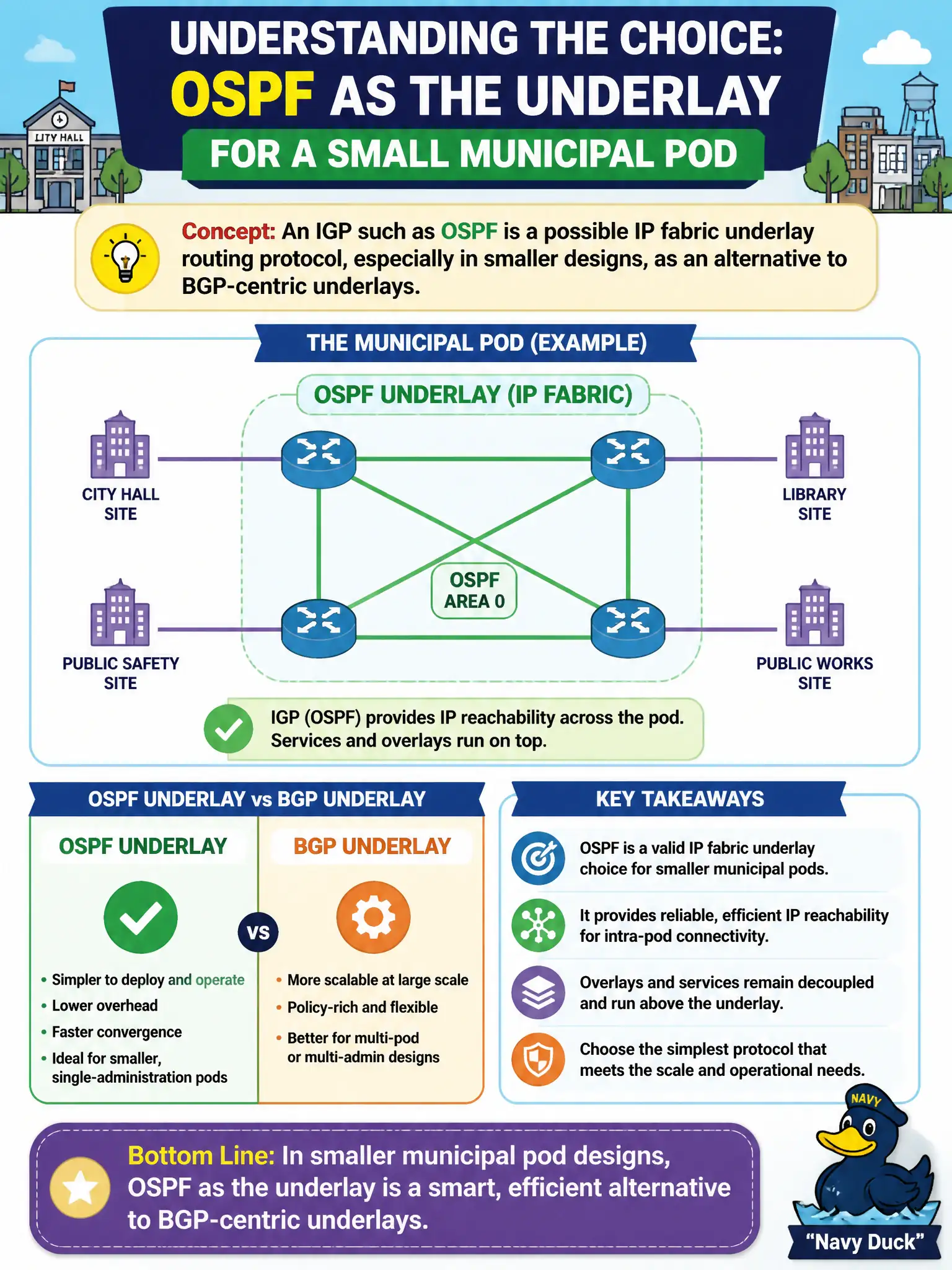
Ops enables OSPF as the underlay for a small municipal pod instead of BGP. How should that choice be understood at concept level?
Select an answer to reveal the explanation.
Short Explanation
Small pod, simple map—OSPF can be the underlay GPS instead of BGP. It is a real option, not a certification crime. You still need those loopbacks reachable; OSPF does not invent free overlay discovery.
Full Explanation
An IGP such as OSPF is a possible IP fabric underlay routing protocol, especially in smaller municipal pods, as an alternative to BGP-centric underlays. IGP underlays are not invalid on Juniper IP fabrics pending mandatory EBGP conversion. OSPF is not spine-only with static-only leaves by definition. OSPF does not replace VTEP loopback advertisement via automatic multicast discovery. Exam caveat: Evaluate scale, policy, and ops fit; infrastructure prefixes including VTEP loopbacks still must be reachable. Operational check: In a small lab pod, confirm OSPF advertises leaf loopbacks end-to-end before enabling overlays. In civic data-center operations, record the expected CLI or collector evidence for this concept so the next on-call engineer can validate fabric behavior without re-deriving the design under incident pressure. In civic data-center operations, record the expected CLI or collector evidence for this concept so the next on-call engineer can validate fabric behavior without re-deriving the design under incident pressure. In civic data-center operations, record the expected CLI or collector evidence for this concept so the next on-call engineer can validate fabric behavior without re-deriving the design under incident pressure.