
County fabric designers prefer IBGP with route reflectors placed on the spines. What underlay routing pattern does that describe?
Select an answer to reveal the explanation.
Short Explanation
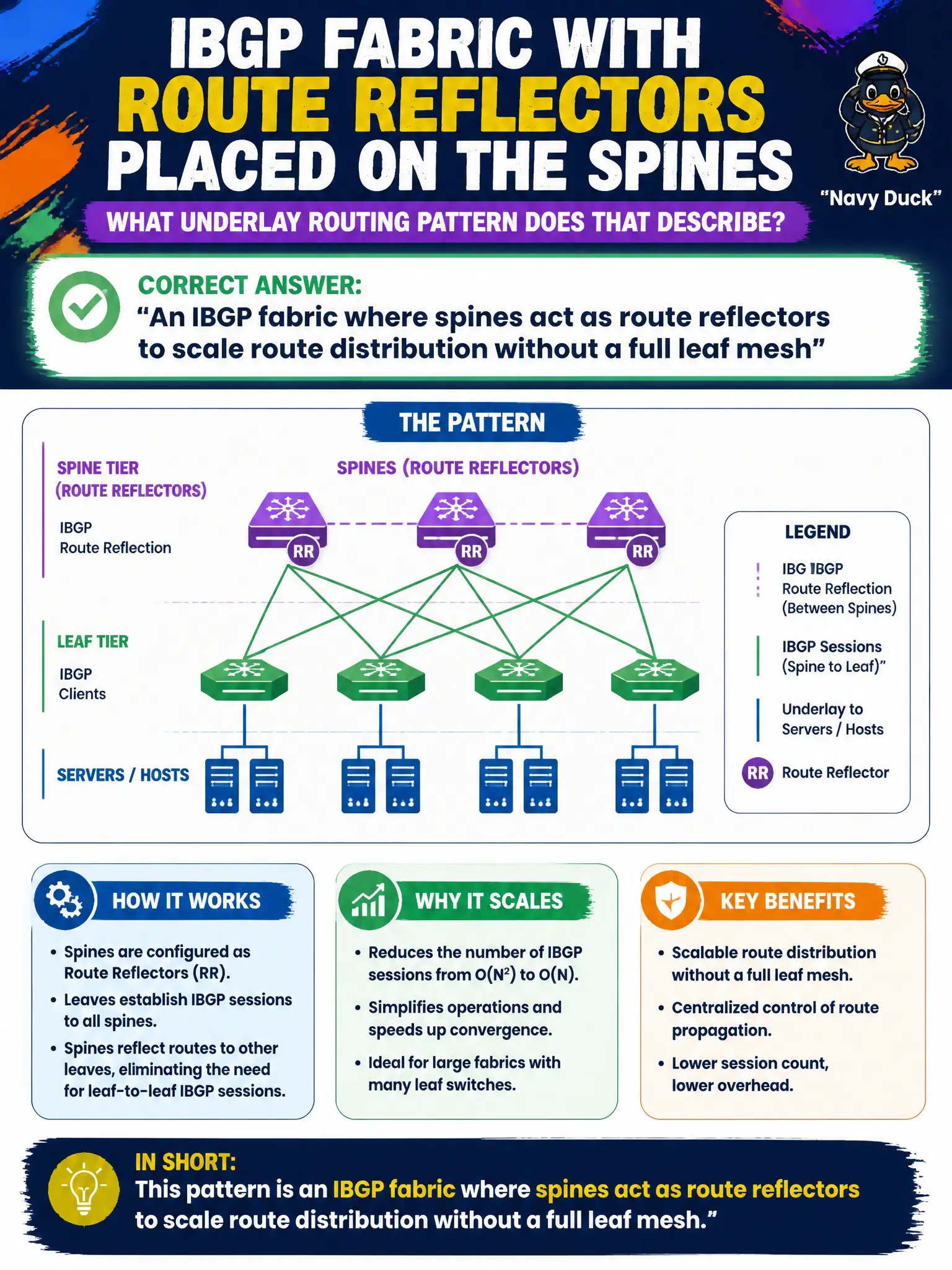
Picture the spines as gossip hubs for IBGP—leaves peer to the reflectors instead of meshing with every other leaf. That is a classic alternate to EBGP Clos. Route reflectors are for BGP scale, not STP.
Full Explanation
IBGP with route reflectors on spines is an IBGP fabric pattern that scales route distribution without a full leaf mesh—an alternate county underlay to hop-by-hop EBGP. It is not an EBGP-only design requiring unique public ARIN ASNs per leaf. Spines still participate in BGP; they do not only flood VXLAN without routing. Route reflectors are not an STP synchronization mechanism for static leaf routing. Exam caveat: Reflector client design and underlay IP reachability remain mandatory. Operational check: Confirm leaves are reflector clients of spine RRs and that infrastructure prefixes propagate without leaf-leaf full mesh. In civic data-center operations, record the expected CLI or collector evidence for this concept so the next on-call engineer can validate fabric behavior without re-deriving the design under incident pressure. In civic data-center operations, record the expected CLI or collector evidence for this concept so the next on-call engineer can validate fabric behavior without re-deriving the design under incident pressure. In civic data-center operations, record the expected CLI or collector evidence for this concept so the next on-call engineer can validate fabric behavior without re-deriving the design under incident pressure.