
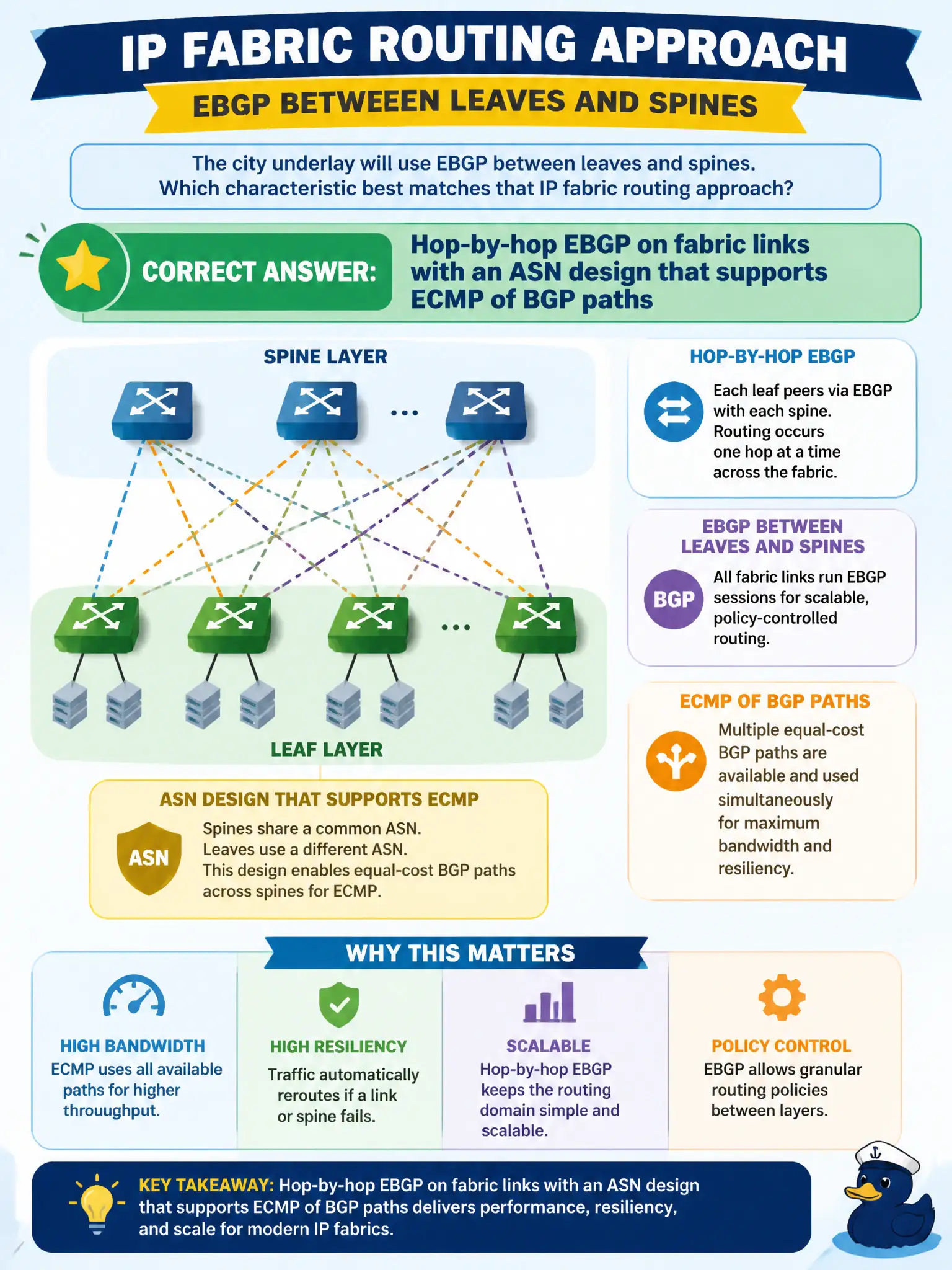
The city underlay will use EBGP between leaves and spines. Which characteristic best matches that IP fabric routing approach?
Select an answer to reveal the explanation.
Short Explanation
EBGP underlay is like each hop speaking “neighbor ASN” across the leaf-spine cables, then ECMP-balancing equal BGP paths. It is not “one giant ASN and hope” or “static defaults forever.” Plan ASN layout so multipath still works.
Full Explanation
City EBGP underlays use hop-by-hop external BGP on fabric links with an ASN design that supports ECMP of BGP paths between leaves and spines. A single shared ASN with iBGP full mesh only describes a different pattern. Replacing all BGP with OSPF areas is an IGP alternative, not the EBGP characteristic asked. Static defaults with no dynamic underlay protocol are not the EBGP Clos approach. Exam caveat: ASN allocation and multipath knobs are part of the EBGP fabric pattern; overlays still need reachable underlay endpoints. Operational check: Verify leaf-spine EBGP sessions and that multiple equal BGP paths install for ECMP. In civic data-center operations, record the expected CLI or collector evidence for this concept so the next on-call engineer can validate fabric behavior without re-deriving the design under incident pressure. In civic data-center operations, record the expected CLI or collector evidence for this concept so the next on-call engineer can validate fabric behavior without re-deriving the design under incident pressure. In civic data-center operations, record the expected CLI or collector evidence for this concept so the next on-call engineer can validate fabric behavior without re-deriving the design under incident pressure.