
A smart-city edge DC proposes running the Clos with only a single spine to save cost. What is the main architectural risk?
Select an answer to reveal the explanation.
Short Explanation
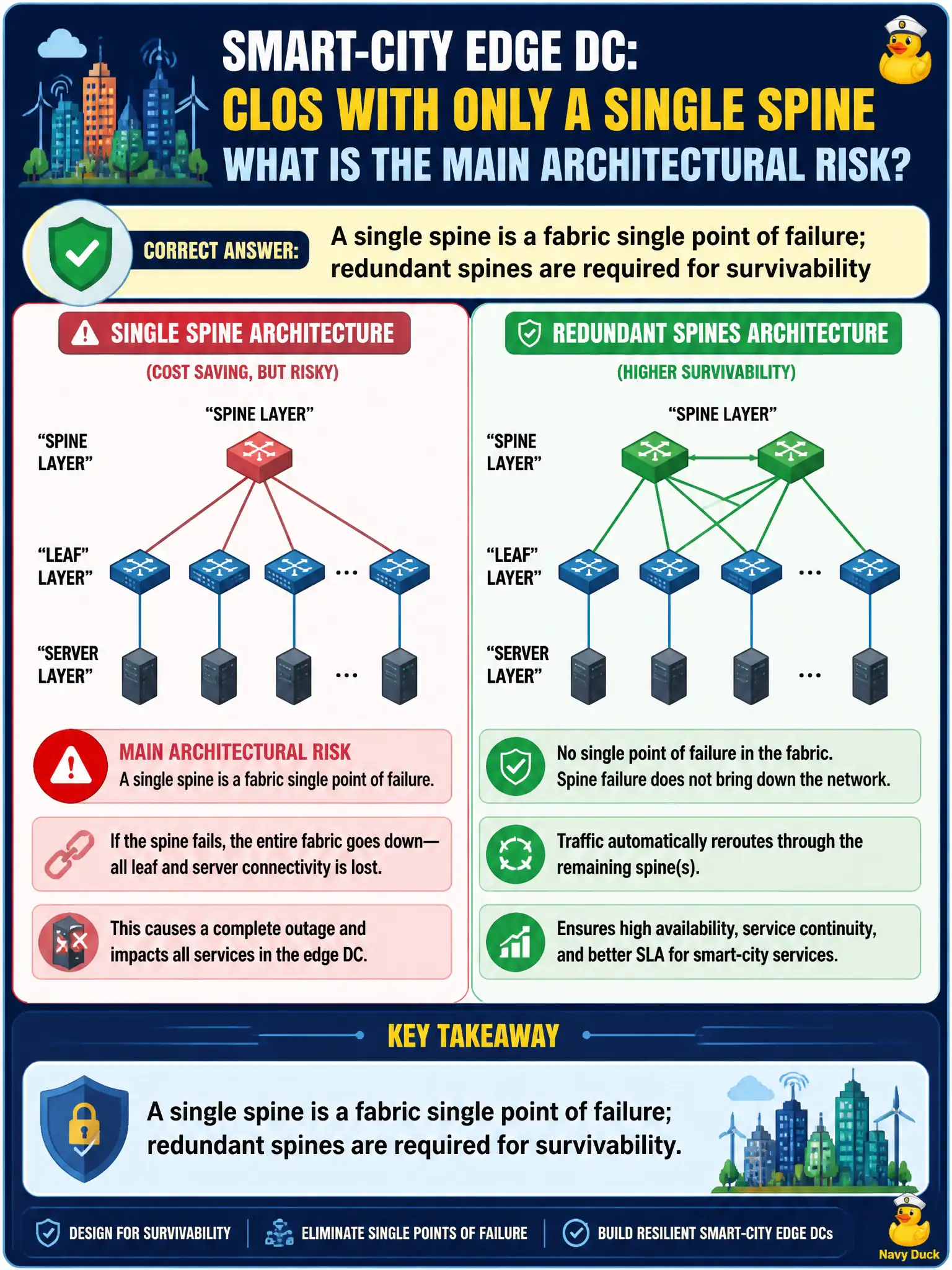
One spine is one light bulb for the whole closet—when it pops, the edge DC goes dark. Clos expects at least a pair so a failure still leaves a path. Saving the second spine is how you buy an outage.
Full Explanation
A single spine is a fabric single point of failure; redundant spines are required for survivability in a smart-city edge DC Clos. ECMP does not require exactly one spine; it works with multiple equal paths. A single spine is not required for leaves to advertise loopbacks. Multiple spines do not force abandoning IP routing for STP. Exam caveat: Cost savings from omitting a second spine buy an outage domain. Operational check: Fail a spine in lab and confirm leaf-to-leaf traffic continues via remaining spines. In civic data-center operations, record the expected CLI or collector evidence for this concept so the next on-call engineer can validate fabric behavior without re-deriving the design under incident pressure. In civic data-center operations, record the expected CLI or collector evidence for this concept so the next on-call engineer can validate fabric behavior without re-deriving the design under incident pressure. In civic data-center operations, record the expected CLI or collector evidence for this concept so the next on-call engineer can validate fabric behavior without re-deriving the design under incident pressure. In civic data-center operations, record the expected CLI or collector evidence for this concept so the next on-call engineer can validate fabric behavior without re-deriving the design under incident pressure.