
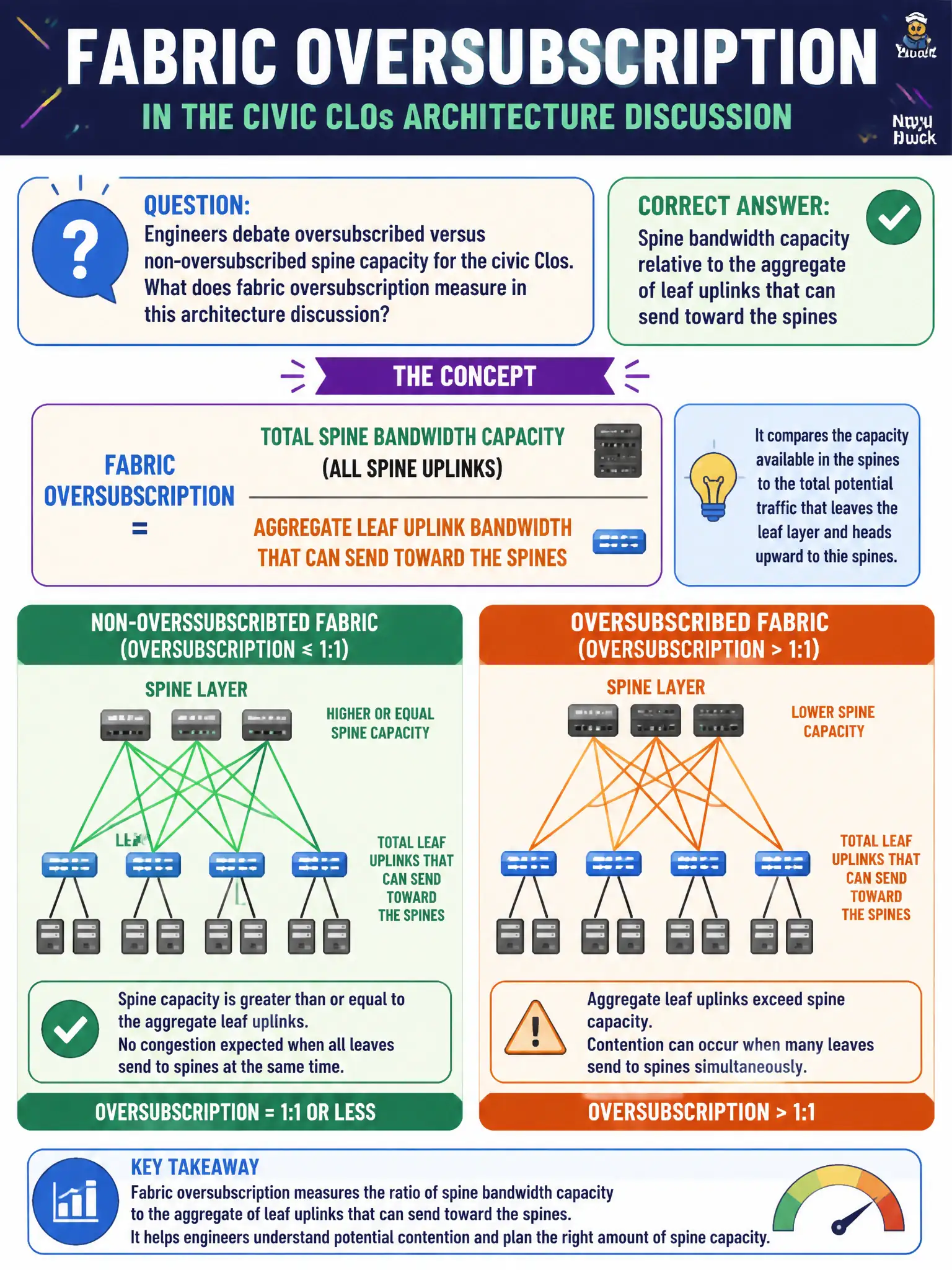
Engineers debate oversubscribed versus non-oversubscribed spine capacity for the civic Clos. What does fabric oversubscription measure in this architecture discussion?
Select an answer to reveal the explanation.
Short Explanation
Oversubscription is just spine horsepower versus the sum of the leaf on-ramps pointing at those spines. If every leaf can push more than the spines can swallow together, you chose an oversubscribed design on purpose—or by accident. Count bandwidth, not blocked STP ports.
Full Explanation
Fabric oversubscription measures spine bandwidth capacity relative to the aggregate of leaf uplinks that can send toward the spines in the civic Clos debate. It is not the ratio of STP blocked ports to forwarding ports. It is not tenant VRF count before BGP must be disabled. It is not how many servers may dual-home before ECMP is forbidden. Exam caveat: Non-oversubscribed designs provision enough spine capacity for intended uplink demand. Operational check: Compute aggregate leaf uplink bandwidth versus spine fabric bandwidth and record the ratio in the design. In civic data-center operations, record the expected CLI or collector evidence for this concept so the next on-call engineer can validate fabric behavior without re-deriving the design under incident pressure. In civic data-center operations, record the expected CLI or collector evidence for this concept so the next on-call engineer can validate fabric behavior without re-deriving the design under incident pressure. In civic data-center operations, record the expected CLI or collector evidence for this concept so the next on-call engineer can validate fabric behavior without re-deriving the design under incident pressure. In civic data-center operations, record the expected CLI or collector evidence for this concept so the next on-call engineer can validate fabric behavior without re-deriving the design under incident pressure.