
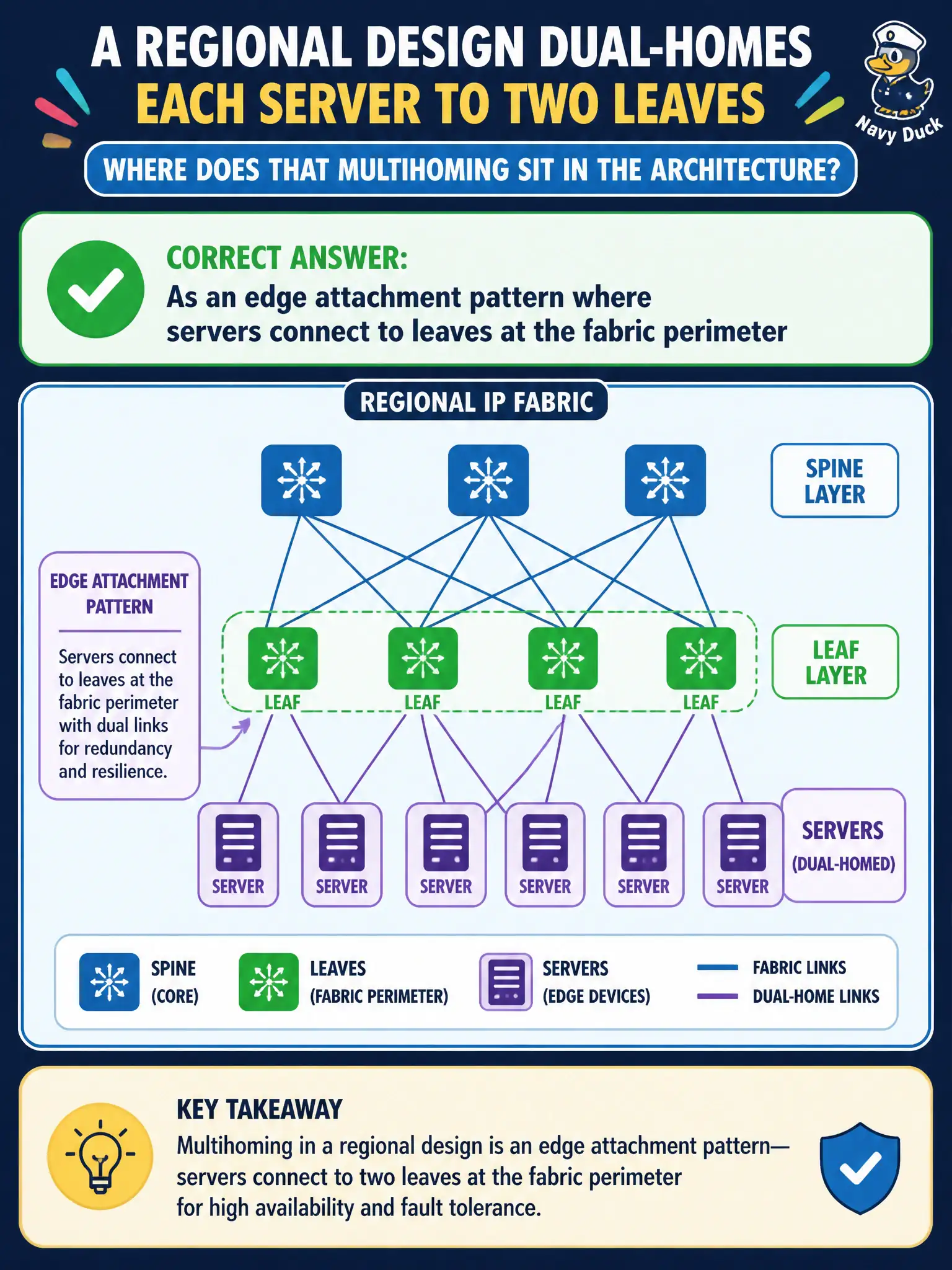
A regional design dual-homes each server to two leaves on the IP fabric. Where does that multihoming sit in the architecture?
Select an answer to reveal the explanation.
Short Explanation
Servers plug into leaves the way houses plug into the curb—two curb cuts for redundancy, still at the edge. Dual-homing does not turn spines into NICs or delete leaf uplinks. Keep the attachment story at the leaf edge.
Full Explanation
Server dual-homing to two leaves is an edge attachment pattern at the fabric perimeter; NICs still land on leaves, not as spine-to-spine ECMP magic. It is not a spine-to-spine overlay adjacency required for ECMP. It does not replace leaf uplinks to spines. It does not require every server to peer EBGP with every spine. Exam caveat: Overlay/EVPN may coordinate multihoming state later, but attachment remains leaf-edge. Operational check: Validate each server has dual leaf attachments and that underlay leaf-spine links remain intact. In civic data-center operations, record the expected CLI or collector evidence for this concept so the next on-call engineer can validate fabric behavior without re-deriving the design under incident pressure. In civic data-center operations, record the expected CLI or collector evidence for this concept so the next on-call engineer can validate fabric behavior without re-deriving the design under incident pressure. In civic data-center operations, record the expected CLI or collector evidence for this concept so the next on-call engineer can validate fabric behavior without re-deriving the design under incident pressure. In civic data-center operations, record the expected CLI or collector evidence for this concept so the next on-call engineer can validate fabric behavior without re-deriving the design under incident pressure.