
Council slides describe the municipal fabric as “Layer 2 everywhere.” What is the accurate IP-fabric correction?
Select an answer to reveal the explanation.
Short Explanation
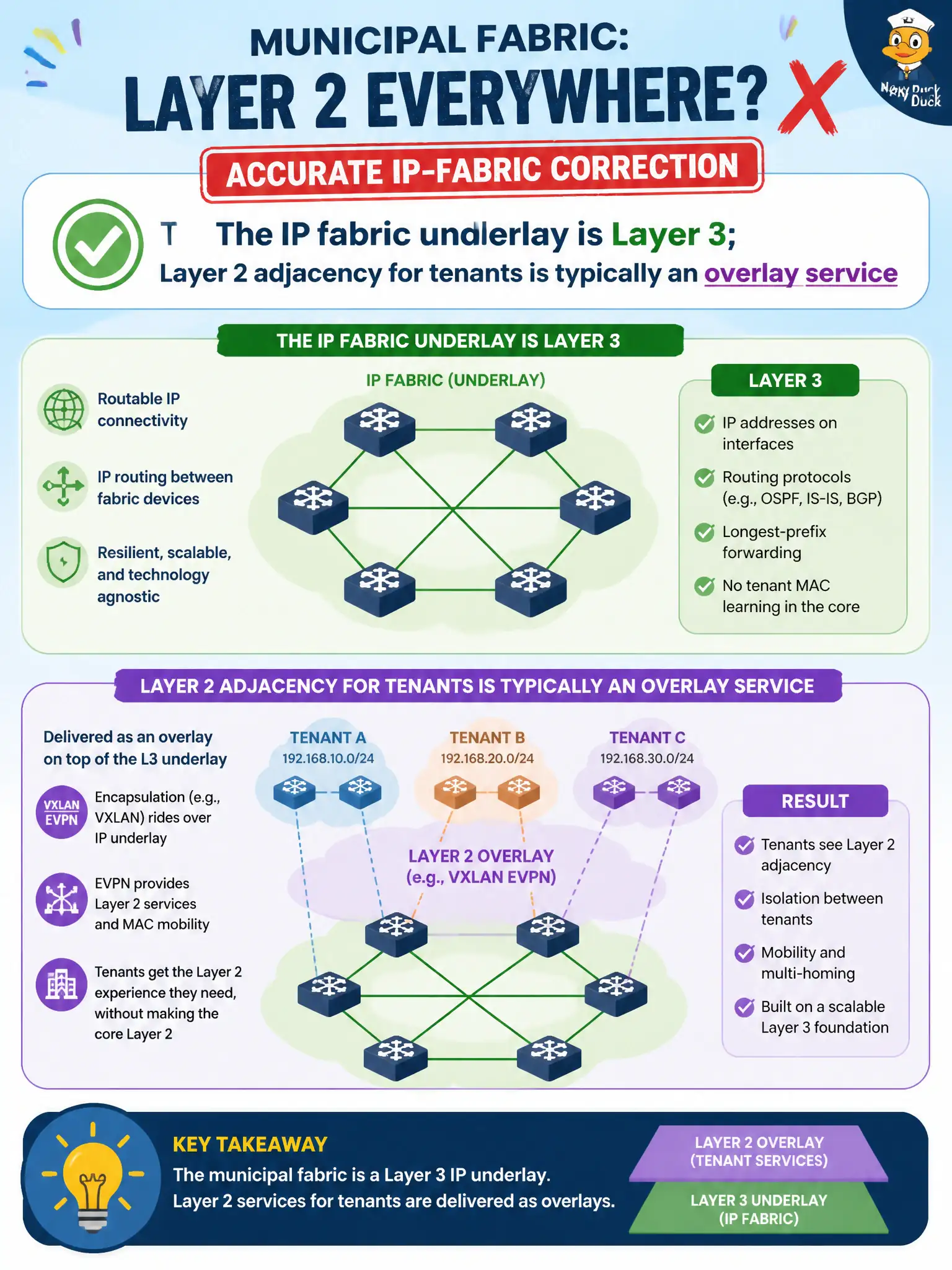
“Layer 2 everywhere” is a catchy slide and a bad fabric. The underlay is IP; if departments still need L2 adjacency, that is usually an overlay on top. Do not flatten the Clos back into one giant broadcast domain.
Full Explanation
The IP fabric underlay is Layer 3; Layer 2 adjacency for tenants is typically an overlay service—correcting council “L2 everywhere” slides for the municipal fabric. The underlay must not be one broadcast domain for VTEP flooding without routing. Spines should not bridge VLANs while leaves route only management. MLAG alone does not make underlay L3 optional. Exam caveat: Extending VLANs across the underlay reintroduces scaling limits Clos avoids. Operational check: Verify underlay is IP-routed hop-by-hop and any needed L2 is carried via overlay VNIs. In civic data-center operations, record the expected CLI or collector evidence for this concept so the next on-call engineer can validate fabric behavior without re-deriving the design under incident pressure. In civic data-center operations, record the expected CLI or collector evidence for this concept so the next on-call engineer can validate fabric behavior without re-deriving the design under incident pressure. In civic data-center operations, record the expected CLI or collector evidence for this concept so the next on-call engineer can validate fabric behavior without re-deriving the design under incident pressure. In civic data-center operations, record the expected CLI or collector evidence for this concept so the next on-call engineer can validate fabric behavior without re-deriving the design under incident pressure.