
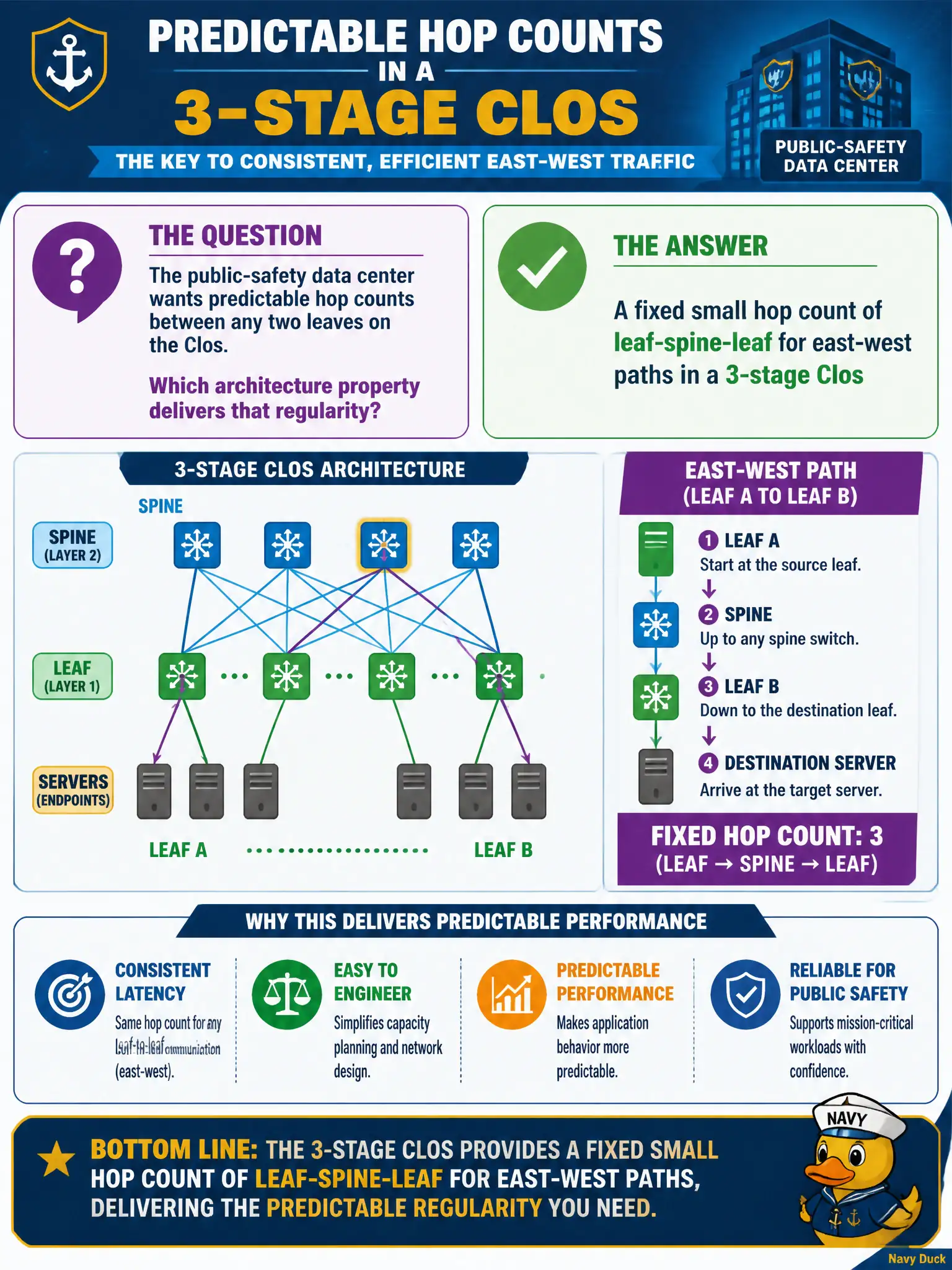
The public-safety data center wants predictable hop counts between any two leaves on the Clos. Which architecture property delivers that regularity?
Select an answer to reveal the explanation.
Short Explanation
In a tidy 3-stage Clos, leaf A to leaf B is always up to a spine and down—same short hop story every time. That predictability is why public-safety likes Clos over mystery STP diameters. Shortcuts and single hairpins just reintroduce weird paths.
Full Explanation
A 3-stage Clos delivers a fixed small hop count of leaf-spine-leaf for east-west paths—predictable diameter public-safety DCs want. STP root elections create variable L2 diameter, not Clos regularity. Direct leaf-leaf underlay edges break the regular hop model. Hairpinning all pairs through one border leaf reintroduces a choke point. Exam caveat: Regular hop count is a first-class Clos benefit for latency predictability. Operational check: Traceroute between two leaf-attached hosts and confirm the leaf-spine-leaf pattern. In civic data-center operations, record the expected CLI or collector evidence for this concept so the next on-call engineer can validate fabric behavior without re-deriving the design under incident pressure. In civic data-center operations, record the expected CLI or collector evidence for this concept so the next on-call engineer can validate fabric behavior without re-deriving the design under incident pressure. In civic data-center operations, record the expected CLI or collector evidence for this concept so the next on-call engineer can validate fabric behavior without re-deriving the design under incident pressure. In civic data-center operations, record the expected CLI or collector evidence for this concept so the next on-call engineer can validate fabric behavior without re-deriving the design under incident pressure.