
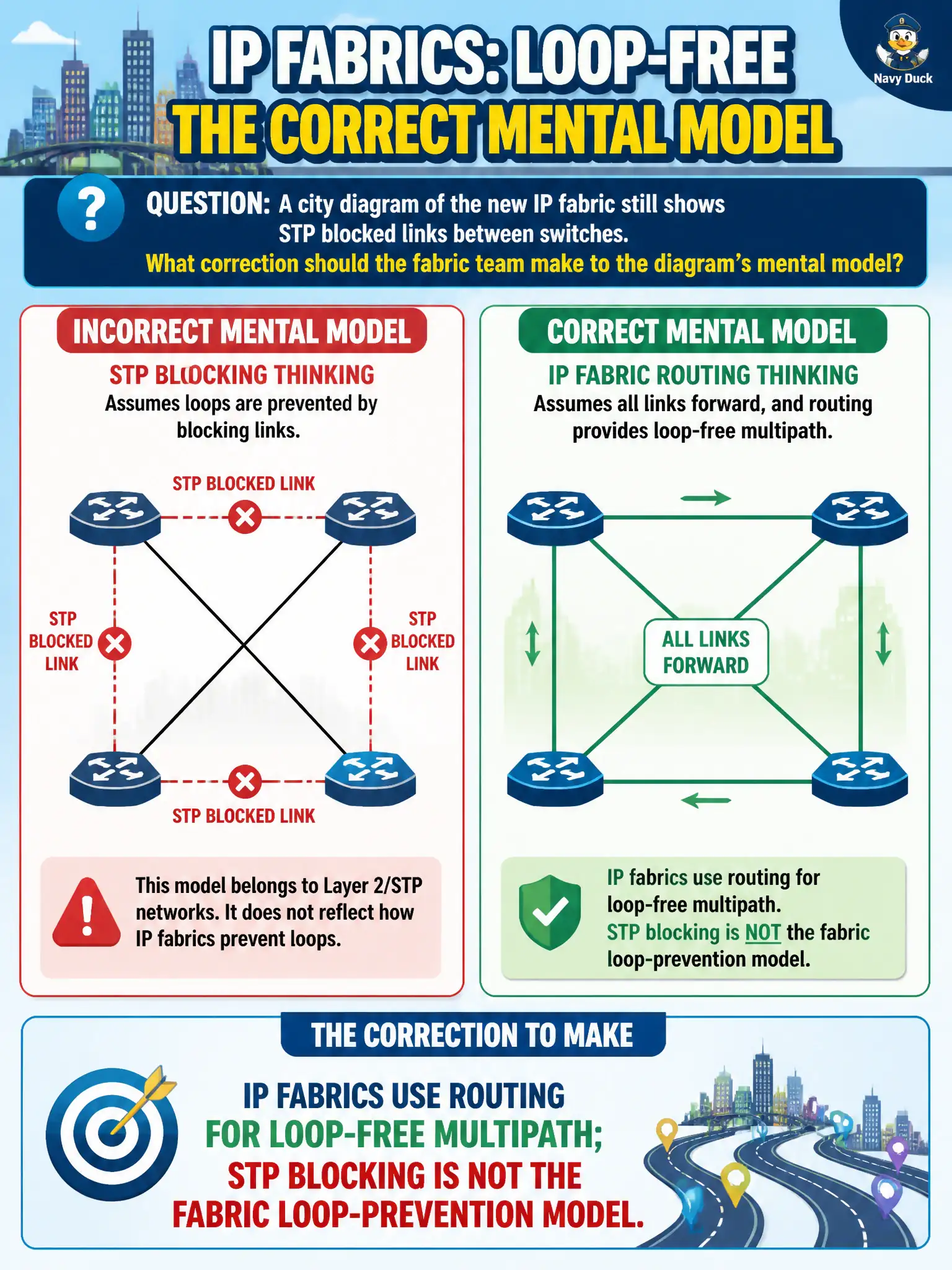
A city diagram of the new IP fabric still shows STP blocked links between switches. What correction should the fabric team make to the diagram’s mental model?
Select an answer to reveal the explanation.
Short Explanation
If the whiteboard still has little STP red X marks on fabric links, it is stuck in access-pod thinking. An IP fabric keeps those links forwarding and lets routing plus ECMP share them. Blocked ports are the old story, not Clos.
Full Explanation
IP fabrics use routing for loop-free multipath; STP blocking is not the fabric loop-prevention model—city diagrams must drop blocked-link mental models on Clos uplinks. Fabric uplinks should not remain STP blocking-alternate for ECMP. Spines should not run Rapid-PVST while leaves run EBGP on the same underlay links as the fabric model. Blocked STP ports are not how Clos guarantees equal-cost paths. Exam caveat: Equal-cost multipath depends on forwarding paths, not blocked alternates. Operational check: Show that fabric interfaces are up/forwarding in the underlay protocol without STP blocking state. In civic data-center operations, record the expected CLI or collector evidence for this concept so the next on-call engineer can validate fabric behavior without re-deriving the design under incident pressure. In civic data-center operations, record the expected CLI or collector evidence for this concept so the next on-call engineer can validate fabric behavior without re-deriving the design under incident pressure. In civic data-center operations, record the expected CLI or collector evidence for this concept so the next on-call engineer can validate fabric behavior without re-deriving the design under incident pressure.