
Ops asks what role the spines play in the civic fabric if overlays typically terminate on the leaves. Which statement is most accurate?
Select an answer to reveal the explanation.
Short Explanation
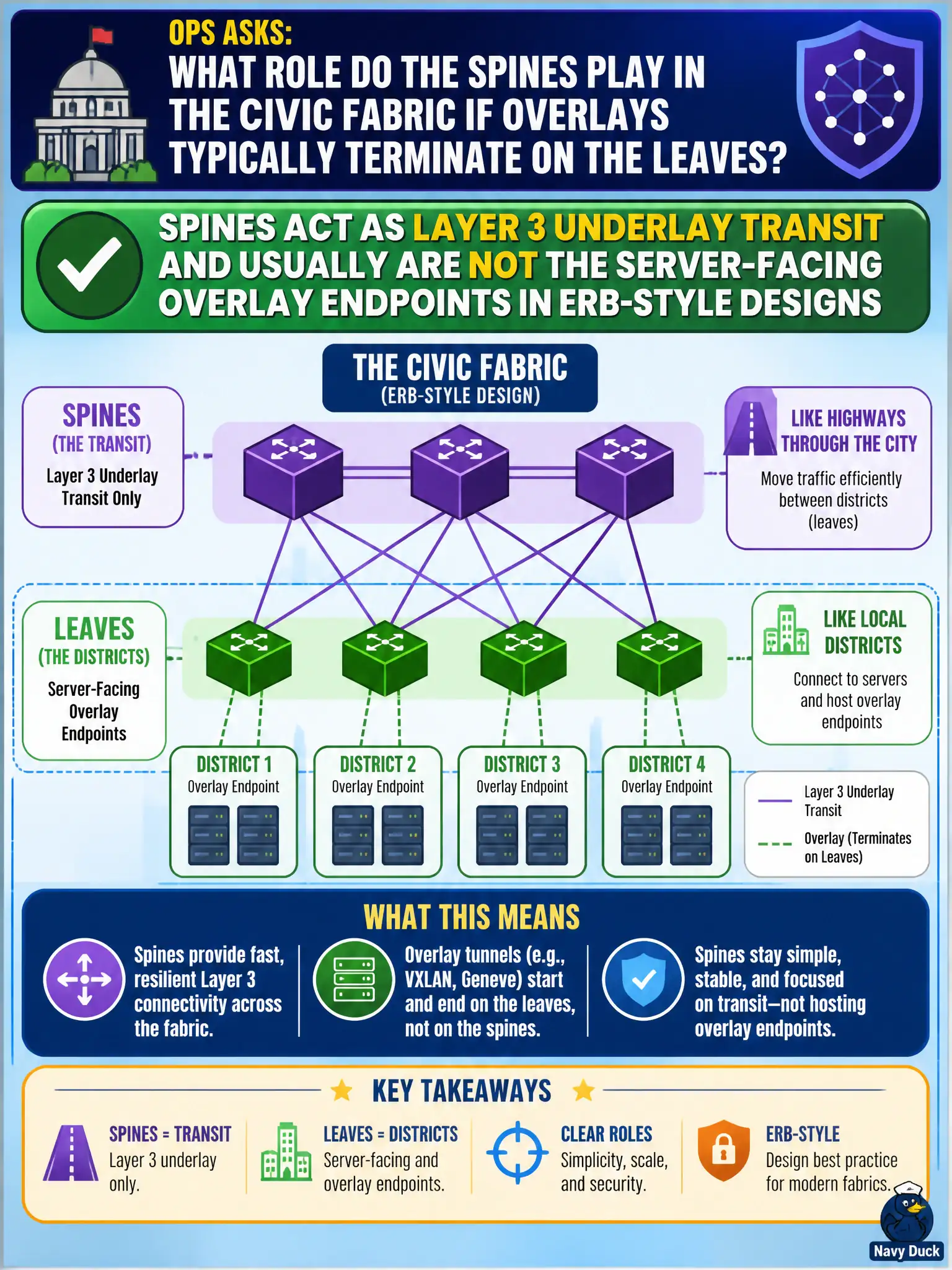
Leaves are where the overlay often hangs its hat; spines are the IP freeway in the middle. In ERB-style civic fabrics, spines move packets between leaves—they do not need to be every tenant’s VTEP. Think transit, not front desk.
Full Explanation
In ERB-style civic designs, spines act as Layer 3 underlay transit and usually are not the server-facing overlay endpoints; VTEPs typically terminate on leaves. Spines need not host every VTEP while leaves stay pure L2 access. Spines do not replace underlay routing by bridging tenant VLANs end to end. Spines are not merely STP blocked-port stores while leaves run BGP. Exam caveat: Know whether your design is ERB vs CRB before placing VTEPs on spines. Operational check: Confirm VTEP addresses live on leaves and spines show underlay routes between those loopbacks. In civic data-center operations, record the expected CLI or collector evidence for this concept so the next on-call engineer can validate fabric behavior without re-deriving the design under incident pressure. In civic data-center operations, record the expected CLI or collector evidence for this concept so the next on-call engineer can validate fabric behavior without re-deriving the design under incident pressure. In civic data-center operations, record the expected CLI or collector evidence for this concept so the next on-call engineer can validate fabric behavior without re-deriving the design under incident pressure. In civic data-center operations, record the expected CLI or collector evidence for this concept so the next on-call engineer can validate fabric behavior without re-deriving the design under incident pressure.