
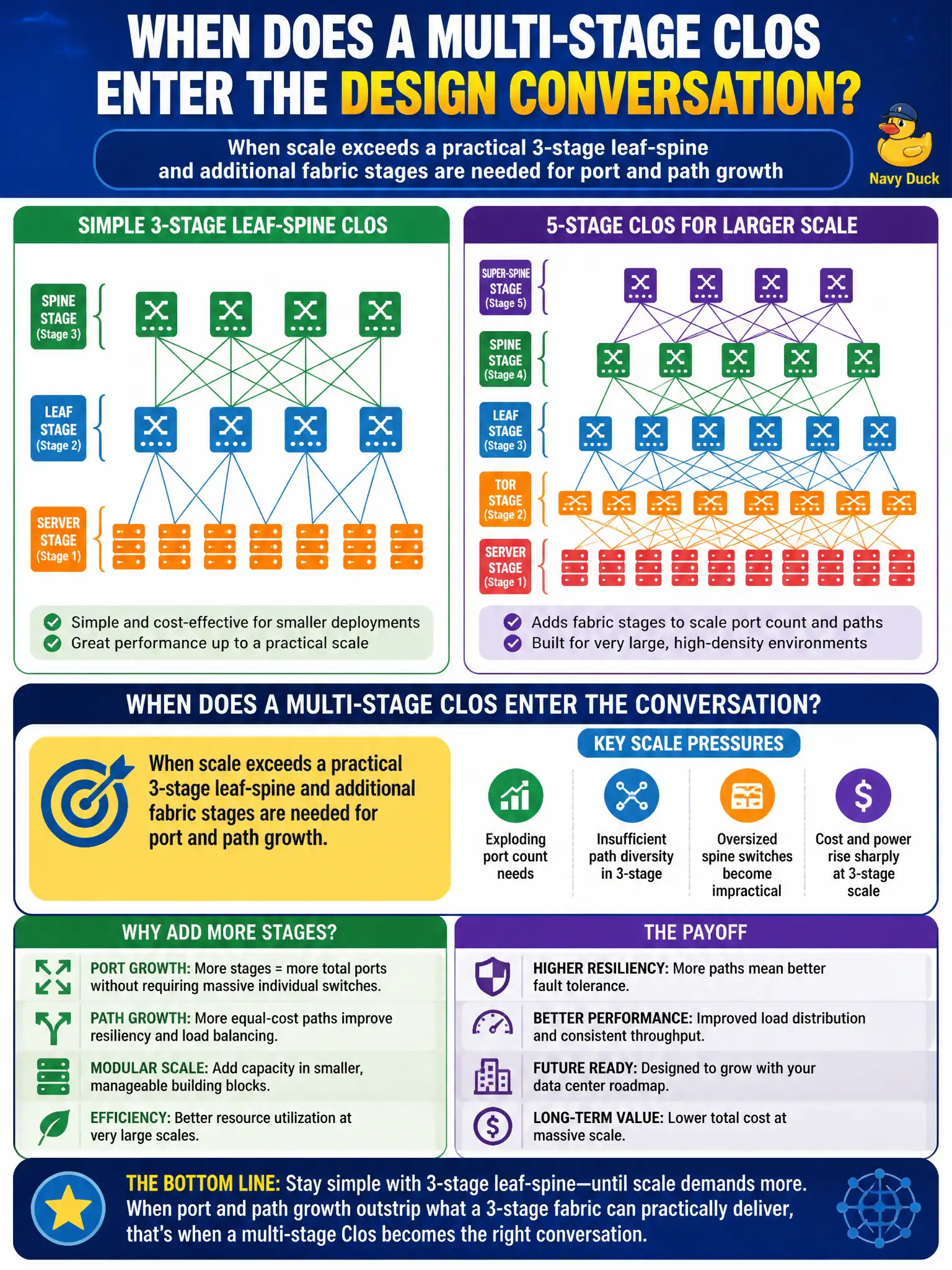
Municipal architects compare a simple 3-stage leaf-spine Clos with a 5-stage Clos for a larger regional data center. When does a multi-stage Clos typically enter the design conversation?
Select an answer to reveal the explanation.
Short Explanation
A 3-stage Clos is the familiar leaf-spine sandwich. When the regional DC outgrows that sandwich, architects add stages—like adding more highway rings—so ports and paths can keep scaling. It is not an excuse to drag STP or server-to-spine attachments back into the picture.
Full Explanation
Multi-stage Clos (for example 5-stage) enters the conversation when scale exceeds a practical 3-stage leaf-spine and additional stages are needed for port and path growth in a regional DC. It is not an excuse to reintroduce STP blocking between stages. It is not required only when VXLAN must be disabled. It is not a cue for servers to dual-attach to spines instead of leaves. Exam caveat: Multi-stage addresses radix/scale; servers still typically attach at the leaf edge. Operational check: Compare port count and path diversity needs against 3-stage limits before selecting 5-stage. In civic data-center operations, record the expected CLI or collector evidence for this concept so the next on-call engineer can validate fabric behavior without re-deriving the design under incident pressure. In civic data-center operations, record the expected CLI or collector evidence for this concept so the next on-call engineer can validate fabric behavior without re-deriving the design under incident pressure. In civic data-center operations, record the expected CLI or collector evidence for this concept so the next on-call engineer can validate fabric behavior without re-deriving the design under incident pressure.