
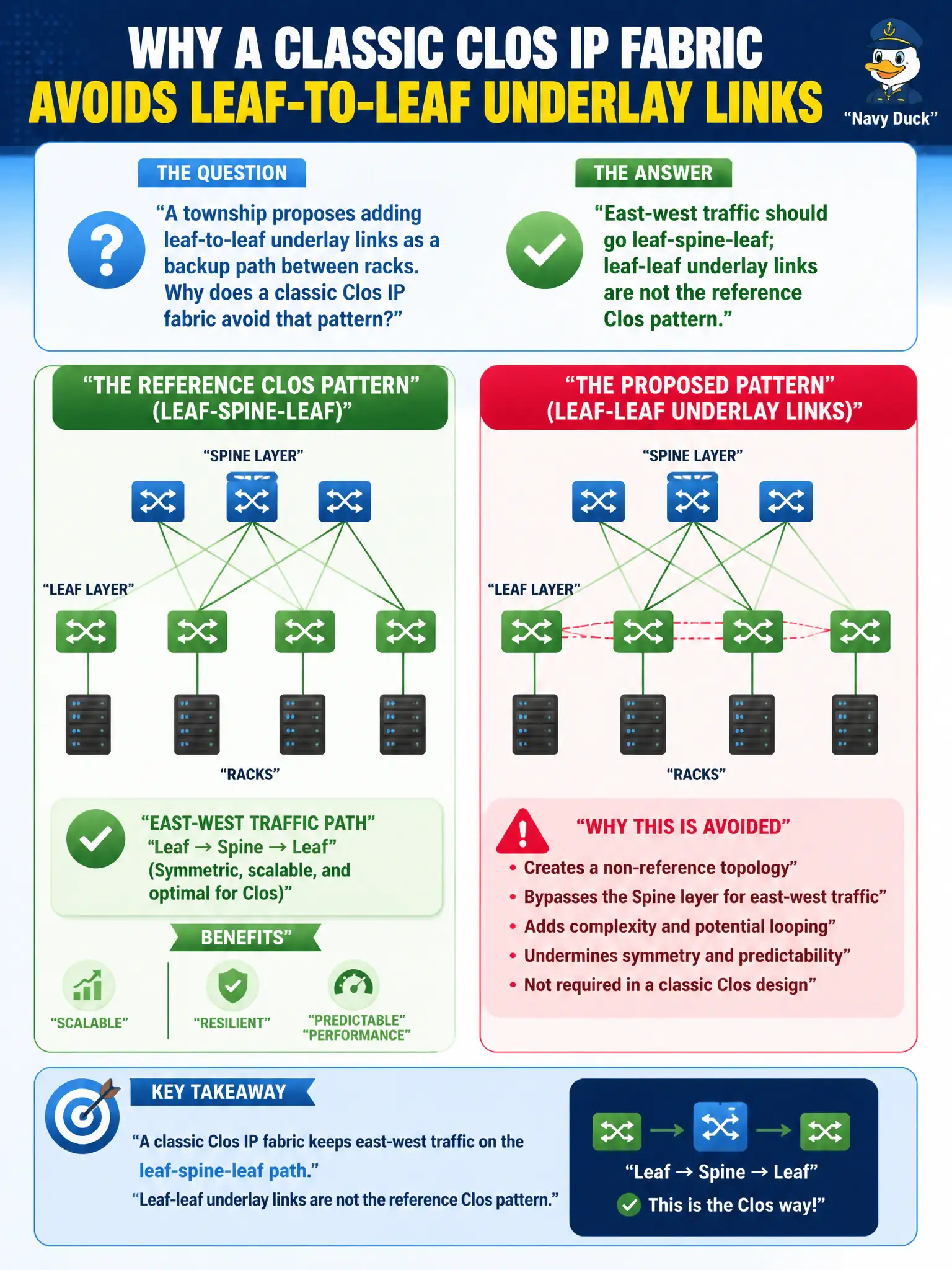
A township proposes adding leaf-to-leaf underlay links as a backup path between racks. Why does a classic Clos IP fabric avoid that pattern?
Select an answer to reveal the explanation.
Short Explanation
Clos wants the spines to be the meeting place—like every neighborhood road meeting at the ring highway. Shortcuts between leaves sound clever until your underlay turns into a spaghetti graph. Keep east-west going up to a spine and back down.
Full Explanation
Classic Clos avoids leaf-to-leaf underlay links because east-west traffic should go leaf-spine-leaf; direct leaf edges are not the reference pattern for township fabrics. Leaf-leaf underlay edges are not required so spines can stay L2-only. Leaf-leaf cables do not replace spine redundancy. Classic Clos does not forbid ECMP in favor of only direct leaf edges. Exam caveat: Direct leaf links break regular hop and ECMP assumptions. Operational check: Inspect underlay topology and remove or avoid leaf-leaf IGP/BGP adjacencies that shortcut the Clos. In civic data-center operations, record the expected CLI or collector evidence for this concept so the next on-call engineer can validate fabric behavior without re-deriving the design under incident pressure. In civic data-center operations, record the expected CLI or collector evidence for this concept so the next on-call engineer can validate fabric behavior without re-deriving the design under incident pressure. In civic data-center operations, record the expected CLI or collector evidence for this concept so the next on-call engineer can validate fabric behavior without re-deriving the design under incident pressure. In civic data-center operations, record the expected CLI or collector evidence for this concept so the next on-call engineer can validate fabric behavior without re-deriving the design under incident pressure.