
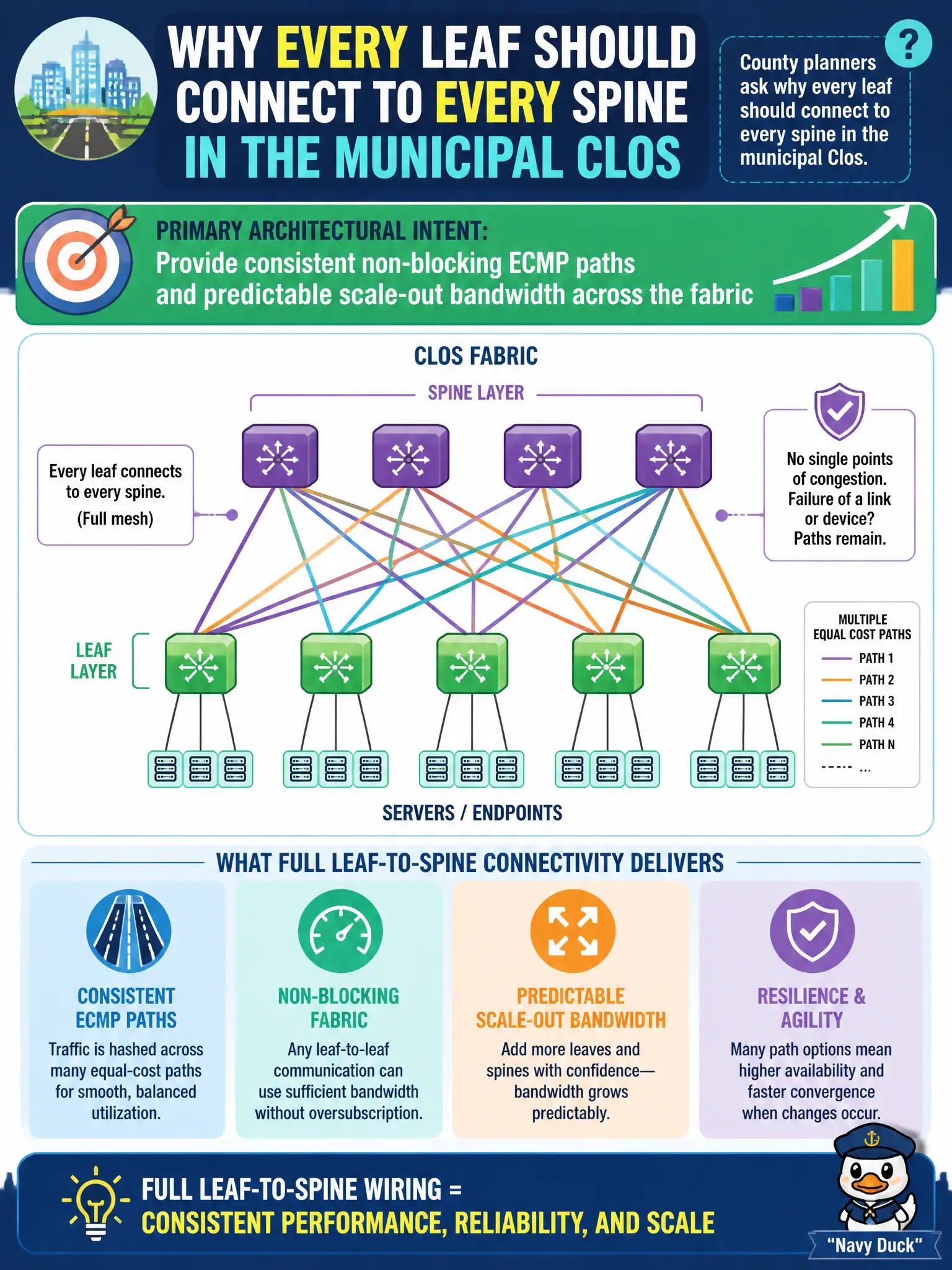
County planners ask why every leaf should connect to every spine in the municipal Clos. What is the primary architectural intent of that full leaf-to-spine wiring?
Select an answer to reveal the explanation.
Short Explanation
Picture every leaf as a city avenue and every spine as a freeway interchange—full mesh to the spines means cars always have equal on-ramps. That is how Clos keeps ECMP fair and bandwidth predictable. Skipping spines is how you invent weird bottlenecks.
Full Explanation
Full leaf-to-spine wiring provides consistent non-blocking ECMP paths and predictable scale-out bandwidth across the municipal Clos. It is not to create an STP ring of blocked ports. It is not to force all east-west through one designated spine. It does not eliminate advertising leaf loopbacks into the underlay. Exam caveat: Partial wiring creates uneven path sets and capacity hot spots. Operational check: Audit that every leaf has uplinks to every spine in the pod and that ECMP members match that wiring. In civic data-center operations, record the expected CLI or collector evidence for this concept so the next on-call engineer can validate fabric behavior without re-deriving the design under incident pressure. In civic data-center operations, record the expected CLI or collector evidence for this concept so the next on-call engineer can validate fabric behavior without re-deriving the design under incident pressure. In civic data-center operations, record the expected CLI or collector evidence for this concept so the next on-call engineer can validate fabric behavior without re-deriving the design under incident pressure. In civic data-center operations, record the expected CLI or collector evidence for this concept so the next on-call engineer can validate fabric behavior without re-deriving the design under incident pressure.